Req 4a — Declaration of Independence
The Declaration of Independence is the document that started the United States. Adopted on July 4, 1776, it announced to the world that the thirteen American colonies were breaking away from British rule and forming a new, independent nation. But it did much more than declare independence — it laid out a philosophy of government that still shapes the country today.
Why Was It Written?
By 1776, tensions between the American colonies and Great Britain had reached a breaking point. The colonists were being taxed without any say in the British Parliament. British soldiers were quartered in their homes. Their protests were met with force. The Continental Congress decided it was time to formally declare independence — and explain to the world why.
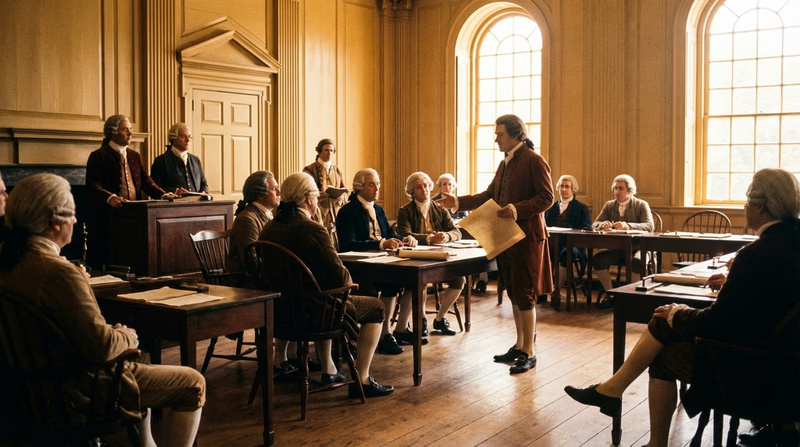
Thomas Jefferson, a 33-year-old delegate from Virginia, was chosen to draft the document. He worked on it for about two weeks, drawing on ideas from philosophers like John Locke and from the Virginia Declaration of Rights. After edits by Benjamin Franklin, John Adams, and the full Congress, the final version was adopted.
The Big Ideas
The Declaration contains some of the most famous words in American history:
“We hold these truths to be self-evident, that all men are created equal, that they are endowed by their Creator with certain unalienable Rights, that among these are Life, Liberty and the pursuit of Happiness.”
Let’s unpack what this means:
- “Self-evident” — These truths are obvious and do not need to be proven.
- “All men are created equal” — Every person has the same basic worth and dignity. (The nation has struggled throughout its history to fully live up to this ideal, but the ideal itself has inspired every generation to push closer.)
- “Unalienable Rights” — These rights cannot be taken away by any government. They belong to you simply because you are a human being.
- “Life, Liberty and the pursuit of Happiness” — The three rights the founders considered most fundamental. Government exists to protect these rights.
The Declaration also states that if a government fails to protect these rights, the people have the right to change it or replace it. This was a revolutionary idea — literally.
Why It Still Matters
The Declaration is not a law. It does not create any rules or government structures. But it is the philosophical foundation of the entire American experiment. Every time the nation has faced a moral crisis — slavery, women’s suffrage, civil rights — people have pointed back to the Declaration’s promise that “all men are created equal” and demanded that the country live up to it.
Abraham Lincoln called the Declaration’s principles the “electric cord” that links all Americans together, regardless of background. Martin Luther King Jr. described it as a “promissory note” that the nation had yet to fully honor. The Declaration is not just a historical artifact — it is a living challenge to every generation.