Req 7 — Exploring National Sites
This is your chance to get out into the real world and experience your nation’s history and government firsthand. You need to complete two of the four options listed above. Read through all of them and choose the two that work best for you based on what is available in your area and what interests you most.
Option A: Visit a National Historic Landmark or Historic Place
The United States has over 2,600 National Historic Landmarks and more than 95,000 places on the National Register of Historic Places. There is almost certainly one near you. These sites could be anything from a battlefield to a courthouse, a bridge to a birthplace, a factory to a farmstead.
How to find one:
Use the National Park Service’s search tool (linked below) to find historic landmarks and registered places in your state or county. You might be surprised — there could be one within walking distance of your home.
What to look for during your visit:
- What happened here? What is the historical significance of this place?
- When was it built or when did the historic events occur?
- Who were the key people involved?
- Why was it designated as a historic landmark or added to the National Register?
- What did you find most interesting or surprising?
Option B: Tour a Capitol Building
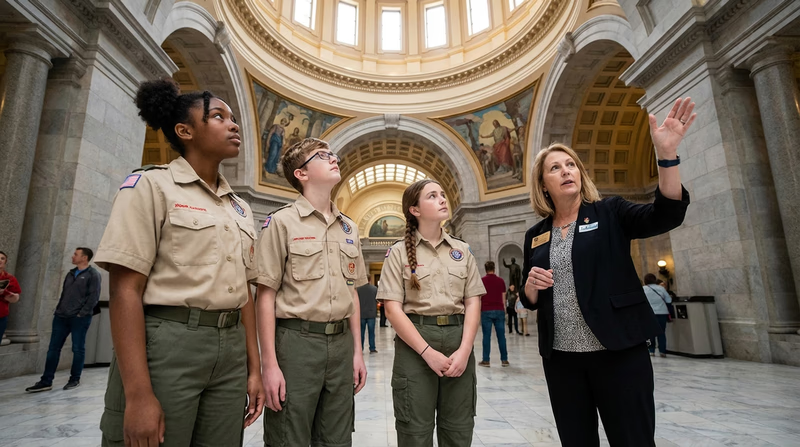
Your state capitol or the U.S. Capitol in Washington, D.C. is where elected representatives meet to debate and pass laws. Touring one of these buildings connects the abstract idea of “the legislative branch” to a real, physical place.
State capitol tips:
- Most state capitols offer free guided tours. Check your state’s legislature website for tour schedules.
- Look for the legislative chambers (House and Senate), the governor’s office, and any historical exhibits.
- Ask your tour guide about the building’s history, architecture, and any famous events that happened there.
U.S. Capitol tips:
- Free tours are available through the U.S. Capitol Visitor Center. Reserve tickets online in advance.
- You can also contact your representative or senator’s office to arrange a staff-led tour, which may include areas not on the public tour.
- The Capitol Visitor Center has excellent exhibits about the history of Congress.
Option C: Tour a Federal Facility
A federal facility is any building or location that is operated by the United States government. This could include:
- A post office — one of the oldest federal services, connecting every community in the country
- A federal courthouse — where federal laws are interpreted and applied
- A military base or installation — where members of the armed forces train and serve (some offer public tours)
- A Veterans Affairs (VA) hospital or clinic — where veterans receive healthcare
- A federal research laboratory — like a NOAA weather station, a USDA research center, or a NASA facility
- A national park visitor center — managed by the National Park Service, a federal agency
What to learn during your visit:
- What is this facility’s mission? What does it do?
- How does it serve the local community?
- How does it serve the nation as a whole?
- Who works here, and what are their roles?
- How is it funded? (Hint: your tax dollars!)
Option D: Research a National Monument
If visiting a physical site is not possible, this option lets you research a United States national monument from home using books, the internet, and other resources.
Some national monuments to consider:
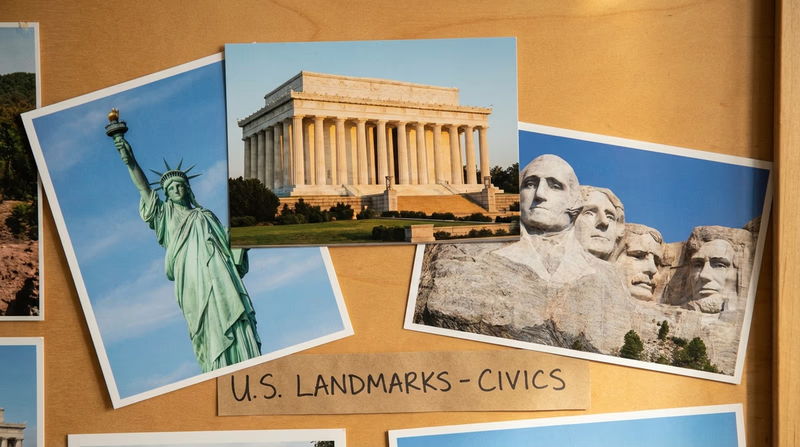
- Statue of Liberty — A gift from France, symbolizing freedom and welcome
- Lincoln Memorial — Honors the 16th President and the preservation of the Union
- Mount Rushmore — Features the carved faces of four Presidents in the Black Hills of South Dakota
- Washington Monument — The tallest structure in Washington, D.C., honoring the first President
- Martin Luther King Jr. Memorial — Honors the civil rights leader on the National Mall
- Pearl Harbor National Memorial — Commemorates the attack that brought the U.S. into World War II
- Statue of Liberty / Ellis Island — Gateway for millions of immigrants arriving in America
- Devils Tower — The first national monument, designated by President Theodore Roosevelt in 1906
What to research:
- When and why was this monument created?
- Who or what does it honor or commemorate?
- What is the monument’s design, and what does the design symbolize?
- Why is it important to the nation’s citizens?
- Would you want to visit it in person? Why or why not?