Extended Learning
A. Introduction
You have completed the requirements for the Citizenship in the World merit badge — congratulations! You now know more about how governments work, how nations interact, and how you fit into the global picture than most people ever learn. But the world keeps changing, and your journey as a global citizen is just getting started.
B. Deep Dive: How International Agreements Are Made
You have learned about international law and organizations, but how do countries actually sit down and hammer out an agreement? The process is fascinating — and surprisingly slow.
Most international agreements begin when countries recognize a shared problem that no single nation can solve alone. Climate change, nuclear weapons, ocean pollution, pandemics — these challenges cross every border. A country or international organization proposes negotiations, and interested nations send delegations of diplomats, lawyers, and subject-matter experts to the table.
Negotiations can take months or even years. Each country arrives with its own interests, red lines, and domestic political pressures. Diplomats draft language, argue over details, make compromises, and revise the text dozens of times. Even the word order in a single sentence can be debated for days because each word carries legal weight.
Once a treaty text is agreed upon, countries “sign” it — but signing is just the beginning. Most treaties require ratification, meaning each country’s legislature must formally approve it before it becomes binding. In the United States, the Senate must ratify treaties by a two-thirds vote. Some treaties have been signed but never ratified, meaning the U.S. agreed in principle but never made it law.
After ratification, implementation begins. Countries must change their own laws, create enforcement mechanisms, and report on compliance. International bodies monitor whether countries are keeping their promises. When disputes arise, they may be resolved through the mechanisms you learned about in Requirement 4 — negotiation, mediation, arbitration, or international courts.
C. Deep Dive: The Universal Declaration of Human Rights
On December 10, 1948, the United Nations General Assembly adopted the Universal Declaration of Human Rights (UDHR) — a document that changed the world. For the first time in history, nations came together to declare that every human being, everywhere, has fundamental rights simply because they are human.
The UDHR was drafted by a committee chaired by Eleanor Roosevelt, the former First Lady of the United States. The committee included representatives from countries on every continent, ensuring that the declaration reflected diverse cultural and legal traditions. The final document contains 30 articles covering civil, political, economic, social, and cultural rights.
Some of the rights it declares:
- The right to life, liberty, and security
- Freedom from slavery and torture
- The right to a fair trial
- Freedom of thought, conscience, and religion
- The right to education
- The right to work and to join trade unions
- Freedom of movement within and between countries
The UDHR is not a legally binding treaty — countries cannot be prosecuted for violating it. But it has inspired more than 70 human rights treaties that are legally binding, and it remains the moral foundation for the global human rights movement. When organizations like Amnesty International or Human Rights Watch report on abuses, they are measuring countries against the standards set by the UDHR.
December 10 is celebrated worldwide as Human Rights Day in honor of the UDHR’s adoption.
United Nations — Universal Declaration of Human Rights Read the full text of the UDHR — all 30 articles that define the rights every person on Earth is entitled to.D. Deep Dive: Model United Nations
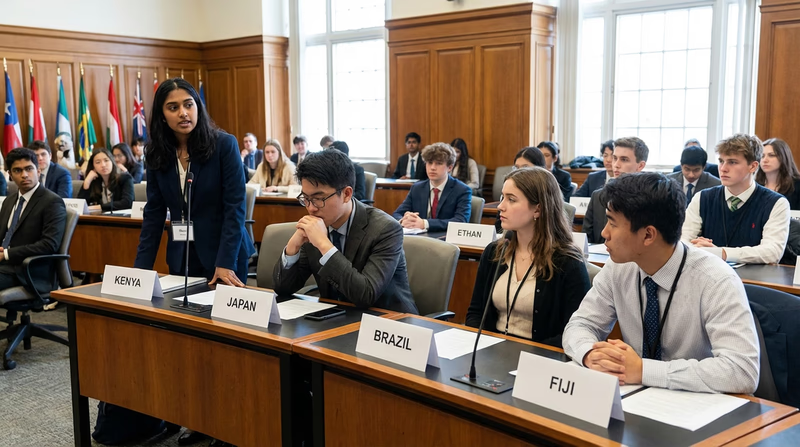
If you enjoyed learning about international organizations and diplomacy, Model United Nations (Model UN or MUN) is one of the best ways to take it further. Model UN is an educational simulation where students role-play as delegates from different countries and debate real-world issues using UN procedures.
In a Model UN conference, you are assigned a country and a committee (like the Security Council, the World Health Assembly, or the Human Rights Council). You research your assigned country’s positions on the issues being debated, write position papers, give speeches, negotiate with other delegates, and draft resolutions — just like real diplomats.
Model UN teaches skills that go far beyond international relations:
- Research — You learn to find and evaluate sources on complex global issues.
- Public speaking — You practice delivering speeches and thinking on your feet.
- Negotiation — You build coalitions, make compromises, and find common ground with people who disagree with you.
- Writing — You draft formal resolutions, position papers, and working papers.
- Empathy — You learn to argue convincingly for a country’s position even if you personally disagree with it.
Many middle schools and high schools have Model UN clubs. If yours does not, you can start one. National conferences like NHSMUN (National High School Model United Nations) and YMUN (Yale Model United Nations) draw students from across the country and around the world.
E. Real-World Experiences
Visit a United Nations Office
Attend a Naturalization Ceremony
Visit an Embassy or Consulate
Participate in JOTA-JOTI
Attend an International Festival
F. Organizations
The international body coordinating Scouting in over 170 countries, promoting peace, development, and youth leadership worldwide.
A global educational program where students simulate UN proceedings, debate international issues, and develop diplomacy skills.
Campaigns for human rights worldwide, with youth programs and volunteer opportunities for young activists.
Connects Americans with the work of the United Nations through advocacy, education, and community engagement.
An international education and advocacy organization working to end extreme poverty, with campaigns and events that anyone can join.
Connects families separated by conflict or disaster, supports international humanitarian law education, and responds to crises worldwide.