Req 5 — Types of Government
These three sub-requirements build on each other. First you learn the big divide (constitutional vs. nonconstitutional), then you identify specific government types, and finally you place them on a map.
Constitutional vs. Nonconstitutional Governments
The most fundamental distinction between governments is whether they are limited by a constitution or not.
Constitutional Government
A constitutional government operates under a written or established set of laws that limit the government’s power and protect the rights of citizens. The constitution is the supreme law — even the most powerful leaders must follow it. Most modern democracies are constitutional governments.
Key features:
- A written or established constitution defines the government’s structure and limits
- Separation of powers (executive, legislative, judicial branches)
- Rule of law — no one is above the law, including the president or prime minister
- Protection of individual rights (speech, religion, assembly, etc.)
- Regular elections and peaceful transfers of power
Examples: United States, Germany, Japan, India, South Africa
Nonconstitutional Government
A nonconstitutional government has no effective constitution limiting its power — or it has one on paper that the leaders ignore. Power is concentrated in one person, one party, or a small group, and citizens have few protections against government overreach.
Key features:
- No meaningful limits on government authority
- Leaders may change laws to benefit themselves
- Citizens have limited or no political rights
- No independent judiciary to check government power
- Power is maintained through force, fear, or control of information
Examples: North Korea, some military dictatorships, absolute monarchies without constitutional limits
Five Types of Government
There are many ways to categorize governments. Here are the major types you will find in the world today:
1. Democracy (Representative / Republic)
In a democracy, power belongs to the people. In a representative democracy (also called a republic), citizens vote for leaders who make decisions on their behalf. This is the most common form of democracy in the world.
- How it works: Citizens vote in regular, free elections. Elected officials serve for set terms. An independent judiciary protects rights.
- Examples: United States, France, India, Brazil
2. Constitutional Monarchy
A constitutional monarchy has a king or queen as the head of state, but the monarch’s power is limited by a constitution. The real governing power belongs to an elected parliament and a prime minister.
- How it works: The monarch serves a ceremonial role (representing the country, hosting diplomats). Elected officials make the laws and run the government.
- Examples: United Kingdom, Japan, Sweden, Spain, Canada (under the British Crown)
3. Authoritarian / Dictatorship
In an authoritarian government, power is concentrated in a single leader or a small group. Individual freedoms are restricted, and political opposition is suppressed. Some authoritarian governments hold elections, but they are not genuinely free or fair.
- How it works: The leader or ruling group controls the military, media, and often the economy. Citizens have little say in government decisions.
- Examples: North Korea, Eritrea, various military governments
4. Communist State (Single-Party State)
A communist state is governed by a single political party that controls the government, the economy, and much of daily life. In theory, communism aims for a classless society where everything is shared equally. In practice, communist states are typically authoritarian, with the ruling party holding all power.
- How it works: One party controls the government. The state owns most businesses and land. Opposition parties are banned or powerless.
- Examples: China, Cuba, Vietnam, Laos
5. Theocracy
A theocracy is a government in which religious leaders hold political power, and the law is based on religious texts. The head of state may be a religious figure, and laws reflect religious doctrine rather than secular principles.
- How it works: Religious law is the law of the land. Religious leaders serve as political leaders or hold veto power over elected officials.
- Examples: Iran (where the Supreme Leader is a religious authority), Vatican City
Other Types Worth Knowing
- Absolute monarchy — A king or queen holds nearly all political power with no constitutional limits. Example: Saudi Arabia (though it has been modernizing).
- Federal republic — A republic where power is shared between a central government and regional governments (states or provinces). Example: United States, Germany, Brazil.
- Parliamentary democracy — A democracy where the head of government (prime minister) is chosen by the legislature, not directly by voters. Example: United Kingdom, Canada, India.
Putting Them on the Map
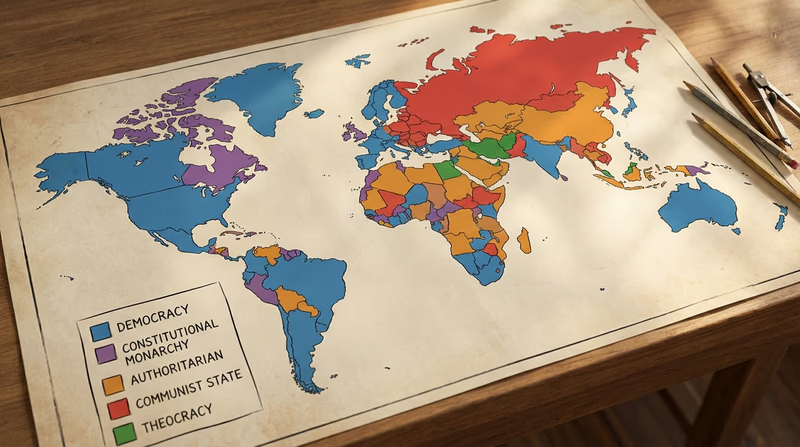
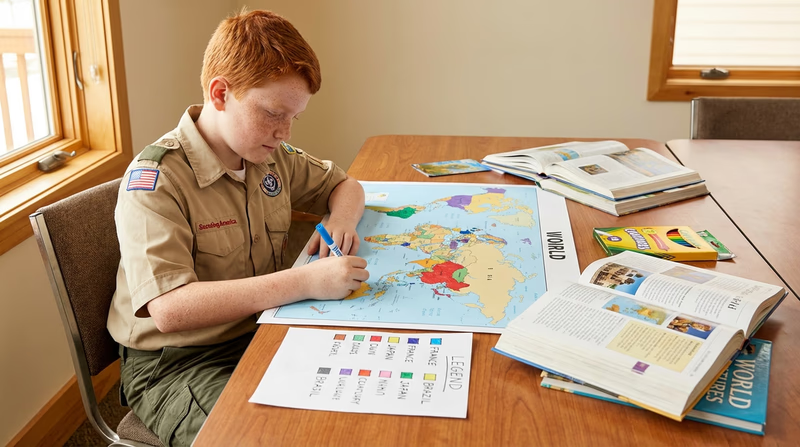
For Requirement 5c, you need to show countries using each of your five government types on a world map. Here is how to prepare:
Map Activity Checklist
Steps to complete your world government map
- Get a blank or outline world map (your counselor, library, or a printable map online can provide one).
- Choose a color or symbol for each of your five government types.
- Create a legend (key) that shows what each color or symbol means.
- Label at least one country for each government type.
- Be ready to explain why you classified each country the way you did.
You now know the major types of government and where to find them on the map. Let’s explore how these governments communicate and work with each other.