Extended Learning
A. Congratulations
You have earned the Climbing merit badge. You can identify hazards, tie five essential knots, belay a partner, climb routes, rappel safely, and care for your gear. Those skills put you in a small group of Scouts who have mastered one of the most demanding and rewarding outdoor activities Scouting offers. What follows are ways to take your climbing further — deeper skills, real experiences, and communities that will support you for years.
B. Building a Self-Rescue Toolkit
The Prusik hitch you learned in Req 7e is just the beginning of self-rescue. When something goes wrong on the wall — a stuck rope, an incapacitated partner, or a locked belay device — knowing how to solve the problem without outside help can be the difference between a minor inconvenience and a genuine emergency.
Ascending a rope with Prusik hitches is a core self-rescue skill. Two Prusik loops — one attached to your harness, one used as a foot loop — let you inch up a fixed rope. The technique is simple but physically demanding. Practice on a low rope first: slide the upper Prusik up, stand in the lower one, slide the lower Prusik up, sit back into the upper one. Repeat. Ascending 30 feet of rope this way takes several minutes and burns your legs, but it gets you to safety.
Escaping the belay is an advanced skill for when the belayer needs to free themselves while keeping the climber’s weight held. This involves tying off the belay device, transferring the load to an anchor using a Prusik or Klemheist knot, and then disconnecting from the system. This technique requires hands-on instruction — read about it, but do not attempt it without qualified training.
Lowering an injured climber from above requires the belayer to convert the system from a static hold to a controlled lower. If the climber cannot descend under their own power, the belayer must know how to rig a lowering system. This is typically taught in rescue courses, not in a merit badge setting, but understanding that the technique exists prepares you for advanced training.
The American Alpine Club and organizations like AMGA (American Mountain Guides Association) offer self-rescue workshops and courses. Even a single weekend course dramatically increases your ability to handle unexpected situations on the wall.
C. Training for Harder Climbing
The merit badge requirements top out at relatively easy climbing, but the discipline extends far beyond 5.6 routes. If the physical challenge of climbing excited you, here is how to keep improving.
Fingerboard training builds the finger and forearm strength that limits most intermediate climbers. A fingerboard (also called a hangboard) mounts above a doorframe and provides edges and pockets of various sizes to hang from. Start with large holds and short hangs — 7 seconds on, 3 seconds off — and gradually progress to smaller edges. Fingerboard training should begin slowly, as tendons strengthen much more slowly than muscles, and overtraining causes finger pulley injuries that can take months to heal.
Movement drills develop the coordination and body awareness that separate strong climbers from skilled climbers. Try these at your gym: climb a route using only your feet and open palms (no gripping). Climb a route silently — zero sound from your feet touching holds. Climb a route using the minimum number of hand moves. Each drill forces you to solve movement problems differently and builds proprioception — your body’s sense of its own position in space.
Route reading improves with structured practice. Before each climb, study the route from the ground for 30 seconds. Identify the crux (hardest section), plan your hand sequence, and locate rest positions. After climbing, compare what actually happened to your plan. Over time, your ability to visualize complex sequences improves dramatically — and you will spend less energy on the wall.
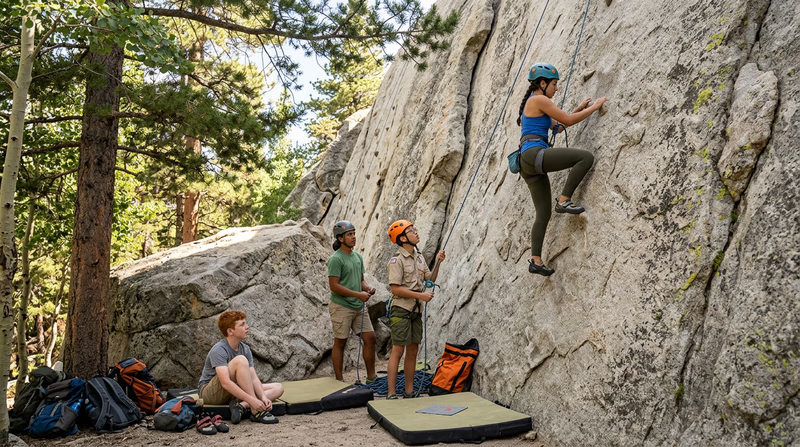
Outdoor climbing adds dimensions that gym climbing cannot replicate: variable hold texture, weather management, route-finding on natural features, and multi-pitch climbing where routes exceed a single rope length. If you have been climbing primarily indoors, seek out a guide service or experienced mentor for your first outdoor sessions. The transition from plastic to rock is humbling but deeply rewarding.
D. Understanding Climbing Ethics
Climbing has a strong culture of self-governance and environmental ethics that goes beyond Leave No Trace. Understanding these unwritten rules makes you a respected member of the climbing community.
Fixed hardware ethics are hotly debated. In some areas, placing permanent bolts is encouraged (sport climbing areas like the Red River Gorge). In others, it is prohibited or controversial (traditionally protected areas like the Gunks in New York or Indian Creek in Utah). Before drilling or placing fixed gear, research the local ethic. The Access Fund and local climbing coalitions publish guidelines for each area.
Crag etiquette includes yielding routes to parties who were there first, not monopolizing popular climbs, keeping noise levels reasonable, and cleaning up chalk and tape. At popular areas on busy days, efficiency matters — set up quickly, climb, and move on so others get a turn.
First ascent ethics apply if you are ever the first to climb a new route or boulder problem. The first ascensionist traditionally names the route and proposes a grade, but the community refines both over time. Chipping holds (altering natural rock to create new holds) is universally condemned in the modern climbing community. The rock sets the challenge — the climber adapts, not the other way around.