Req 10 — Belaying Skills
This requirement covers five belaying tasks:
- 10a — Explain the importance of belaying and when it is necessary
- 10b — Belay three climbers on three different routes
- 10c — Serve as a backup belayer on three different climbs
- 10d — Belay three rappellers on three different routes
- 10e — Serve as a backup belayer on three different rappels
When you belay, another person’s life is literally in your hands. The belayer manages the rope that catches falls, controls descents, and keeps the climber connected to safety. A distracted belayer is more dangerous than a loose rock, a frayed rope, or a poor knot — because the belayer is the last line of defense when everything else goes wrong.
Why Belaying Matters (10a)
Belaying serves three critical functions:
- Catching falls — When a climber slips, the belayer locks the rope to stop the fall. Without a belayer, a fall on a roped climb would be uncontrolled.
- Controlling descent — The belayer smoothly lowers the climber to the ground after completing a route. A jerky or too-fast lower can cause injury.
- Managing slack — The belayer feeds rope out as the climber moves up and takes in slack to minimize fall distance. Too much slack means a longer fall; too little means the climber gets pulled off the wall.
When is belaying necessary? Any time someone is roped climbing or rappelling. The only climbing situation without a belayer is bouldering, which uses spotters and crash pads instead. For this merit badge, you will belay during both climbing (10b–c) and rappelling (10d–e).
Belay Devices
A belay device creates friction on the rope, making it possible for a belayer to hold a falling climber with one hand. There are two main categories:
Tubular Devices (ATC)
The ATC (Air Traffic Controller) and similar tubular devices are simple, lightweight, and versatile. The rope passes through a slot in the device and over a carabiner. To brake, the belayer pulls the rope down and back, creating a sharp bend that generates friction.
Pros: Works for climbing and rappelling, inexpensive, lightweight Cons: Requires active braking — the belayer must hold the rope in the brake position
Assisted-Braking Devices (GriGri)
The Petzl GriGri and similar devices use a camming mechanism that pinches the rope when loaded suddenly, providing assisted braking. If the climber falls, the cam rotates and locks the rope automatically.
Pros: Adds a mechanical backup to the belayer’s grip Cons: Heavier, more expensive, and can give false confidence — the belayer must still actively manage the rope
Belaying a Climber (10b)
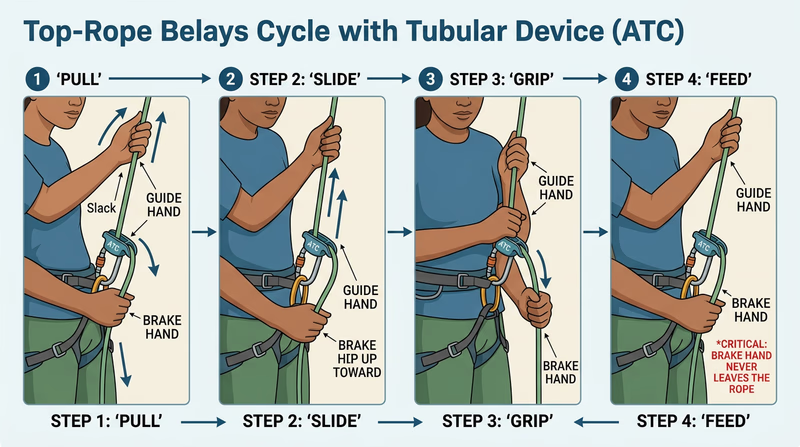
When belaying a top-rope climber, the belayer’s job is to take in slack as the climber ascends. The basic cycle:
- Pull rope through the device with the guide hand
- Brake hand slides up to meet the guide hand (brake hand stays on the rope the entire time)
- Grip the rope below the device with the brake hand in the new position
- Repeat — slide the guide hand back up the rope and pull more slack through
When catching a fall, pull the brake strand sharply downward and step back slightly. The friction in the device does most of the work — your job is to maintain the brake position.
For lowering, smoothly feed rope through the device while maintaining steady friction. Lower at a controlled speed — not too fast, not jerky. Communicate with the climber: “Lowering!”
Backup Belaying (10c)
A backup belayer stands behind the primary belayer and holds the brake strand of the rope below the primary belayer’s brake hand. If the primary belayer loses control — from being pulled off balance, getting distracted, or any other reason — the backup belayer clamps down on the rope to stop it.
The backup belayer’s rules:
- Stand directly behind the primary belayer
- Hold the rope loosely below the primary belayer’s hands — do not interfere with the primary belayer’s technique
- Watch the climber and the primary belayer simultaneously
- Be ready to lock the rope at any moment
- Let go of the rope immediately when the primary belayer signals “off belay”
Belaying a Rappeller (10d)
Belaying a rappeller uses a technique called a fireman’s belay. The belayer stands at the bottom of the rappel, holding the rope ends that hang below the rappeller. If the rappeller loses control, the belayer pulls the ropes taut — this locks the rappeller’s device and stops the descent.
Key differences from climb belaying:
- The belayer is below, not at the base of the climb
- The belayer pulls down on the rope to brake (not up through a device)
- The rappeller controls their own speed; the belayer is the emergency backup
Backup Belaying a Rappel (10e)
The backup belayer for a rappel assists the fireman’s belayer in the same way as for climbing — standing behind and holding the rope below the primary belayer’s hands. This adds a second layer of safety for the rappeller.
Weight Difference Considerations
If you are significantly lighter than the climber you are belaying, you may be pulled off the ground or slammed into the wall during a fall. This is a real concern for younger or smaller Scouts belaying adults.
Solutions:
- The belayer can anchor themselves to a ground anchor
- Use a heavier backup belayer
- Stand close to the wall to reduce the pull distance
- Communicate with the climber about fall potential