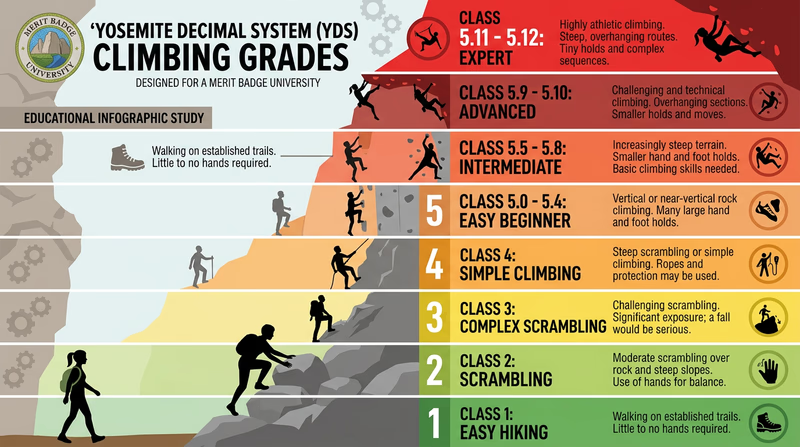
Req 4a — Climb Difficulty Ratings
You arrive at a crag and see routes labeled 5.6, 5.10a, and 5.12c. Without understanding the rating system, those numbers are meaningless. With it, you can instantly gauge whether a route is within your ability — or whether you should build more skill before attempting it.
The Yosemite Decimal System (YDS)
The most widely used climbing rating system in North America is the Yosemite Decimal System. It was developed in the 1950s at Tahquitz Rock in Southern California and refined over decades by Yosemite climbers.
The system classifies terrain into five classes:
| Class | Description | Example |
|---|---|---|
| Class 1 | Walking on a trail | A maintained hiking path |
| Class 2 | Simple scrambling, may use hands for balance | Boulder hopping on a rocky trail |
| Class 3 | Scrambling on steep terrain, exposure to falls | Ascending a rocky ridge with some exposure |
| Class 4 | Simple climbing, rope recommended | Easy rock with serious fall consequences |
| Class 5 | Technical rock climbing, rope and protection required | What you do for this merit badge |
Class 5 Breakdown
Class 5 is where real climbing begins, and it has its own detailed sub-ratings:
| Rating | Description |
|---|---|
| 5.0–5.4 | Very easy climbing. Large, obvious holds. Like climbing a steep ladder. |
| 5.5–5.6 | Easy. Good holds, moderate angle. Most beginners start here. |
| 5.7–5.8 | Moderate. Smaller holds, steeper angles. Requires some technique. |
| 5.9 | Difficult. Holds get smaller, moves become more precise. |
| 5.10a–5.10d | Hard. Requires specific techniques and good fitness. |
| 5.11a–5.11d | Very hard. Sustained difficult moves, strength and endurance required. |
| 5.12+ | Expert. At the edge of human ability for most recreational climbers. |
Notice that starting at 5.10, ratings add a letter suffix (a, b, c, d) to create finer distinctions. A 5.10a is significantly easier than a 5.10d.
Bouldering Grades: The V-Scale
Bouldering uses a separate rating system called the V-scale (also called the Hueco scale, after Hueco Tanks in Texas where it was developed).
| Grade | Description |
|---|---|
| VB | Beginner. Easy moves on large holds. |
| V0–V1 | Introductory. Requires basic technique. |
| V2–V3 | Moderate. More demanding moves and body positions. |
| V4–V5 | Difficult. Requires strength and specific technique. |
| V6+ | Advanced and beyond. |
There is no direct conversion between the V-scale and YDS, but very roughly, V0 corresponds to the difficulty of moves on a 5.10 route.
Indoor Gym Ratings
Indoor climbing gyms use the same YDS and V-scale numbers, but they also add color-coded routes. Each color represents a difficulty level, and the gym’s route-setters assign ratings based on the intended difficulty. Gym ratings tend to be slightly easier than outdoor ratings of the same number because indoor holds are manufactured and predictable.
Other Rating Systems
If you climb internationally or read older guidebooks, you may encounter other systems:
- French system — Used worldwide for sport climbing (e.g., 6a, 7b+). Common in European gyms.
- UIAA scale — Used in Central Europe (e.g., VI, VII+).
- British system — Combines an adjectival grade (e.g., “Hard Very Severe”) with a technical grade.
For this merit badge, focus on the YDS and V-scale — they are the standard in North America.