Req 5 — Communication on the Wall
This requirement covers the verbal signals used by four roles:
- Climbers (5a)
- Rappellers (5b)
- Belayers (5c)
- Boulderers and their spotters (5d)
“Slack!” You hear the shout from forty feet up, but wind garbles the next word. Was it “Slack” or “Take”? Those two commands do opposite things — one feeds rope out, the other pulls it tight. If the belayer guesses wrong, the climber could fall or get pulled off balance. Verbal signals are not suggestions. They are the communication system that keeps everyone alive.
Why Signals Matter
Climbing is a team activity where two people — climber and belayer — cannot always see each other. The climber may be around a corner, above an overhang, or simply too far away for casual conversation. Wind, echoes, and other climbers add noise. Standardized verbal signals cut through all of this because:
- They are short and distinct — each command sounds different from the others
- They are universal — climbers everywhere use the same words
- They create a confirmation loop — every command gets a response
Climbing Signals (5a)
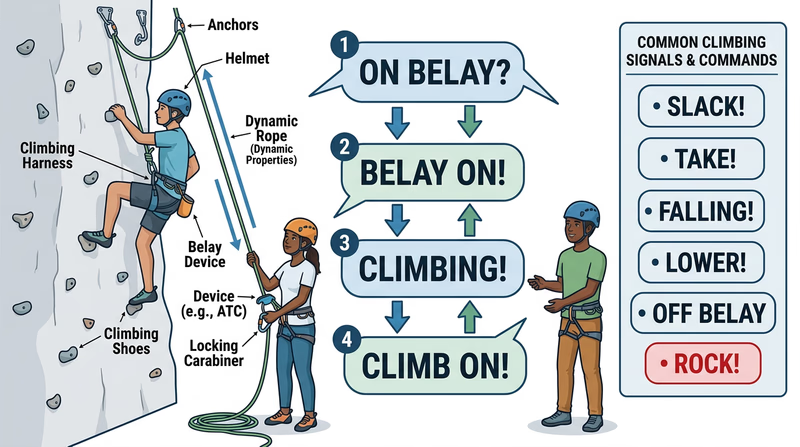
These signals form a call-and-response sequence between the climber and belayer:
| Who Says It | Signal | Meaning |
|---|---|---|
| Climber | “On belay?” | “Am I connected to the belay system? Are you ready?” |
| Belayer | “Belay on.” | “Yes, I have you. The system is active.” |
| Climber | “Climbing.” | “I am about to start moving up.” |
| Belayer | “Climb on.” | “Go ahead, I am managing the rope.” |
| Climber | “Slack!” | “Give me more rope — it is too tight.” |
| Climber | “Up rope!” or “Take!” | “Pull the rope tighter — too much slack.” |
| Climber | “Falling!” | “I am falling — catch me!” |
| Climber | “Lower!” or “Take!” | “I am done — lower me to the ground.” |
| Climber | “Off belay.” | “I am safe and no longer need the belay.” |
| Belayer | “Belay off.” | “The belay system is deactivated.” |
Rappelling Signals (5b)
Rappelling uses a similar system. The rappeller controls their own descent, but a belayer (or backup belayer) manages a safety line below.
| Who Says It | Signal | Meaning |
|---|---|---|
| Rappeller | “On rappel?” | “Is the belay ready for my descent?” |
| Belayer | “Rappel on.” | “The fireman’s belay is ready. Descend when ready.” |
| Rappeller | “Rappelling!” | “I am beginning my descent.” |
| Rappeller | “Off rappel.” | “I am down and disconnected from the rope.” |
| Belayer | “Belay off.” | “The safety line is released.” |
If the rappeller needs the belayer to lock the rope (stop their descent), the belayer can pull the rope taut from below — this is called a fireman’s belay. The rappeller shouts “Stop!” if they need to pause.
Belayer Signals (5c)
The belayer is the silent partner through most of the climb, responding to the climber’s commands. But belayers also initiate signals when needed:
| Who Says It | Signal | Meaning |
|---|---|---|
| Belayer | “Belay on.” | Response confirming the belay is active |
| Belayer | “Climb on.” | Response confirming the climber can begin |
| Belayer | “Belay off.” | The belay is no longer active |
| Belayer | “Watch me!” | “I see something — pay attention” (used for rockfall, etc.) |
| Anyone | “ROCK!” | “Something is falling — protect yourself!” |
The “ROCK!” signal deserves special emphasis. It is the one signal that everyone at the crag must know and respond to instantly. When you hear “ROCK!” — do not look up. Press against the wall, tuck your head, and let your helmet do its job.
Bouldering and Spotter Signals (5d)
Bouldering has no rope system, so signals are simpler — but spotting communication is critical.
| Who Says It | Signal | Meaning |
|---|---|---|
| Boulderer | “Spot me.” | “I am about to start. Be ready.” |
| Spotter | “Spotting.” | “I am in position and paying attention.” |
| Boulderer | “Falling!” | “I am coming off — guide me to the pad.” |
| Spotter | “Watch your left/right.” | “Move your pad — the fall line is shifting.” |
| Anyone | “Clear!” | “Move crash pads, I am jumping down.” |
The Spotter’s Role
A spotter does not catch a falling boulderer — that would injure both people. Instead, the spotter:
- Stands with arms up, hands open, ready to redirect the climber’s upper body
- Guides the climber’s hips and shoulders so they land feet-first on the crash pad
- Keeps the landing zone clear of gear, water bottles, and other tripping hazards
- Moves the crash pad if the climber traverses laterally
Practice Makes Automatic
You will demonstrate these signals with your counselor or another Scout. Practice them until they are automatic — in a real situation, you will not have time to think. The signals should come out as instinct, not as something you have to remember.
Petzl — Climbing Communication Visual guide to climbing communication signals from a leading climbing equipment manufacturer.