Req 6 — Rope Care & Management
This requirement covers five topics about climbing rope:
- 6a — Kinds of rope acceptable for climbing and rappelling
- 6b — How to examine a rope for wear or damage
- 6c — Ways to prevent rope damage
- 6d — When and how to retire a rope
- 6e — How to properly coil a rope
Your climbing rope is the single most important piece of safety equipment you own. A 60-meter dynamic rope, thinner than your thumb, can catch a 200-pound climber falling 20 feet without breaking. But that same rope, if damaged, can fail without warning. Understanding rope types, inspection, care, and retirement is not optional knowledge — it is survival knowledge.
6a: Kinds of Climbing Rope
Dynamic Ropes
Dynamic ropes are designed to stretch under the force of a fall, absorbing energy gradually rather than stopping the climber with a sudden jerk. This stretch is critical — a rope that does not stretch transfers all the force of a fall directly to the climber’s body, the anchor, and the belayer.
Dynamic ropes are the only ropes acceptable for climbing where falls are possible. They are what you will use for top-rope climbing, lead climbing, and rappelling with a belay.
Dynamic ropes come in three categories:
| Type | Diameter | Use |
|---|---|---|
| Single rope | 9.0–10.2mm | Standard for top-roping and single-line lead climbing |
| Half rope | 8.0–9.0mm | Used in pairs for trad climbing; each strand clips different protection |
| Twin rope | 7.0–8.0mm | Used in pairs, both strands clipped together; ultralight alpine use |
For this merit badge, you will most likely use a single dynamic rope.
Static Ropes
Static ropes do not stretch significantly. They are used for:
- Fixed lines (hauling gear, ascending with mechanical ascenders)
- Rescue operations
- Rappelling on fixed installations (when no falls are possible)
Rope Construction
Modern climbing ropes use a kernmantle construction: a core (kern) of parallel and braided nylon fibers provides strength, wrapped by a woven outer sheath (mantle) that protects against abrasion. The sheath takes the wear; the core carries the load.
6b: Inspecting a Rope
Inspect your rope before every climbing session and after any significant fall, rockfall contact, or exposure to chemicals.
Visual Inspection
Run the entire rope through your hands, looking for:
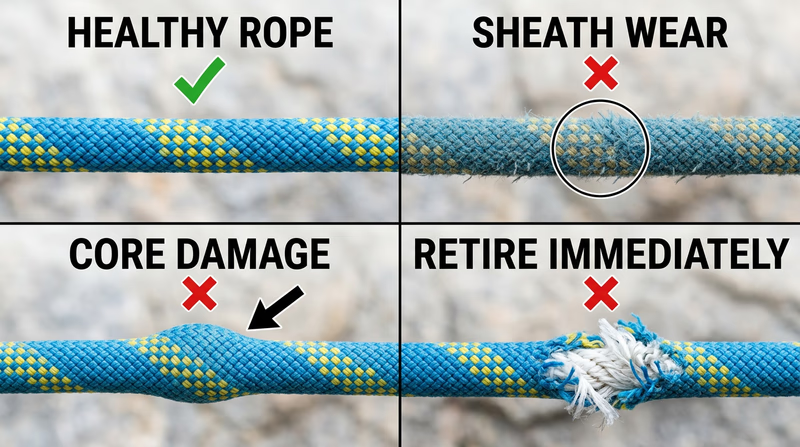
- Sheath damage: Cuts, fuzzy spots, flat sections, or areas where the core is visible through the sheath
- Discoloration: Stains from chemicals, solvents, or battery acid (these weaken nylon invisibly)
- Stiffness: Sections that feel hard or crunchy compared to the rest of the rope
Tactile Inspection
Feel for:
- Lumps or thin spots: These indicate core damage. A healthy rope feels uniform in diameter throughout its length. A lump means the core fibers are bunched; a thin spot means some have broken.
- Soft spots: Areas that feel mushy or collapse easily under finger pressure, suggesting the core is compromised.
6c: Preventing Rope Damage
Prevention is always easier than replacement. Climbing ropes are expensive and your life depends on them.
Rope Protection Habits
Follow these every time you climb
- Keep the rope away from sharp edges. Use edge protectors or padding over sharp rock.
- Never step on a climbing rope. Boot soles grind dirt and tiny rock particles into the sheath, cutting core fibers invisibly.
- Avoid dragging the rope across rough ground. Carry it to the base of the route.
- Keep rope away from chemicals: sunscreen, insect repellent, battery acid, gasoline.
- Do not leave rope in direct sunlight for extended periods. UV light degrades nylon over time.
- Prevent the rope from running over other ropes under load — friction between two loaded ropes generates enough heat to melt through the sheath in seconds.
Cleaning Your Rope
Dirt is a rope’s slow enemy. Grit works its way into the sheath and gradually abrades core fibers. Wash your rope periodically:
- Fill a bathtub with cool water and a mild soap (rope-specific wash or gentle dish soap)
- Loosely coil the rope and submerge it
- Gently work the soap through the rope by hand
- Drain and refill with clean water to rinse — repeat until water runs clear
- Air dry in shade, draped loosely — never in a dryer or direct sunlight
6d: Retiring a Rope
Even a well-maintained rope does not last forever. Retire a rope when any of these conditions apply:
| Condition | Action |
|---|---|
| Core visible through the sheath | Retire immediately |
| Core damage (lumps, thin spots) | Retire immediately |
| Severe fall (high fall factor) | Retire or have it professionally inspected |
| Chemical exposure | Retire immediately — damage is invisible |
| Excessive fuzziness on the sheath | Approaching end of life |
| Age — unused rope stored properly | Retire after 10 years regardless of condition |
| Age — regular weekend use | Retire after 3–5 years |
| Age — daily or heavy use | Retire after 1–2 years |
When you retire a rope, cut it into short lengths so no one accidentally uses it for climbing. Retired ropes make great practice knots, camp guy-lines, or dog leashes.
6e: Coiling a Rope
A properly coiled rope stores neatly, deploys without tangles, and is easy to carry. There are several coiling methods — your counselor will show you the technique they prefer. Here is the general approach for the mountaineer’s coil (also called the butterfly coil):
- Find the middle of the rope
- Drape the midpoint over the back of your neck, with equal lengths hanging on each side
- Alternately take an arm’s-length loop from each side, laying them into your hand
- When a few feet remain, wrap the tails around the top of the coil several times
- Pass a loop through the top of the coil and pull the tails through it to secure
- The tails become shoulder straps for carrying