Req 7 — Essential Climbing Knots
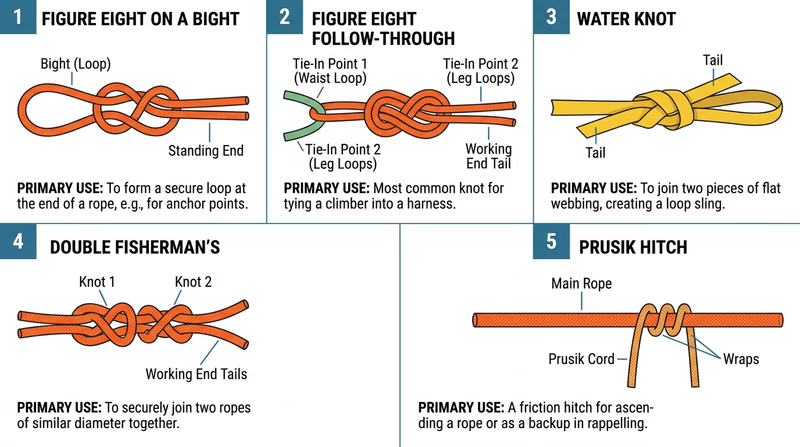
This requirement covers five knots:
- Figure eight on a bight (7a)
- Figure eight follow-through (7b)
- Water knot (7c)
- Double fisherman’s knot (7d)
- Prusik hitch (7e)
Every climber’s life depends on a handful of knots. Not dozens — just a few, tied perfectly every time. A figure eight follow-through connects you to the rope. A double fisherman’s joins two ropes for a long rappel. A Prusik can get you out of a jam mid-route. You do not need to know fifty knots. You need to know these five cold — in the dark, with gloves on, when you are tired.
Figure Eight on a Bight (7a)
The figure eight on a bight creates a fixed loop in the middle of a rope without needing access to either end. “Bight” means a U-shaped bend in the rope.
How it is used: This knot creates a clip-in point on the rope. It is commonly used to attach the rope to an anchor using a carabiner. If you are building a top-rope anchor with the climbing rope, you will likely tie a figure eight on a bight at the anchor end.
Key features:
- Easy to inspect visually — the knot should look like the number 8 with a loop coming out of it
- Does not slip or roll under load
- Relatively easy to untie after being loaded (compared to an overhand on a bight)
Figure Eight Follow-Through (7b)
The figure eight follow-through (also called a rewoven or retraced figure eight) ties the rope directly to your harness. This is the most important knot you will learn — it is the knot that holds you to the rope every time you climb.
How it is used: The climber threads the rope through both tie-in points on the harness, then retraces a figure eight knot. This creates a secure, non-slipping connection between the climber and the rope.
Key features:
- Extremely strong — retains approximately 75–80% of the rope’s rated strength
- Easy to visually inspect: the two strands should run perfectly parallel through the entire knot
- Must have a tail of at least 6 inches after the knot (some guides require a backup stopper knot on the tail)
Water Knot (7c)
The water knot (also called a ring bend or overhand retrace) joins the two ends of flat webbing to make a sling or runner. It is the standard knot for tying nylon webbing into a loop.
How it is used: Climbers use webbing slings for building anchors, extending placements, and creating equalized anchor systems. The water knot connects the ends of a length of webbing into a closed loop.
Key features:
- Specifically designed for flat webbing — do not use it to join ropes
- Must be tied tightly with tails of at least 3 inches on each side
- Critical: The water knot can slowly work itself loose over time. Check it before every use and retighten if the tails have shortened.
Double Fisherman’s Knot (7d)
The double fisherman’s knot (also called a grapevine knot) joins two rope ends together. It is incredibly secure — once loaded, it can be nearly impossible to untie.
How it is used: This knot joins two ropes together for long rappels when a single rope is too short to reach the ground. It is also used to tie accessory cord into loops for Prusik hitches (see 7e below) and to make cordelettes for anchor building.
Key features:
- Each side is a double overhand knot wrapped around the other rope
- When complete, the two knots should slide together snugly with no gap between them
- The “X” pattern on each knot should be clearly visible — if it looks messy, retie it
- Tails should be at least 3 inches long
Prusik Hitch (7e)
The Prusik hitch is a friction knot tied with a thin loop of accessory cord around a thicker climbing rope. It grips the rope when loaded but can be slid along the rope when unloaded.
How it is used: The Prusik is a self-rescue knot. If a climber is stranded on a rope mid-route — hanging in space after a fall, for example — they can attach Prusik hitches to the rope and inch their way up or down. Prusiks are also used as backup friction knots during rappelling.
Key features:
- The accessory cord must be significantly thinner than the climbing rope (typically 5–7mm cord on a 9–10mm rope)
- Usually wrapped three times around the climbing rope for sufficient friction
- Grips when pulled downward but slides when the load is released and the knot is pushed
- The Prusik loop is typically made by tying a piece of accessory cord into a loop with a double fisherman’s knot (7d)
Practice Until Automatic
Your counselor will ask you to demonstrate each knot and explain its use. Practice at home with a piece of rope or cord until you can tie each one without looking at instructions. A knot you have to think about on the wall is a knot you might tie wrong when it matters most.
Animated Knots — Climbing Knots Step-by-step animated instructions for every climbing knot, including all five required for this badge.