Extended Learning
A. Congratulations, Collector
You have learned how coins are made, mastered the vocabulary of numismatics, built a collection across six denominations, explored commemorative coinage, identified the faces on U.S. currency, and stepped into the wider world of collecting. That is a serious foundation — and the hobby only gets deeper from here.
B. The Art of Coin Grading
Every coin you handle has a story written in its surface. The sharpness of the design, the luster of the metal, and the presence (or absence) of wear marks all tell you how that coin has been treated since it left the Mint. Coin grading is the skill of reading those clues and assigning a standardized condition rating.
The industry standard is the Sheldon scale, which runs from 1 (barely identifiable) to 70 (absolutely perfect — exactly as it left the dies). Here is a simplified overview of the key grade ranges:
| Grade Range | Abbreviation | What It Means |
|---|---|---|
| 1–3 | PO to AG | Heavily worn, major details visible but barely |
| 4–6 | G | Worn smooth in high spots, major design clear |
| 8–15 | VG to F | Moderate wear, all major and most minor details visible |
| 20–35 | VF to XF | Light wear on high points, sharp details remain |
| 40–45 | AU | Slight wear on the very highest points only, most luster intact |
| 50–58 | AU | Trace of wear, nearly full luster |
| 60–70 | MS (Mint State) | No wear at all — uncirculated |
The difference between an MS-63 and an MS-67 coin might be invisible to the untrained eye, but to a professional grader it involves the number and severity of contact marks, the quality of the strike, the fullness of the luster, and the overall eye appeal. A coin graded MS-67 can be worth 10 or even 100 times more than the same date and mint mark graded MS-63.
Learning to grade takes practice. Start by comparing coins of the same type in different conditions. A worn Lincoln cent from 1960 next to a fresh one from 2024 makes the concept of wear immediately visible. The American Numismatic Association offers a correspondence course in coin grading and hosts grading seminars at their conventions.
C. Error Coins and Varieties
The U.S. Mint produces billions of coins per year at tremendous speed. Despite rigorous quality control, mistakes happen — and collectors love them. Error coins are unintentional manufacturing defects, while varieties are minor design differences caused by variations in the dies.
Common error types:
- Off-center strikes: The planchet was not properly seated in the collar, so the design is shifted to one side. A coin struck 50% off-center with the date still visible can be worth hundreds of dollars.
- Doubled dies: The die was impressed with the hub at slightly different angles, creating a doubled image on the finished coin. The 1955 and 1972 Lincoln cent doubled dies are famous examples.
- Wrong planchet errors: A planchet meant for one denomination enters the press for another. A cent struck on a dime planchet, for example, creates a wildly wrong-sized coin.
- Broadstrikes: The collar failed to constrain the coin, so the metal spread outward under pressure, creating an oversized, rimless coin.
- Die cracks and cuds: Cracks in the die create raised lines on the coin. A large crack at the rim can produce a blob of raised metal called a “cud.”
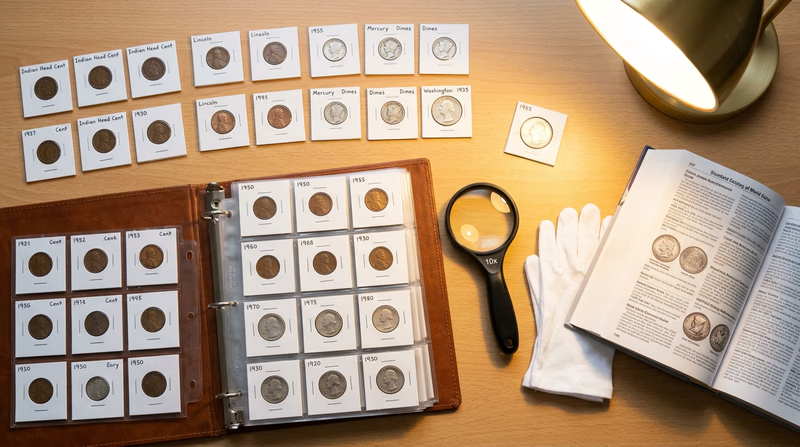
Error collecting adds a detective element to the hobby. Every coin you handle could be an error — you just have to look closely enough. A basic loupe (5x to 10x magnification) and good lighting are your essential tools.
D. Ancient and Medieval Coins
One of the most rewarding extensions of coin collecting is stepping backward in time. Ancient coins — from Greek, Roman, Celtic, Byzantine, and other civilizations — connect you to people who lived thousands of years ago in a way that photographs and museum displays cannot.
Getting started with ancient coins is more accessible than most people think. Common bronze coins from the late Roman Empire (4th–5th century AD) can be purchased for $5–$20 from reputable dealers. These are not reproductions — they are genuine artifacts, more than 1,500 years old, that once changed hands in marketplaces across Europe, North Africa, and the Middle East.
When you hold a Roman coin showing Emperor Constantine, you are holding something that might have been used to buy bread in a town that is now an archaeological site. That physical connection to history is what draws many collectors into ancient numismatics.
Key differences from modern collecting:
- Ancient coins were struck by hand between two dies, so no two are exactly alike (unlike modern machine-struck coins, which are nearly identical).
- Grading ancient coins focuses more on centering, sharpness, and surface quality than on the 1–70 Sheldon scale.
- Authentication matters — fakes exist, especially for expensive rarities. Buy from established dealers who guarantee authenticity.
- Ancient coins are legal to own in the United States, though import laws and cultural heritage regulations vary by country of origin.
E. Real-World Experiences
Visit the Smithsonian’s National Numismatic Collection
The National Museum of American History in Washington, D.C. houses one of the world’s largest coin collections — over 450,000 objects. The collection includes the legendary 1933 Double Eagle, colonial coins, and currency from around the world. If you are ever in D.C., this is a must-see.
Attend an ANA Convention
The American Numismatic Association holds two major conventions each year — the World’s Fair of Money (summer) and the National Money Show (spring). These events feature hundreds of dealers, educational programs, a young numismatists program, and exhibits of some of the rarest coins in existence. ANA conventions are open to the public, and admission is usually free for young collectors.
Start a Coin Roll Hunting Habit
One of the most popular and affordable ways to find interesting coins is coin roll hunting (CRH). Buy rolls of coins from your bank, search through them for valuable dates, errors, silver coins, or unusual varieties, and return the common coins. Many collectors have found silver dimes, rare mint marks, and error coins this way — all at face value.
Compete in Numismatic Exhibits
The ANA and many regional shows host competitive exhibits where collectors display their collections with written descriptions, historical context, and thematic organization. Young numismatists (YN) categories exist specifically for collectors under 18. Competing teaches you research skills, presentation skills, and a deeper understanding of the coins you collect.
Explore a Mint Gift Shop or Museum
Even if you cannot take a full tour of a Mint facility, the gift shops at the Philadelphia and Denver Mints sell uncirculated coin sets, proof sets, and special products at retail prices. The gift shops also feature small museum exhibits about coin history and production.