Req 1 — How Coins Are Made
A quarter does not just appear in your pocket. It begins as a sheet of raw metal, gets punched, pressed, and inspected at incredible speed, and travels through one of the most precise manufacturing operations in the country before it ever reaches your hand. Understanding this process will change the way you look at every coin you touch.
From Metal to Money
The journey of a coin starts long before it enters a press. Here is how it works, step by step.
Step 1: Designing the Coin
Every new coin design begins with artists. The U.S. Mint employs a team of sculptor-engravers and also accepts designs from the public through its Artistic Infusion Program. Proposed designs go through review by the Citizens Coinage Advisory Committee and the Commission of Fine Arts before the Secretary of the Treasury makes the final selection.
Once a design is approved, a sculptor-engraver creates a large clay or digital model — typically 8 to 12 inches across. This oversized model captures fine details that will be shrunk down to coin size.
Step 2: Making the Dies
The large model is transferred to a steel hub using a pantograph-like device called a reducing lathe (or, increasingly, digital engraving technology). The hub creates a master die, and the master die stamps out working dies — the hardened steel cylinders that will actually strike the coins. A single working die can produce hundreds of thousands of coins before it wears out and is replaced.
Step 3: Preparing the Blanks
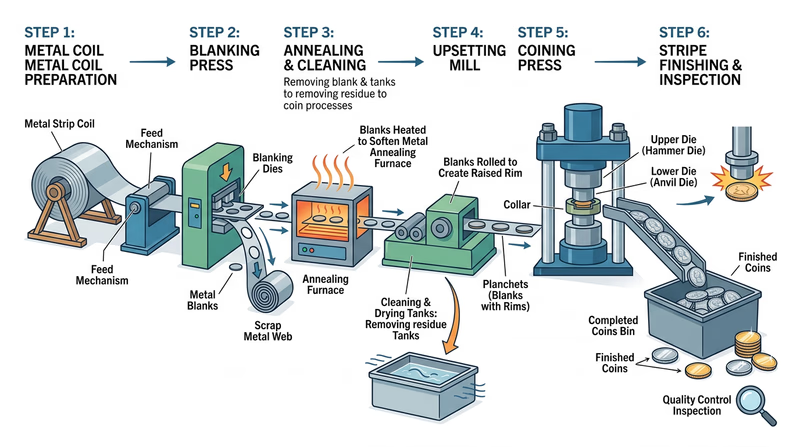
Coins start as large coils of metal strip. For most circulating coins, the Mint buys pre-made strip from outside suppliers. A blanking press punches out round discs called blanks (also called planchets once they are prepared). The blanks are heated in an annealing furnace to soften them, then washed and dried.
For clad coins like dimes and quarters, the strip is a sandwich — a copper core bonded between layers of a copper-nickel alloy. If you look at the edge of a quarter, you can see the copper core peeking through as a thin reddish-brown line.
Step 4: The Upsetting Mill
Before striking, blanks pass through an upsetting mill that raises a slight rim around the edge. This rim protects the coin’s design from wear and helps coins stack neatly. At this point, the blank is officially called a planchet.
Step 5: Striking
The planchet enters a coining press, where it sits in a collar (a ring that constrains the coin’s diameter and can impress edge designs like reeding). Two dies — one for the obverse (front) and one for the reverse (back) — slam together with 35 to 100 tons of force, impressing the design in a fraction of a second. Modern presses can strike over 800 coins per minute.
Step 6: Inspection and Bagging
After striking, coins pass through automated inspection systems that check for defects. Rejected coins are recycled. Accepted coins are counted by machine, poured into large bags, and shipped to Federal Reserve Banks, which distribute them to commercial banks — and eventually to your pocket.
Active U.S. Mint Facilities
The United States Mint operates several facilities, each with a specific role. The ones that produce coins for circulation mark their products with a small letter called a mint mark.
Philadelphia Mint (P)
Located in Philadelphia, Pennsylvania — where the Mint has operated since 1792. This is the largest Mint facility and produces coins for circulation (marked with a “P” or, historically, no mint mark at all). It also manufactures the dies used by all other facilities.
Denver Mint (D)
Located in Denver, Colorado, and in operation since 1906. The Denver Mint produces coins for circulation marked with a “D” and is the second-largest production facility.
San Francisco Mint (S)
Located in San Francisco, California. Once a major producer of circulating coins, the San Francisco Mint now focuses primarily on proof coins and special collector editions marked with an “S.” Proof coins are struck with specially polished dies that produce mirror-like surfaces and sharp details.
West Point Mint (W)
Located at the United States Military Academy in West Point, New York. This facility produces gold, silver, and platinum bullion coins, as well as commemorative coins marked with a “W.” It also serves as a secure storage site for gold and silver bullion.
Headquarters — Washington, D.C.
The Mint’s administrative headquarters is in Washington, D.C. No coins are struck here, but it oversees all Mint operations, policy, and the design selection process.
Fort Knox Bullion Depository
Located at Fort Knox, Kentucky. This is not a coin production facility — it is a fortified vault that stores a large portion of the United States’ gold reserves. While it is part of the Mint’s operations, it does not produce any coins.
How Coins Are Made — U.S. Mint The official U.S. Mint page walks through the entire coin production process with photos and diagrams.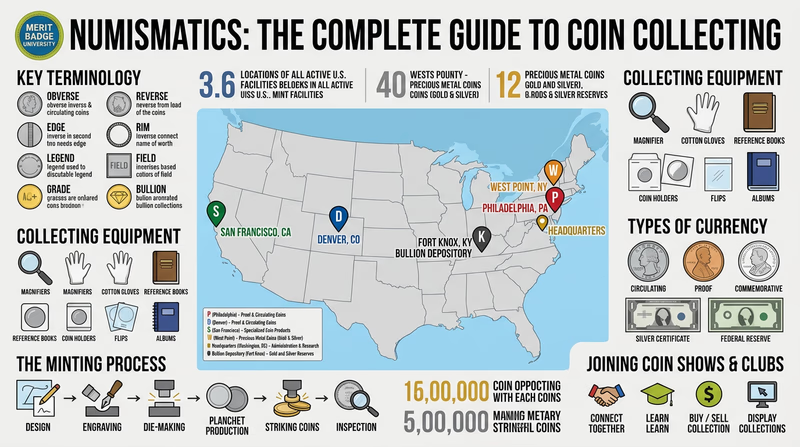
Why This Matters to Collectors
Understanding the minting process helps you appreciate what you are holding. When you know that a proof coin was struck twice on polished dies, you understand why it looks so different from a coin pulled from circulation. When you spot a coin struck slightly off-center, you recognize it as a manufacturing error — potentially valuable. And when you see a mint mark, you can trace that coin back to the exact building where it was born.