Req 2 — Coin Terminology
Every hobby has its own vocabulary, and coin collecting is no exception. These six terms are the building blocks of numismatic language. Once you know them, you will be able to talk with any collector — from a casual hobbyist to a professional dealer — and understand exactly what they mean.
The Anatomy of a Coin
Obverse
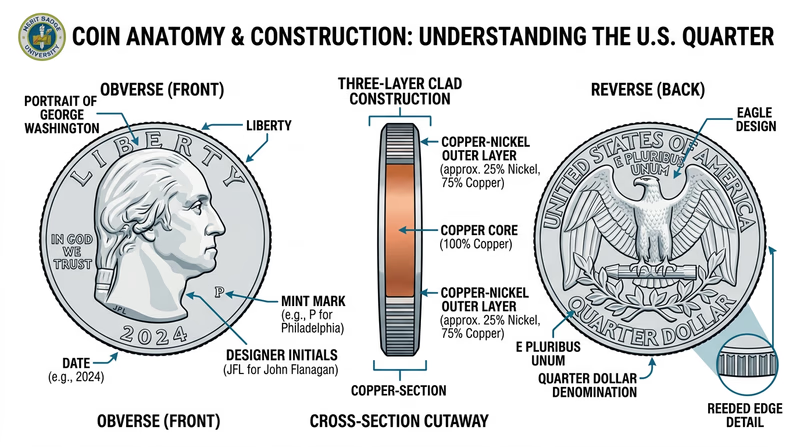
The obverse is the front of the coin — the side most people think of as “heads.” On U.S. coins, the obverse typically features a portrait or symbolic figure. Lincoln appears on the cent, Jefferson on the nickel, Roosevelt on the dime, Washington on the quarter, Kennedy on the half dollar, and various figures on the dollar coin.
The obverse usually carries the date, the mint mark, and the motto “IN GOD WE TRUST.” Think of it as the coin’s face — the side that introduces itself to the world.
Reverse
The reverse is the back of the coin — the “tails” side. This is where designers often get the most creative freedom. The reverse of the Lincoln cent has changed from the Lincoln Memorial (1959–2008) to the Union Shield (2010–present). The quarter’s reverse has transformed dramatically through the 50 State Quarters, America the Beautiful, and American Women programs.
The reverse typically displays the denomination (how much the coin is worth), “UNITED STATES OF AMERICA,” and the motto “E PLURIBUS UNUM” — Latin for “Out of Many, One.”
Reeding
Reeding refers to the ridged edge found on dimes, quarters, half dollars, and some dollar coins. Run your fingernail along the edge of a quarter and you will feel the tiny parallel grooves — that is reeding.
Reeding was originally an anti-counterfeiting and anti-clipping measure. In the days when coins were made of precious metals, dishonest people would shave or “clip” tiny amounts of silver or gold from the edges and melt the shavings down. Reeded edges made this kind of tampering immediately obvious. Today, reeding serves mainly as a tactile identifier — it helps visually impaired people distinguish between coins of similar size by touch.
Not all coins have reeding. The cent and nickel have smooth (plain) edges. The Presidential dollar coins feature edge lettering instead of traditional reeding.
Clad
Clad describes a coin made from layers of different metals bonded together. Before 1965, dimes, quarters, and half dollars were made of 90% silver. When the price of silver rose above the face value of these coins, Congress passed the Coinage Act of 1965, replacing silver with clad construction.
A clad coin is a sandwich: a core of pure copper between outer layers of copper-nickel alloy (75% copper, 25% nickel). This combination gives the coin a silvery appearance while keeping production costs low. Look at the edge of any modern quarter or dime — the reddish-brown stripe you see is the copper core peeking through.
Ways to Organize a Collection
Type Set
A type set is a collection that includes one example of each major design type within a category. Instead of trying to collect every date and mint mark of the Lincoln cent (which would be hundreds of coins), a type set collector would want just one representative Lincoln cent — and then move on to a Buffalo nickel, a Mercury dime, a Standing Liberty quarter, and so on.
Type sets give you a broad overview of American coinage history without requiring a huge budget or decades of searching. They are an excellent way to start collecting because each coin you add looks dramatically different from the last.
A common approach is to build a “20th Century Type Set” that includes one example of every major coin design used from 1900 to 1999. This might include 15 to 20 coins and could be assembled for a few hundred dollars.
Date Set
A date set is a collection organized by year. The goal is to acquire one coin from every year a particular series was produced. A Lincoln cent date set from 1959 to the present, for example, means finding a cent for each year — and possibly each mint mark — in that range.
Date sets can range from simple (a complete set of America the Beautiful quarters from 2010 to 2021) to extremely challenging (a complete set of Morgan silver dollars from 1878 to 1921, which includes some very rare dates). The difficulty and cost depend entirely on which series you choose.
Putting It All Together
These six terms form the foundation of everything you will learn in this badge. When your counselor asks you to explain the design features of a coin, you will use “obverse” and “reverse.” When you discuss why modern coins look different from older ones, you will talk about “clad” construction. And when you describe how your collection is organized, you will use “type set” or “date set” — or both.
Coin Terminology Glossary — American Numismatic Association A comprehensive glossary of coin collecting terms from the ANA, covering hundreds of terms beyond the six covered here.