Req 4c — The Ten-Cent Coin
The Roosevelt dime is a coin with a straightforward requirement — but its story is richer than its small size suggests. This tiny coin honors a president who transformed America and helped defeat polio, and its design has barely changed in nearly eighty years.
The Roosevelt Dime (1946–Present)
The Roosevelt dime was introduced in 1946, one year after President Franklin D. Roosevelt’s death. Roosevelt was closely associated with the dime because of his role in founding the March of Dimes — originally called the National Foundation for Infantile Paralysis — which raised money to fight polio by asking Americans to contribute their dimes.
The coin was designed by John R. Sinnock, the Mint’s Chief Engraver.
Design features to know:
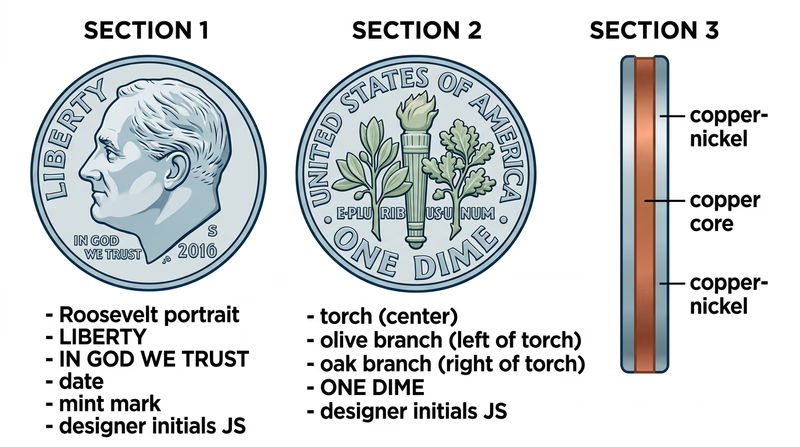
- Obverse: Roosevelt’s portrait facing left, with “LIBERTY” along the left rim and “IN GOD WE TRUST” along the lower left. The date appears at the bottom right, and the mint mark is just above the date. Sinnock’s initials “JS” appear at the base of Roosevelt’s neck.
- Reverse: A torch flanked by an olive branch (on the left, symbolizing peace) and an oak branch (on the right, symbolizing strength and independence). “UNITED STATES OF AMERICA” arcs across the top, “E PLURIBUS UNUM” runs along the bottom left, and “ONE DIME” appears at the base. Sinnock’s initials “JS” also appear at the base of the torch.
The 1965 Transition
The most significant change to the Roosevelt dime happened in 1965, when the Mint switched from 90% silver to clad construction (copper-nickel over copper). As you learned in Req 2, this change was driven by the rising price of silver. The 1964 dime was the last silver dime produced for circulation, and collectors immediately began hoarding them.
If you compare a pre-1965 and post-1965 dime edge-on, the difference is obvious. The older coin has a uniform silvery edge, while the clad coin shows a thin copper stripe sandwiched between the outer layers.
A Design That Endures
Unlike the cent, nickel, and quarter — which have all received new reverse designs in recent decades — the Roosevelt dime has kept essentially the same design since 1946. Minor adjustments have been made (the mint mark moved from the reverse to the obverse in 1968, and the lettering has been slightly refined), but the overall design remains John Sinnock’s original vision.
This consistency makes the Roosevelt dime one of the simplest coins to collect but also one of the most understated. It does not get the attention of flashy quarter programs or bicentennial specials, but it has quietly honored Roosevelt’s legacy for nearly eight decades.
What to Collect
For this requirement, you need:
- One dime dated 1965 or later (clad Roosevelt dime)
This is the easiest coin to find for this badge — any dime in your pocket almost certainly qualifies. Focus your preparation on knowing the design features, the designer (John R. Sinnock), where to find “JS” on both sides, and the story of why Roosevelt appears on this coin.
The Roosevelt Dime — CoinWeek A detailed profile of the Roosevelt dime covering its history, design evolution, and key dates for collectors.