Req 5 — Bicentennial Coins
In 1976, the United States celebrated its 200th birthday. The Mint marked the occasion by doing something it had never done before and has never done since: temporarily replacing the reverse designs on three circulating denominations at the same time. These Bicentennial coins are among the most distinctive in American numismatic history.
A National Celebration
Congress authorized the Bicentennial coinage program in 1973, giving the Mint time to select designs and prepare for production. A national design competition drew over 800 entries from professional and amateur artists. Three winning designs were chosen — one each for the quarter, half dollar, and dollar.
All three coins carry a special dual date — 1776–1976 — instead of a single year. This means no coins bear the date 1975 for these denominations. Every quarter, half dollar, and dollar struck in both 1975 and 1976 carries the 1776–1976 dual date.
The Three Bicentennial Designs
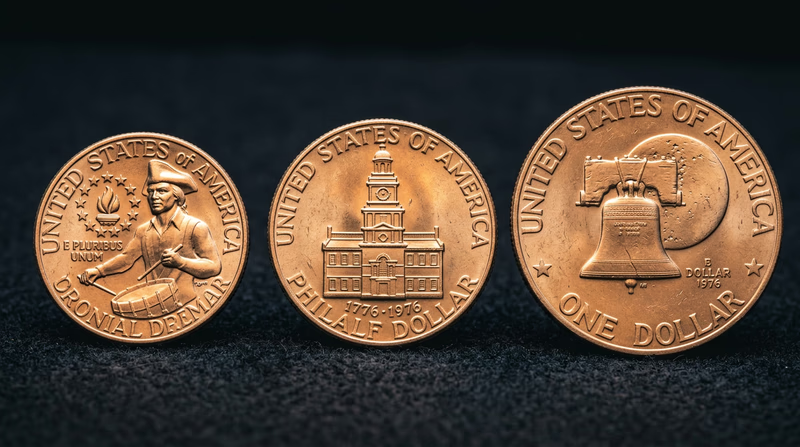
Bicentennial Quarter — Colonial Drummer
The reverse features a Colonial drummer — a young soldier marching with a drum, accompanied by a victory torch surrounded by 13 stars (representing the original colonies). Designed by Jack L. Ahr, whose initials “JLA” appear near the drummer’s boot.
The obverse retains John Flanagan’s familiar Washington portrait but replaces the single date with “1776–1976.”
This is probably the most commonly encountered Bicentennial coin. Hundreds of millions were struck, and they still turn up in circulation regularly. The Colonial Drummer became an iconic symbol of America’s bicentennial celebration.
Bicentennial Half Dollar — Independence Hall
The reverse depicts Independence Hall in Philadelphia — the building where the Declaration of Independence was signed and the Constitution was drafted. The view shows the south facade of the building, with “200 YEARS OF FREEDOM” inscribed below. Designed by Seth G. Huntington, with initials “SGH” to the right of the building.
The obverse retains Gilroy Roberts’ Kennedy portrait with the dual date. As you learned in Req 4e, the half dollar was already becoming scarce in circulation by this time, so many Bicentennial halves were saved by collectors rather than spent.
Bicentennial Dollar — Liberty Bell and Moon
The reverse shows the Liberty Bell superimposed on the Moon — a striking combination of two American symbols, connecting the nation’s founding to the Space Age. Designed by Dennis R. Williams, with initials “DRW” below the bell.
The obverse retains Frank Gasparro’s Eisenhower portrait with the dual date. The Eisenhower dollar was the last large-format dollar coin (38.1mm diameter), making the Bicentennial dollar a substantial and impressive coin to hold.
Special Collector Editions
In addition to the regular copper-nickel clad versions struck for circulation, the Mint also produced special 40% silver versions of all three Bicentennial coins. These were sold in collector sets and are distinguished by their “S” mint mark (San Francisco). The silver versions have a slightly different luster and feel compared to the clad versions.
The Mint offered three-coin sets containing all three silver Bicentennial coins in both uncirculated and proof finishes. These sets remain popular with collectors today and can be found at coin shops and online for $15–$30.
Why the Bicentennial Coins Matter
The Bicentennial coinage program was more than a celebration — it was a demonstration of how coins can serve as cultural artifacts. These coins captured a national moment: the pride of a 200th birthday, the connection between past and future (Liberty Bell meets Moon), and the grassroots patriotism of a nation marking its origins.
For collectors, the Bicentennial coins are also a case study in how temporary designs create collecting opportunities. Because they were struck in enormous quantities, they remain affordable. But because they look so different from standard coinage, they catch people’s attention and spark curiosity — which is exactly what the Mint intended.
Bicentennial Coinage — U.S. Mint The official Mint page on the Bicentennial quarter, with links to the half dollar and dollar designs.