Req 6 — U.S. Currency
Coins are minted. Paper money is printed — and the distinction matters. While the U.S. Mint handles coins, paper currency comes from a completely separate government agency with its own fascinating history.
The Faces on U.S. Currency
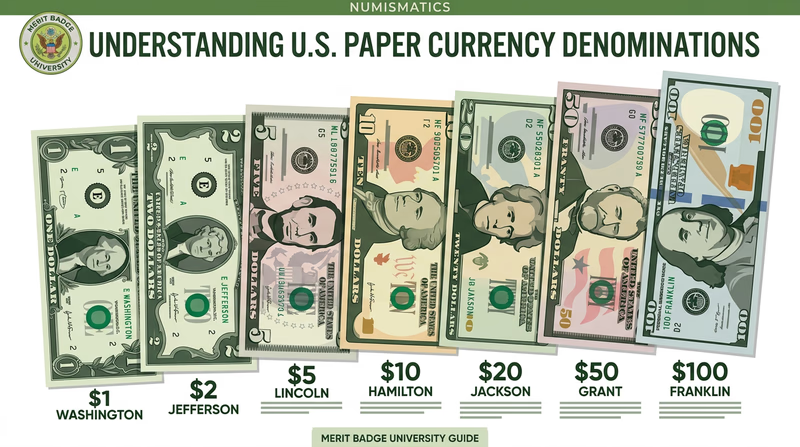
Every denomination of U.S. paper money features a prominent American leader. Here are the current portraits:
| Denomination | Portrait | Notable Role |
|---|---|---|
| $1 | George Washington | 1st President, Commander of the Continental Army |
| $2 | Thomas Jefferson | 3rd President, author of the Declaration of Independence |
| $5 | Abraham Lincoln | 16th President, preserved the Union during the Civil War |
| $10 | Alexander Hamilton | 1st Secretary of the Treasury, architect of the U.S. financial system |
| $20 | Andrew Jackson | 7th President, controversial populist and military hero |
| $50 | Ulysses S. Grant | 18th President, commanding general of the Union Army |
| $100 | Benjamin Franklin | Founding Father, diplomat, inventor, and scientist |
The $2 Bill — Rarer Than You Think
The $2 bill featuring Thomas Jefferson is still in production, but it is printed in much smaller quantities than other denominations. Many people believe the $2 bill has been discontinued, but that is a myth. The Bureau of Engraving and Printing produces new $2 bills periodically when the Federal Reserve orders them. Their relative scarcity makes them a fun conversation piece — and some people collect $2 bills by serial number or series year.
The Reverse Designs
The backs of U.S. bills are just as interesting as the fronts:
- $1 — The Great Seal of the United States (both sides: the eagle and the unfinished pyramid with the Eye of Providence)
- $2 — John Trumbull’s painting Declaration of Independence, showing the presentation of the document to Congress
- $5 — The Lincoln Memorial
- $10 — The U.S. Treasury Building
- $20 — The White House
- $50 — The U.S. Capitol Building
- $100 — Independence Hall
Where U.S. Currency Is Printed
U.S. paper money is produced by the Bureau of Engraving and Printing (BEP), a division of the U.S. Department of the Treasury. The BEP operates two production facilities:
Washington, D.C. Facility
The original and primary facility, located at 14th and C Streets SW in Washington, D.C. This facility has been printing currency since 1914. It is open to the public for tours, where visitors can watch billions of dollars being printed on massive high-speed presses.
Fort Worth, Texas Facility
The Western Currency Facility in Fort Worth, Texas, opened in 1991 to supplement production. Notes printed here carry a small “FW” designation near the Federal Reserve seal — a detail most people never notice.
How Paper Money Is Made
The BEP uses a combination of intaglio printing (where ink is applied to engraved plates and wiped from the surface, leaving ink only in the recessed lines) and offset printing (for background colors and patterns). This multi-step process creates the distinctive raised feel of genuine U.S. currency — run your finger across the portrait on a bill and you can feel the texture of the ink.
Modern U.S. bills also include advanced security features:
Security Features on Modern U.S. Bills
- Watermark: Hold the bill up to light and you will see a faint portrait matching the one on the front.
- Security thread: A thin embedded strip that glows a specific color under ultraviolet light (different for each denomination).
- Color-shifting ink: The denomination number in the lower right corner changes color when you tilt the bill.
- Microprinting: Tiny text visible only with magnification, printed around the portrait and in other locations.
- 3-D security ribbon ($100 only): A blue ribbon woven into the paper that shows moving images when tilted.
Coins vs. Currency: Key Differences
Since this badge focuses on coin collecting, it is worth noting the key distinctions between coins and paper money:
- Coins are made by the U.S. Mint (Department of the Treasury). Paper money is printed by the Bureau of Engraving and Printing (also Department of the Treasury, but a separate bureau).
- Coins are “minted” (struck from metal). Paper money is “printed” (on special cotton-linen blend paper — not wood-pulp paper like books or newspapers).
- Coins last 25–30+ years in circulation. Paper bills last only 5–15 years depending on denomination (the $1 bill lasts about 6 years on average).
- Both coins and paper money are distributed to the public through the Federal Reserve System.