Req 7 — Expanding Your Horizons
This final requirement gives you a choice: explore the world through coins, paper money, or tokens — or experience the collecting community firsthand. Read through all four options below, then pick the one that excites you most.
- Option a: Collect 20 world coins from at least 7 countries
- Option b: Collect 20 pieces of world paper money from at least 7 countries
- Option c: Collect 20 tokens and/or medals
- Option d: Attend a coin show, club meeting, Mint tour, or approved virtual exhibit
Option A: World Coins
World coins open a window to other cultures, histories, and artistic traditions. A coin from Japan looks nothing like a coin from South Africa, and both look nothing like a coin from Brazil. The variety is staggering.
Where to Find World Coins
- Friends and family who have traveled often have leftover foreign change sitting in drawers.
- Coin shops usually have bins of unsorted world coins at low prices (often $0.25–$1.00 each).
- Online dealers sell assorted world coin lots — a bag of 50 mixed coins from multiple countries typically costs $10–$20.
- Currency exchange leftovers at airports or banks.
What to Look For
For each coin, you need to identify:
- Country of origin — Often written on the coin, though sometimes in the local language or script.
- Denomination — The face value and currency name (e.g., “5 Pence” from the United Kingdom, “10 Yen” from Japan).
- Major design elements — What is depicted on each side? A monarch? A national symbol? An animal? A landmark?
Option B: World Paper Money
World paper money (called banknotes) showcases some of the most elaborate artwork and security features of any printed material in the world. Many countries use polymer (plastic) banknotes with transparent windows, holographic strips, and color-shifting elements that make U.S. bills look plain by comparison.
Where to Find World Banknotes
- Travelers in your family or troop may have leftover bills from trips.
- Coin and currency dealers sell world banknotes, often at modest markups above face value.
- Online marketplaces offer assorted lots of world banknotes for collectors.
- Banks occasionally have foreign currency available, though usually only major currencies.
What to Look For
Just like coins, identify the country, denomination, and major design elements. Pay special attention to:
- Who or what is depicted (leaders, animals, landmarks, cultural symbols)
- Security features (watermarks, holograms, color-shifting ink, transparent windows)
- The material — is it traditional cotton/linen paper or modern polymer?
Option C: Tokens and Medals
Tokens and medals look like coins but serve different purposes. A token substitutes for money in a specific context (arcade tokens, transit tokens, trade tokens). A medal commemorates a person, event, or achievement but has no monetary value.
Where to Find Tokens and Medals
- Antique shops and flea markets are excellent sources for old trade tokens and commemorative medals.
- Amusement parks, arcades, and car washes still use tokens in some locations.
- Military surplus stores sometimes carry challenge coins and campaign medals.
- Souvenir shops at national parks, historical sites, and tourist attractions often sell commemorative medals.
- Elongated pennies — those flattened souvenir pennies from tourist attractions — count as a type of token.
What to Look For
For each item, identify:
- The issuer — Who created or distributed it? A business? A government? An organization?
- The use — What was it for? Payment in a specific system? A commemorative keepsake? An award?
Option D: Experience the Hobby
This option asks you to step outside your own collection and experience the coin collecting community. Complete one of these:
1. Attend a Coin Show
Coin shows (also called coin bourses) are events where dealers set up tables to buy, sell, and trade coins. Shows range from small local gatherings to massive national conventions. Walking a coin show floor is like visiting a museum where everything is for sale — you will see coins you have only read about, and dealers are usually happy to answer questions and show off their best pieces.
2. Attend a Coin Club Meeting
Local coin clubs meet regularly (usually monthly) and welcome visitors, including Scouts working on this badge. Meetings often feature guest speakers, show-and-tell presentations, and educational programs. The American Numismatic Association maintains a list of local clubs on their website.
3. Tour a U.S. Mint Facility or Museum
The Philadelphia and Denver Mints offer public tours where you can watch coins being struck in real time. The tour includes exhibits on coin history and the minting process. As you learned in Req 1, these are working production facilities — you will see the same machines that produce the coins in your pocket.
4. Tour a Virtual Exhibit
With your parent or guardian’s permission, visit an online numismatic exhibit approved by your counselor. The Smithsonian’s National Numismatic Collection and the American Numismatic Association’s Money Museum both offer virtual exhibits.
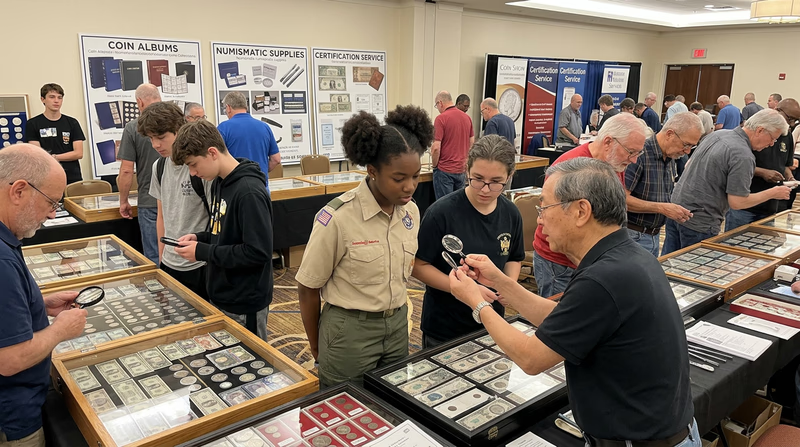
Preparing for Your Experience (Option d)
- Contact the venue in advance: Confirm dates, hours, and any admission fees.
- Bring a magnifying glass: You will want to examine coins up close.
- Bring a notebook: Write down what you see, what surprises you, and questions that come up.
- Set a budget: If you plan to buy anything, decide how much you can spend before you go.
- Ask questions: Dealers, club members, and museum staff are almost always eager to share their knowledge with young collectors.