Extended Learning
A. Introduction
You have completed the requirements for the Communication merit badge — congratulations! You have tracked your communication habits, given a speech, conducted an interview, attended a public meeting, taught a skill, published something, led a ceremony, and explored careers. Those are real-world skills that most adults are still working to improve. But the journey does not end here — there is so much more to explore.
B. Deep Dive: The Power of Storytelling
Storytelling is the oldest form of communication, and it remains one of the most powerful. Long before writing was invented, humans passed down knowledge, culture, and values through stories told around the fire. Today, the best communicators — from business leaders to filmmakers to coaches — are great storytellers.
What makes a story memorable? It is not just what happened, but how you tell it. Great stories follow a structure called the narrative arc:
- Setup — Introduce the characters, setting, and situation. Give the audience a reason to care.
- Conflict — Present a problem, challenge, or question. This is what creates tension and keeps people listening.
- Rising action — Show the struggle. What did the character try? What obstacles stood in the way?
- Climax — The turning point. The moment of greatest tension where everything changes.
- Resolution — How things turned out. What was learned? What changed?
You can use this structure everywhere: in speeches, in interviews, in letters to the editor, and even in casual conversations. When someone asks “How was your campout?” instead of saying “It was fun,” try telling the story of the moment your tent collapsed in the rain and how your patrol worked together to fix it. That is the difference between reporting and storytelling.
Practice storytelling by sharing one story per week with a friend or family member. Pay attention to their reaction. Did they lean in? Did they laugh or gasp at the right moments? Their response will tell you whether your storytelling is improving.
C. Deep Dive: Digital Literacy and Media Awareness
In an age of constant information, one of the most important communication skills is the ability to evaluate what you read, see, and hear. Not everything on the internet is true, and not every source has your best interests in mind. Being digitally literate means you can tell the difference between reliable information and misinformation — and that you communicate responsibly online.
Here are key habits of digitally literate communicators:
- Check the source — Who created this content? Is the author an expert, a journalist, or an anonymous poster? Look for credentials and track records.
- Verify with multiple sources — If a claim seems surprising, search for it on two or three other reputable sites. If only one source is reporting it, be cautious.
- Look for bias — Every source has a perspective. Ask yourself: What is this author trying to accomplish? Are they informing, persuading, or entertaining?
- Check the date — Old articles can be shared as if they are new. Make sure the information is current and relevant.
- Be skeptical of emotional content — Stories designed to make you angry, scared, or outraged are often exaggerated or misleading. Strong emotions can cloud your judgment.
- Think before you share — Before reposting or forwarding something, ask: Is this true? Is it helpful? Could it hurt someone?
These skills are directly connected to what you practiced in Requirement 5 — objective reporting. The same discipline that helped you write a fair, balanced meeting report will help you navigate the complex world of digital information.
D. Deep Dive: Conflict Resolution Through Communication
Some of the most important communication happens during disagreements. Knowing how to resolve conflict without escalating it is a leadership skill that will serve you in every area of your life — from patrol meetings to family dinners to future workplaces.
Effective conflict resolution follows a process:
- Stay calm — Take a breath before responding. Reacting in anger almost always makes things worse.
- Listen first — Before stating your position, hear the other person out completely. Use active listening — the same skills from Requirement 1.
- Use “I” statements — Instead of “You always interrupt me,” try “I feel frustrated when I do not get to finish my thought.” This describes your experience without blaming the other person.
- Identify the real issue — Sometimes arguments about small things are really about bigger things. Ask yourself: What is the underlying concern here?
- Look for common ground — Even in strong disagreements, there is usually something both sides agree on. Start there and build outward.
- Propose solutions — Move from the problem to the fix. “What if we tried…” is a powerful phrase.
- Follow up — After reaching an agreement, check in later to make sure the solution is working.
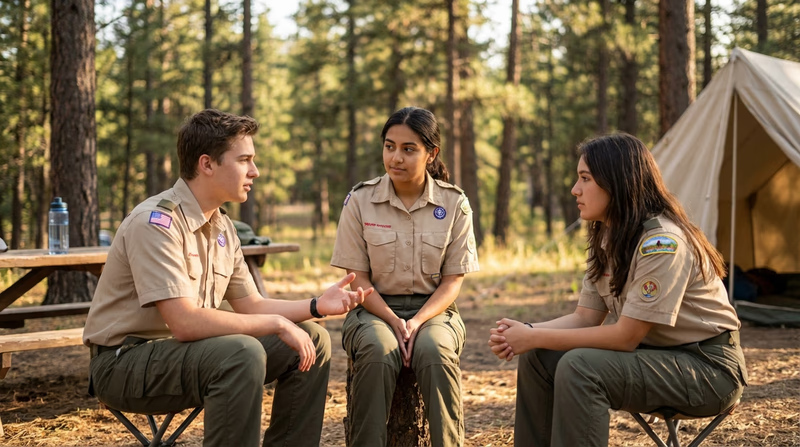
These skills are especially valuable in Scouting, where you work in teams and need to make group decisions. A patrol leader who can resolve conflicts fairly earns trust and respect from the entire patrol.
E. Real-World Experiences
Communication skills come alive when you use them in the real world. Here are some experiences that will sharpen the skills you have built:
Toastmasters Youth Leadership Program
School Newspaper or Yearbook
Local Government Youth Board
Community Theater or Debate Team
Volunteer at a Local Radio or TV Station
F. Organizations
These organizations can help you continue developing your communication skills long after you earn this badge:
The world’s largest organization dedicated to helping people become better speakers and leaders. Many clubs welcome youth participants.
The honor society for high school speech and debate. Offers competitions, resources, and a supportive community for young speakers.
Supports and defends the First Amendment rights of student journalists. Offers resources for students interested in journalism and media.
Advocates for media literacy education in schools. Provides resources to help young people become critical thinkers about the media they consume.
The largest professional organization for communication scholars and practitioners. Offers student resources and career information.