Req 3 — Writing & Delivering a Speech
Public speaking is one of the most valuable skills you can develop — and one of the most feared. Surveys consistently show that many people rank public speaking as their number-one fear, even above heights or spiders. But here is the truth: public speaking is a skill, not a talent. Anyone can learn to do it well, and this requirement will show you how.
Choosing Your Topic
The best speeches come from topics you genuinely care about. When you are passionate about your subject, your energy comes through naturally and keeps your audience engaged.
Think about:
- Something you know a lot about (a hobby, a skill, a place you have visited)
- Something you feel strongly about (a cause, a belief, a change you want to see)
- Something your audience would find useful or interesting (a practical tip, a surprising fact, an inspiring story)
Structuring Your Speech
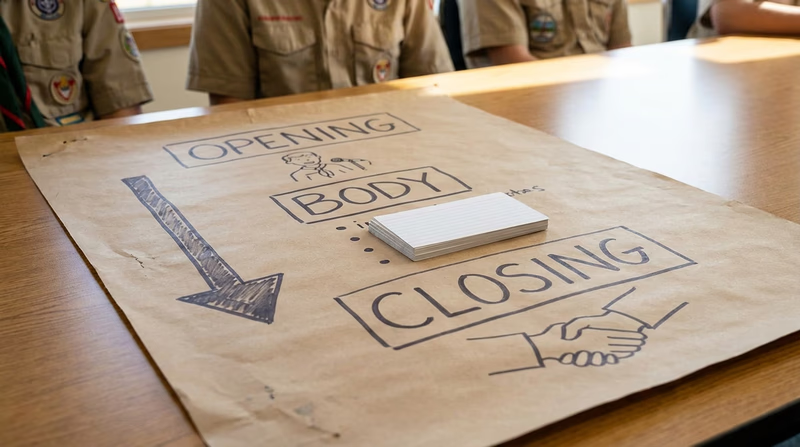
Every great speech has three parts:
1. The Opening (30–60 seconds)
Your opening grabs the audience’s attention and tells them what you are going to talk about. You can start with:
- A surprising fact or statistic
- A short personal story
- A thought-provoking question
- A bold statement
Avoid starting with “Hi, my name is…” or “Today I’m going to talk about…” — these are forgettable. Jump right into something interesting.
2. The Body (3–4 minutes)
This is the heart of your speech. Organize your main points in a logical order. Two to three main points is ideal for a five-minute speech. For each point:
- State the point clearly
- Support it with evidence, an example, or a story
- Connect it back to your main idea
3. The Closing (30–60 seconds)
Your closing is what the audience will remember most. Summarize your key message and end with impact. You can:
- Circle back to your opening story or question
- Issue a call to action
- Leave the audience with a memorable quote or image
Writing Tips
Speech Writing Checklist
Review these before finalizing your speech
- One clear main idea: Can you state your speech’s purpose in one sentence?
- Strong opening: Does your first line grab attention?
- Logical flow: Do your points build on each other?
- Transitions: Do you connect each section smoothly?
- Vivid language: Are you using concrete examples and descriptive words?
- Strong closing: Does your ending leave an impression?
- Timed it: Is your speech between 4.5 and 5.5 minutes when you read it aloud?
Delivering Your Speech
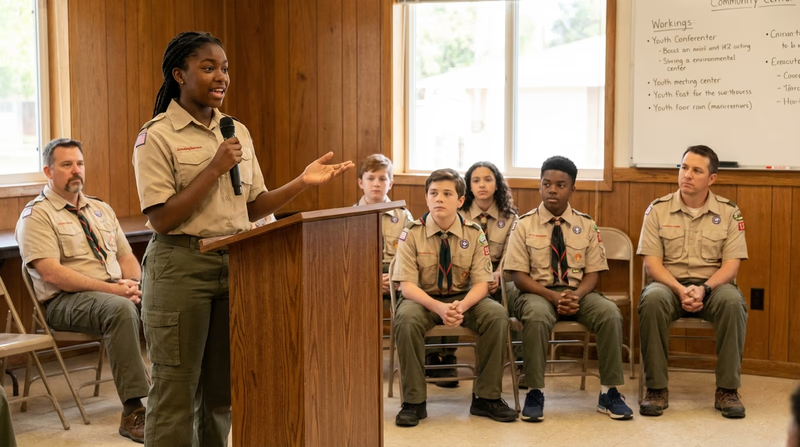
Writing the speech is only half the work. How you deliver it matters just as much — sometimes more.
Practice, Practice, Practice
Rehearse your speech out loud at least five times. Practice in front of a mirror, record yourself on your phone, or deliver it to a family member. Each time, you will get smoother and more confident.
Body Language
- Stand tall with your feet shoulder-width apart.
- Make eye contact by looking at different people around the room — not at the ceiling, the floor, or your notes.
- Use gestures naturally. Moving your hands helps emphasize points, but avoid fidgeting or pacing.
- Smile when appropriate. It relaxes you and makes the audience feel comfortable.
Voice Control
- Speak slowly — most new speakers rush. Aim to speak about 20% slower than feels natural.
- Vary your tone — a monotone voice puts people to sleep. Raise your voice for emphasis and lower it for serious points.
- Pause — Short silences after important points give your audience time to absorb what you said. Pauses are powerful.
- Project — Speak loud enough for the person in the back row to hear you clearly.
Where to Give Your Speech
The requirement says “a meeting of a group.” Good options include:
- Your troop or patrol meeting
- A school club or class
- A religious group meeting
- A family gathering