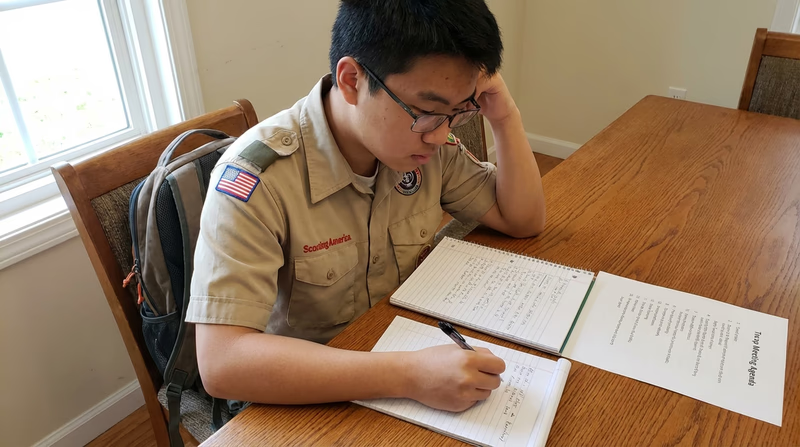
Req 5 — Public Meeting Report
This requirement takes your communication skills out of the meeting room and into the real world. You will attend an actual public meeting, listen to real people debating real issues, and write a fair, balanced report. This is the kind of communication that keeps communities and democracies running.
Finding a Public Meeting
You need your counselor’s approval before attending, so start by identifying a few options and discussing them together. Good choices include:
- City or town council meetings — These are usually held monthly and cover local issues like zoning, budgets, and public safety.
- School board meetings — Topics might include school policies, budgets, new programs, or facility changes.
- County commission meetings — Similar to city council but covering a larger area.
- Public debates — Candidates running for office or community groups debating a local issue.
- Homeowners association meetings — Often feature spirited discussion about neighborhood rules and improvements.
Preparing for the Meeting
Before you walk in the door, take a few minutes to prepare:
- Read the agenda — Know what topics will be discussed.
- Research the issue — A basic understanding of the topic will help you follow the discussion.
- Bring a notebook and pen — You will be taking detailed notes.
- Arrive early — Give yourself time to find a seat and settle in before the meeting starts.
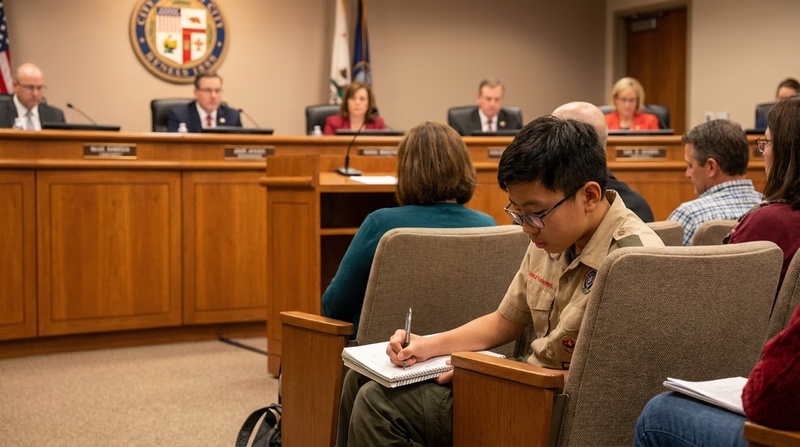
Active Listening at the Meeting
This is where your listening skills from Requirement 1 pay off. You will hear multiple speakers with different — sometimes opposing — viewpoints. Your job is to listen carefully to all of them.
What to Listen For
For each speaker or point of view, note:
- Who is speaking — Their name, title, or role (council member, resident, business owner)
- Their position — Are they for or against the issue? What do they want to happen?
- Their reasoning — What facts, experiences, or arguments do they use to support their position?
- Their tone — Are they calm and logical, passionate and emotional, or somewhere in between?
Note-Taking Template
Use these columns for each speaker
- Speaker: Name and role of the person speaking.
- Position: What side of the issue they support.
- Key arguments: The main reasons they give for their position.
- Evidence used: Any facts, statistics, or personal experiences they cite.
- Tone and delivery: How they communicated their message.
Writing Your Report
Your report must be objective — that means you present all viewpoints fairly without showing which side you personally agree with. Think of yourself as a journalist reporting the facts.
Report Structure
- Introduction — Identify the meeting (what, when, where) and the main issue being discussed.
- Background — Briefly explain the issue and why it matters to the community.
- Points of View — Present each viewpoint you heard, including the key arguments and evidence used. Give roughly equal space to each side.
- Conclusion — Summarize the outcome of the discussion. Was a decision made? Was the issue tabled for future discussion? What seemed to be the majority sentiment?
Staying Objective
Objectivity is harder than it sounds. Here are some pitfalls to avoid:
- Do not editorialize — Phrases like “the best argument was…” or “they were wrong because…” show bias. Stick to “Speaker A argued that…” and “Speaker B countered that…”
- Do not cherry-pick — Present all significant viewpoints, even ones you disagree with.
- Use neutral language — Instead of “claimed,” try “stated” or “argued.” Instead of “admitted,” try “acknowledged.”