Req 6 — Teach a Skill
Teaching is one of the highest forms of communication. When you teach someone a skill, you have to understand the subject deeply, organize your thoughts clearly, and adjust your approach based on how your learner responds. If you can teach something well, you truly understand it.
Choosing What to Teach
Pick something you know well and feel confident explaining. The best subjects are specific and hands-on. Here are some ideas:
- Scouting skills — Tying knots, using a compass, building a fire, first aid basics
- Hobbies — Drawing, cooking a recipe, playing a card game, solving a Rubik’s Cube
- Academic skills — A math concept, a science experiment, a study technique
- Practical skills — Changing a tire, sewing a button, organizing a backpack, basic coding
Developing Your Teaching Plan
Every good lesson follows a structure. Before you start teaching, write out a plan that covers these elements:
1. Learning Objective
What will your learner be able to do after your lesson? Write this as a clear, measurable statement:
- “After this lesson, you will be able to tie a bowline knot without help.”
- “After this lesson, you will be able to identify three edible wild plants.”
2. Materials Needed
List everything you will need — rope, paper, a whiteboard, ingredients, tools, or any other supplies.
3. Step-by-Step Instruction
Break the skill down into small, logical steps. Number them. For each step, note:
- What you will say (the explanation)
- What you will show (the demonstration)
- What the learner will do (hands-on practice)
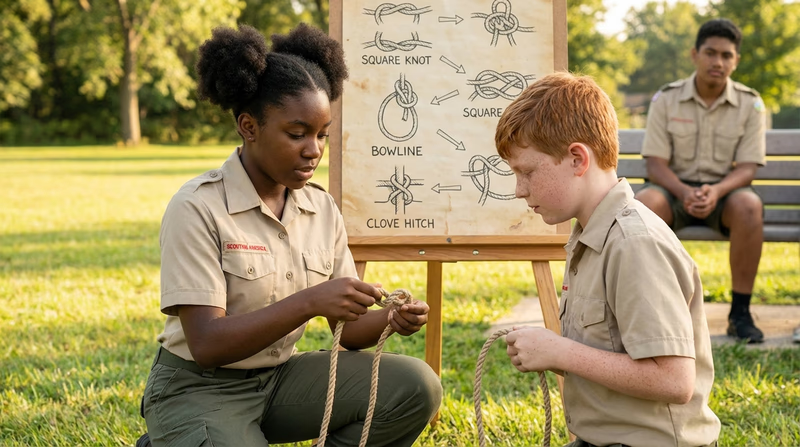
4. Teaching Aids
The requirement specifically asks you to prepare teaching aids. These are tools that make your lesson clearer and more engaging:
- Visual aids — Posters, diagrams, printed instructions, or slides
- Demonstration materials — The actual objects or tools used in the skill
- Handouts — A step-by-step reference card the learner can keep
- Videos — A short clip that shows the skill in action (use this as a supplement, not a replacement for your teaching)
5. Assessment
How will you know if your learner actually learned the skill? Plan a way to check:
- Ask them to perform the skill independently
- Ask them to explain the steps back to you
- Give them a slightly different scenario and see if they can apply what they learned
The EDGE Method
Scouting uses a proven teaching method called EDGE. It stands for:
- E — Explain — Tell the learner what you are going to teach and why it matters.
- D — Demonstrate — Show them how to do it while explaining each step.
- G — Guide — Let them try it while you watch and offer corrections.
- E — Enable — Step back and let them do it on their own. Only help if they get stuck.
EDGE Method Checklist
Follow these four steps during your lesson
- Explain: Describe the skill and why it is useful. Set the learning objective.
- Demonstrate: Perform the skill slowly while narrating each step.
- Guide: Have the learner try it while you coach and correct.
- Enable: Let the learner perform the skill independently. Observe and give feedback.
Tips for Being a Great Teacher
- Be patient — Everyone learns at a different pace. If your learner is struggling, slow down and try explaining it a different way.
- Check for understanding — Do not just ask “Do you understand?” Instead, ask “Can you show me what you would do next?” Actions reveal understanding better than words.
- Encourage — Celebrate small wins. A simple “Great job, you got it!” goes a long way.
- Adapt — If your original plan is not working, change your approach. Maybe your learner is a visual person and needs a diagram instead of a verbal explanation.
After the Lesson
Meet with your counselor to discuss how it went. Together, determine whether your learner achieved the learning objective. Reflect on:
- What worked well in your lesson?
- What would you do differently next time?
- How did your teaching aids help (or not help)?
- How did you adapt when something did not go as planned?