 Getting Started
Introduction & Overview
A kayak that weighs less than a mountain bike. A wind turbine blade longer than a football field. A race car body that can survive a 200-mph crash and protect the driver inside. None of these would exist without composite materials — engineered combinations of two or more substances that, working together, outperform anything either material could do alone.
Composite materials are everywhere, from the fishing rod in your hand to the helmet on your head. In this badge, you will learn how these materials are designed, why they behave the way they do, and how to build with them yourself.
Then and Now
Then
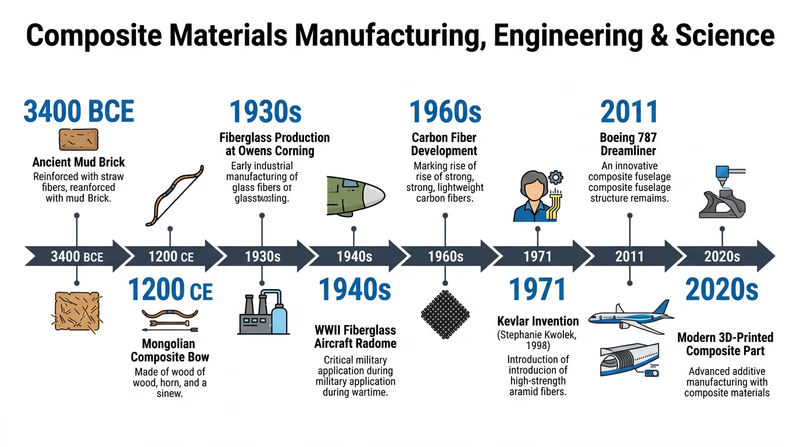
People have been making composites for thousands of years — they just did not call them that. Around 3400 BCE, ancient Mesopotamians pressed straw into mud bricks to keep them from cracking, creating one of the first engineered composites. Egyptian craftsmen laminated wood strips in alternating grain directions to build stronger furniture and chariots. Mongolian warriors built devastating composite bows from layers of horn, wood, and animal sinew — a combination that stored more energy than any single material could, giving their arrows lethal range.
The modern composites era began in the 1930s when Owens-Illinois (later Owens Corning) developed a process to spin molten glass into fine fibers. Paired with newly invented polyester resin, fiberglass was born. During World War II, fiberglass-reinforced plastics replaced scarce metals in aircraft radomes, boat hulls, and equipment housings. By the 1960s, boron and carbon fibers appeared, and aerospace engineers saw a future where aircraft could be strong and feather-light at the same time.
Now
Today, composites are a multi-billion-dollar industry reshaping transportation, energy, sports, and construction. The Boeing 787 Dreamliner is over 50% composite by weight — a first for a commercial airliner — making it lighter, more fuel-efficient, and resistant to corrosion. Formula 1 cars use carbon fiber monocoques that weigh about 35 kilograms yet can withstand crashes that would destroy a steel frame. Wind turbine blades made from fiberglass and carbon fiber now exceed 100 meters in length, capturing more energy from every gust.
New frontiers include 3D-printed composites, bio-based resins derived from plant oils, and recyclable thermoplastic composites that can be melted and reformed instead of ending up in a landfill. Researchers are even developing self-healing composites — materials embedded with microcapsules of resin that automatically repair small cracks before they spread.
Get Ready!
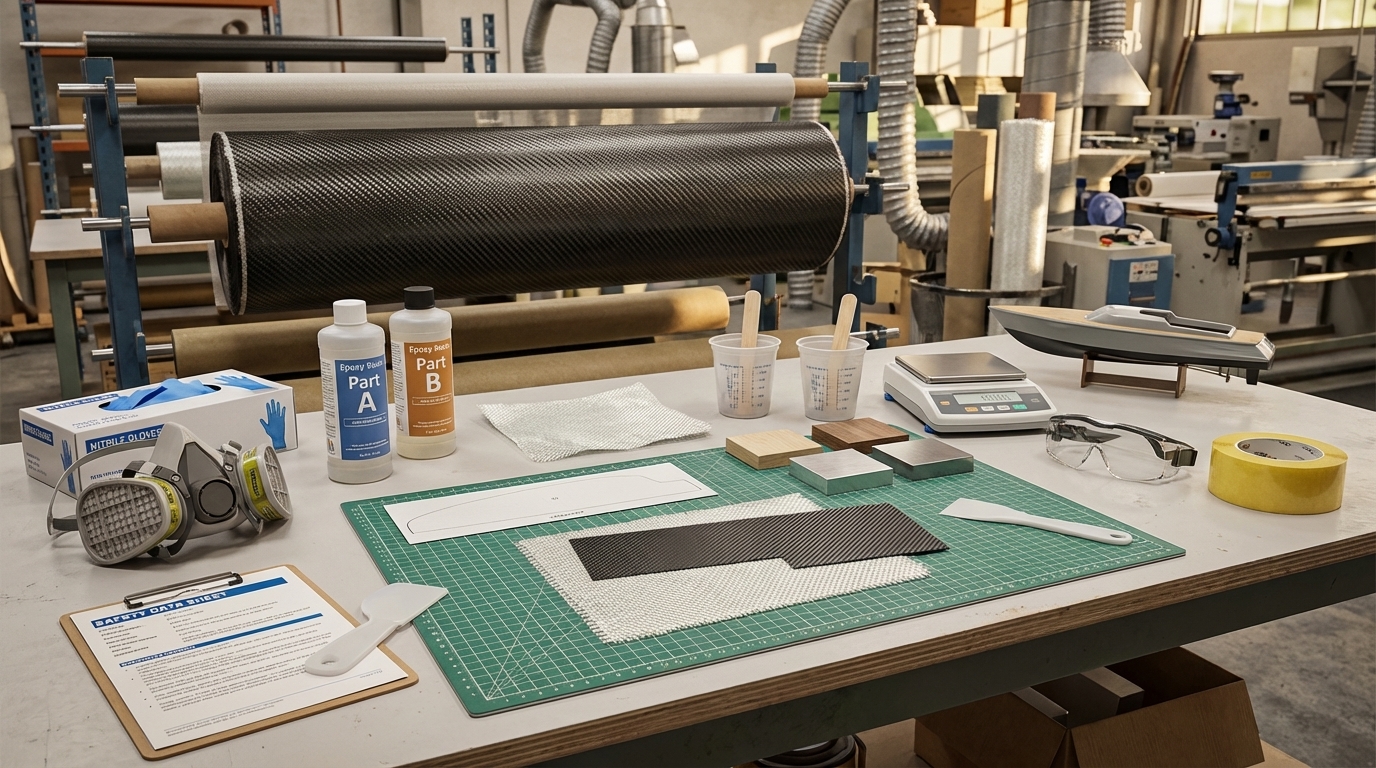
This badge puts real tools and real chemistry in your hands. You will learn how fibers and resins work together to create materials stronger than steel, lighter than aluminum, and more versatile than either. Then you will actually build something with them. Along the way, you will pick up safety skills, materials science knowledge, and hands-on fabrication experience that engineers and technicians use every day.
Kinds of Composite Materials
Fiber-Reinforced Polymers (FRP)
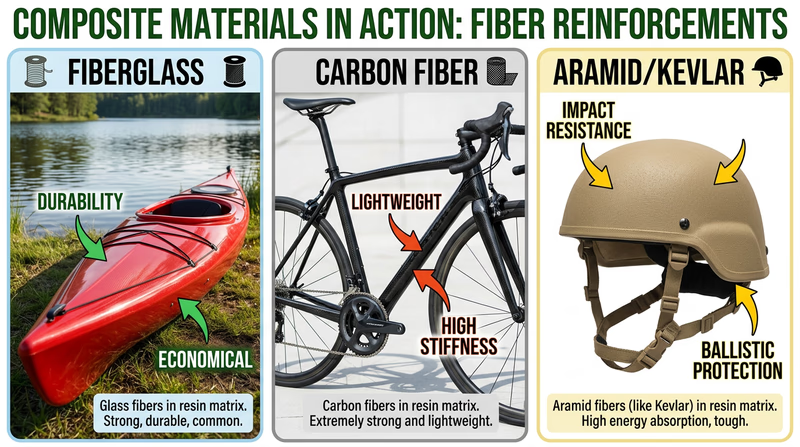
These are the composites most people picture: strong fibers embedded in a plastic resin that holds everything together. The fibers carry the load; the resin transfers stress between fibers and protects them from the environment. Fiberglass (glass fibers in polyester or epoxy resin) is the most common type — you will find it in boat hulls, shower stalls, and surfboards. Carbon fiber reinforced polymer (CFRP) uses carbon fibers instead, offering exceptional stiffness and low weight for aerospace, racing, and high-end sports equipment. Aramid fiber composites (like Kevlar) absorb impact energy, making them ideal for body armor and motorcycle helmets.
Particle-Reinforced Composites
Instead of long fibers, these composites use small particles or chunks of one material scattered through another. Concrete is the classic example: gravel and sand (the reinforcement) bonded by cement paste (the matrix). Particleboard uses wood chips bonded with adhesive. These composites are usually cheaper and easier to manufacture than fiber-reinforced types, but they are not as strong for their weight.
Laminated Composites
Laminated composites stack thin layers of different materials and bond them together. Plywood alternates wood veneer layers with their grain rotated 90 degrees, making the panel strong in every direction. Safety glass sandwiches a plastic interlayer between two sheets of glass — on impact, the glass cracks but the plastic holds the shards in place. Printed circuit boards laminate copper foil onto fiberglass-reinforced epoxy to create the backbone of every electronic device you own.
Natural Composites
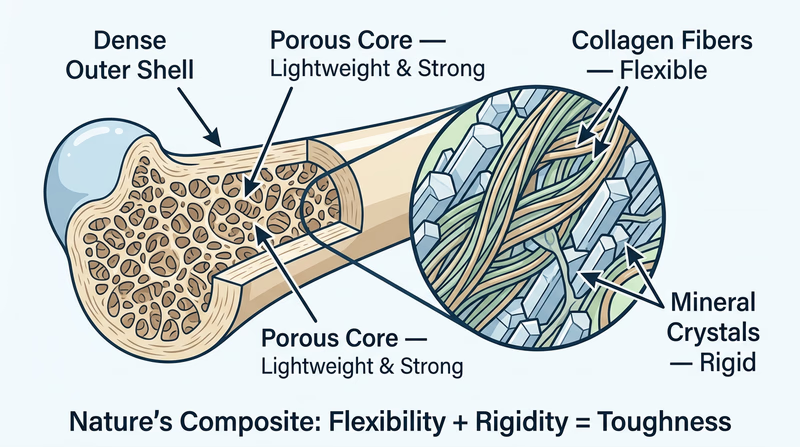
Nature invented composites long before humans did. Bone is a composite of collagen (a flexible protein) and hydroxyapatite (a hard mineral), giving it both toughness and rigidity. Wood combines cellulose fibers in a lignin matrix. Bamboo arranges its fibers in a gradient — denser near the outer wall, more porous inside — giving it an outstanding strength-to-weight ratio. Engineers study these natural designs to inspire new synthetic materials.
Metal Matrix Composites (MMC)
When polymers cannot handle the heat, metal matrix composites step in. These embed ceramic fibers or particles in a metal matrix — often aluminum or titanium. The metal carries loads and conducts heat while the ceramic reinforcement adds stiffness and wear resistance. MMCs show up in aircraft engine parts, automotive brake rotors, and spacecraft structures where temperatures would melt ordinary plastics.
Ready to get started? The first step is learning how to work with composite materials safely — because the resins and fibers you will use demand respect.