Req 1c — Safety Data Sheets
You just learned general rules for handling and disposing of composite materials in Req 1b. But every resin, hardener, solvent, and fiber product has its own specific hazards, exposure limits, and emergency procedures. A Safety Data Sheet is where all of that information lives.
What Is a Safety Data Sheet?
A Safety Data Sheet (SDS) is a standardized document that provides detailed information about a chemical product’s hazards, safe handling procedures, storage requirements, and emergency response measures. In the United States, OSHA (the Occupational Safety and Health Administration) requires manufacturers to create an SDS for every hazardous chemical they produce, and employers must keep those sheets accessible to anyone who works with the product.
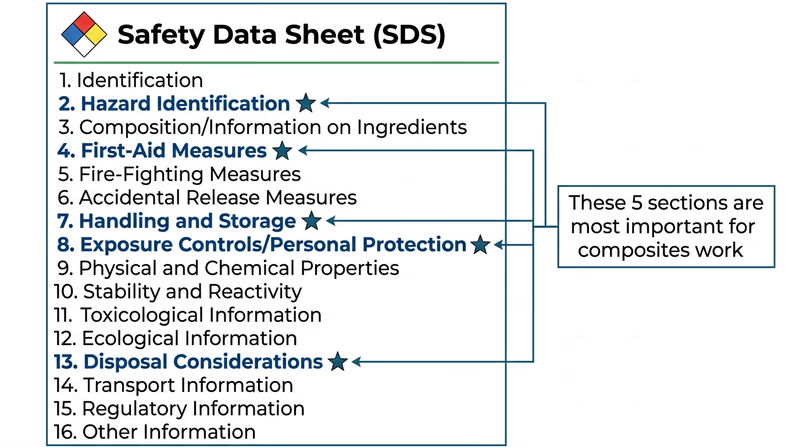
The SDS follows a globally standardized format called GHS (Globally Harmonized System of Classification and Labelling of Chemicals). Every SDS has exactly 16 sections, always in the same order. This consistency means that once you know how to read one SDS, you can read any of them — whether it is for an epoxy resin, a can of acetone, or an industrial cleaner.
The 16 Sections of an SDS
You do not need to memorize every section, but you should understand the ones most relevant to your composites work.
| Section | Title | What It Tells You |
|---|---|---|
| 1 | Identification | Product name, manufacturer, intended use, emergency phone number |
| 2 | Hazard(s) Identification | Signal word (Danger/Warning), hazard statements, pictograms |
| 3 | Composition/Ingredients | Chemical names and concentrations of hazardous ingredients |
| 4 | First-Aid Measures | What to do if swallowed, inhaled, or contacts skin/eyes |
| 5 | Fire-Fighting Measures | Extinguishing media, special hazards, firefighter precautions |
| 6 | Accidental Release Measures | Spill cleanup procedures |
| 7 | Handling and Storage | Safe handling practices, storage conditions, incompatible materials |
| 8 | Exposure Controls/PPE | Exposure limits, recommended gloves, respirator type, eye protection |
| 9 | Physical/Chemical Properties | Appearance, odor, flash point, boiling point, vapor pressure |
| 10 | Stability and Reactivity | Conditions to avoid, incompatible materials, hazardous decomposition |
| 11 | Toxicological Information | Health effects from short-term and long-term exposure |
| 12 | Ecological Information | Environmental impact, aquatic toxicity |
| 13 | Disposal Considerations | Proper disposal methods, waste treatment |
| 14 | Transport Information | Shipping classification, UN number, packing group |
| 15 | Regulatory Information | Laws and regulations that apply to the product |
| 16 | Other Information | Revision date, changes from previous version |
The bolded sections (2, 4, 7, 8, 13) are the ones you will refer to most often in composites work.
Why Are Safety Data Sheets Used?
Worker Protection
An SDS translates chemical formulas into practical safety instructions. Without it, you would have no way of knowing that a particular hardener requires butyl rubber gloves instead of nitrile, or that a resin produces toxic hydrogen chloride gas if it catches fire.
Emergency Response
If someone is exposed to a chemical and needs medical treatment, the SDS provides the exact information a doctor or poison control center needs. Section 4 (First-Aid Measures) and Section 11 (Toxicological Information) guide medical professionals on how to treat specific exposures.
Legal Requirement
Federal law (OSHA’s Hazard Communication Standard, 29 CFR 1910.1200) requires that SDSs be available to every worker who handles hazardous chemicals. Manufacturers must provide them. Employers must keep them accessible. If someone asks for an SDS, it must be provided — no exceptions.
Environmental Protection
Sections 12 and 13 tell you what happens if the chemical reaches waterways or soil, and how to dispose of it without causing environmental damage.
How to Find an SDS
Most manufacturers post their SDSs on their websites. You can also:
- Search the product name plus “SDS” in any search engine
- Ask your merit badge counselor or the supplier who provided your materials
- Check databases that collect SDSs from multiple manufacturers
For Req 3a and Req 3b, you will need to obtain and read the actual SDSs for the reinforcement materials and resins you choose. Start practicing now — find the SDS for a common product like acetone or a household epoxy and read through Sections 2, 4, 7, and 8.
With the safety foundation complete — hazards, PPE, handling procedures, and SDS knowledge — you are ready to dig into the science. What exactly are composite materials, and where did they come from?