Req 2a — What Are Composites?
Pick up a piece of plywood and try to snap it. Now try the same with a single thin sheet of wood veneer. The veneer breaks easily; the plywood resists. That is a composite in action — two or more materials combined to create something better than either one alone.
Defining Composite Materials
A composite material is an engineered material made from two or more constituent materials with significantly different physical or chemical properties. When combined, they produce a material with characteristics different from — and usually superior to — the individual components. The key distinction from alloys or solutions is that the constituent materials remain separate and distinct within the finished product. You can often see or identify the individual components if you look closely enough.
Every composite has two essential parts:
- Matrix — the material that surrounds, binds, and protects the reinforcement. In most modern composites, this is a polymer resin (like epoxy or polyester), but it can also be a metal or ceramic.
- Reinforcement — the material that provides strength and stiffness. This is usually a fiber (glass, carbon, aramid) but can also be particles, flakes, or whiskers.
Think of it like reinforced concrete: the concrete (matrix) handles compression and protects the steel rebar (reinforcement) from corrosion, while the rebar handles tension forces that would crack plain concrete. Neither material alone could do what the combination does.
A Brief History of Composites
Ancient Composites (3400 BCE – 1800s)
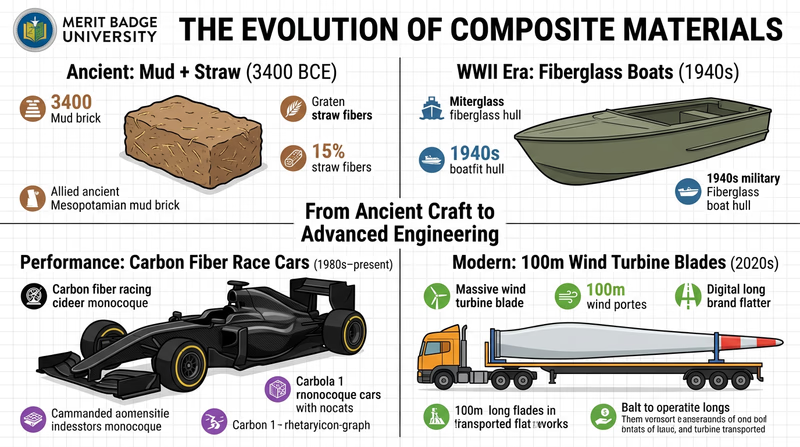
The oldest known engineered composite is mud brick reinforced with straw, used in Mesopotamia around 3400 BCE. The dried mud handles compression (squeezing forces), while the straw fibers resist tension (pulling forces) and prevent cracking. This same principle — a matrix reinforced with fibers — is still the foundation of modern composites.
Ancient Egyptians laminated wood by gluing thin strips with their grain directions alternated, creating panels stronger than solid wood. They also mixed animal glue with papyrus to create a crude form of fiber-reinforced material for furniture and burial artifacts.
Mongolian composite bows (around 1200 CE) layered animal horn (compression-resistant), wood (flexible core), and sinew (tension-resistant) into a weapon that stored more energy per unit of draw weight than any simple wooden bow. These bows gave mounted warriors a decisive advantage at range.
The Fiberglass Revolution (1930s – 1960s)
In 1932, researcher Dale Kleist accidentally discovered glass fibers when a jet of compressed air hit a stream of molten glass. By 1936, Owens Corning was producing fiberglass commercially. When combined with newly developed polyester resin in the late 1930s, fiberglass-reinforced plastic (FRP) was born.
World War II accelerated composites development. The military needed lightweight materials to replace metals that were in short supply. Fiberglass found its way into aircraft radomes (the domes that protect radar equipment), boat hulls, and structural panels. After the war, fiberglass spread into civilian life — Corvette bodies, bathtubs, and fishing rods.
Advanced Composites (1960s – 2000s)
The space race and military aviation drove the development of higher-performance fibers:
- Boron fibers (1960s) — extremely stiff, used in military aircraft like the F-14 Tomcat
- Carbon fibers (1960s–70s) — lighter and stiffer than fiberglass, developed in both the UK and Japan
- Aramid fibers (1971) — DuPont introduced Kevlar, a fiber five times stronger than steel by weight, ideal for ballistic protection
By the 1980s, carbon fiber composites were standard in fighter jets, tennis rackets, and Formula 1 cars.
Modern Era (2000s – Present)
Composites have moved from specialty applications to mainstream manufacturing:
- Boeing 787 Dreamliner (2011) — first commercial airliner with a composite fuselage (over 50% composite by weight)
- Wind energy — turbine blades over 100 meters long rely entirely on fiberglass and carbon fiber composites
- Automotive — BMW’s i3 electric car used a carbon fiber passenger cell, proving composites could work in mass production
- 3D-printed composites — continuous fiber 3D printers now lay carbon fiber directly into parts, eliminating the need for molds
- Recyclable thermoplastics — new resin systems that can be melted and reformed, addressing the long-standing problem of composite waste
Now that you understand what composites are and where they came from, let’s compare them head-to-head with the traditional materials they often replace.