Req 2b — Composites vs. Traditional Materials
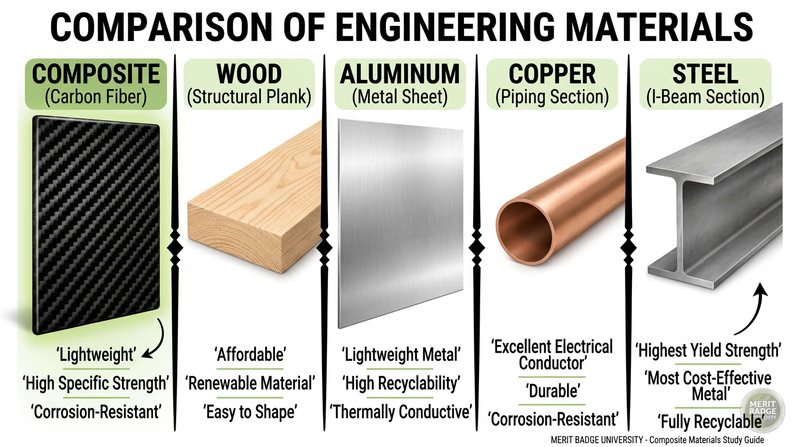
Engineers choose materials the way a chef chooses ingredients — each one has strengths, weaknesses, and a price tag. Understanding how composites compare to wood, aluminum, copper, and steel will help you see why composites replace traditional materials in some applications and why they do not in others.
Property Comparison
The table below compares key properties across all five material types. Keep in mind that “composites” is a broad category — a fiberglass boat hull and a carbon fiber aircraft wing have very different properties. The values here represent typical fiber-reinforced polymer composites.
| Property | Composites (FRP) | Wood | Aluminum | Copper | Steel |
|---|---|---|---|---|---|
| Density (weight) | Low | Low | Medium | High | High |
| Tensile strength | High (directional) | Low–Medium | Medium | Low–Medium | High |
| Stiffness | Medium–High (directional) | Low–Medium | Medium | Low | High |
| Electrical conductivity | Very low (insulator) | Very low | High | Very high | Medium |
| Thermal conductivity | Low | Low | High | Very high | Medium |
| Corrosion resistance | Excellent | Poor (rots, fungus) | Good (oxide layer) | Good (patina) | Poor (rusts) |
| Flammability | Burns, toxic fumes | Burns readily | Non-flammable | Non-flammable | Non-flammable |
| Cost | Medium–High | Low | Medium | Medium–High | Low–Medium |
| Repairability | Moderate (patch/bond) | Easy (cut, glue, nail) | Moderate (weld, rivet) | Moderate (solder, weld) | Moderate (weld) |
| Recyclability | Difficult (thermosets) | Easy | Excellent | Excellent | Excellent |
Material Deep Dives
Wood
Wood is one of humanity’s oldest building materials and is itself a natural composite (cellulose fibers in a lignin matrix). It is lightweight, easy to shape with simple tools, and renewable. A carpenter can cut, sand, join, and finish wood with hand tools — no special chemistry or curing required.
Key properties: Low density, moderate strength along the grain (but weak across it), poor weather resistance without treatment, flammable, excellent machinability, very low cost.
Shaping example: A wooden canoe is built by steam bending — thin planks of cedar or ash are heated with steam until they become flexible, then bent over a form and held in place until they cool and hold their shape. The result is a lightweight, graceful hull shaped from a material that would crack if bent cold.
Where composites win: Composites do not rot, are not eaten by insects, and do not absorb water. A fiberglass canoe will outlast a wooden one in wet conditions by decades. Where wood wins: renewable, biodegradable, requires no chemical processing, and far easier to repair.
Aluminum
Aluminum is the most abundant metal in Earth’s crust and the go-to lightweight metal for aerospace, transportation, and packaging. It naturally forms a thin oxide layer that protects it from corrosion — unlike steel, it does not rust.
Key properties: Medium density (about one-third the weight of steel), good strength, excellent corrosion resistance, high electrical and thermal conductivity, non-flammable, fully recyclable.
Shaping example: Aluminum beverage cans are made by deep drawing — a flat disc of aluminum is punched into a die cavity, stretching it into a seamless cup shape. A single sheet of aluminum becomes a thin-walled, pressure-resistant container in a fraction of a second.
Where composites win: Composites can be even lighter than aluminum with equal or greater strength, and they do not fatigue the same way (aluminum develops micro-cracks over repeated stress cycles). Where aluminum wins: fully recyclable, easier to join (riveting and welding are well-understood), and conducts electricity and heat — properties composites lack.
Copper
Copper has been used for over 10,000 years, making it one of the first metals humans worked with. Its defining feature is exceptional electrical and thermal conductivity — which is why the wiring in your walls and the heat exchanger in your refrigerator are made from it.
Key properties: High density, moderate strength, outstanding electrical conductivity (second only to silver), excellent thermal conductivity, good corrosion resistance (forms a green patina over time), non-flammable, very recyclable.
Shaping example: Copper pipes for plumbing are made by extrusion — a heated billet of copper is forced through a die with a mandrel in the center, creating a hollow tube in a continuous process. The result is seamless, corrosion-resistant pipe that carries water through buildings worldwide.
Where composites win: Composites are dramatically lighter and do not conduct electricity (which is an advantage in some applications, like non-magnetic MRI rooms or electrical insulation). Where copper wins: nothing matches copper’s electrical conductivity, making it irreplaceable for wiring, motors, and electronics.
Steel
Steel is an alloy of iron and carbon — and it has been the backbone of construction, transportation, and manufacturing for over 150 years. It is the strongest common metal, relatively cheap, and can be recycled indefinitely without losing quality.
Key properties: High density (heavy), very high tensile strength, high stiffness, moderate corrosion resistance (stainless steel versions are excellent), non-flammable, low cost, excellent recyclability.
Shaping example: Steel I-beams for building construction are made by hot rolling — a red-hot slab of steel is passed through a series of rollers that progressively squeeze it into the distinctive I-shaped cross section. This shape maximizes strength while minimizing the amount of material used.
Where composites win: Weight. A carbon fiber composite part can be 70% lighter than its steel equivalent while matching or exceeding its strength. Composites also do not rust. Where steel wins: cost (steel is far cheaper), stiffness in all directions, weldability, and recyclability. Steel structures can be repaired with standard tools and techniques that every fabricator knows.
The Composites Trade-Off
No material is perfect for every application. Here is a quick way to think about when composites make sense and when they do not:
Choose composites when:
- Weight savings justify the cost (aerospace, racing, portable equipment)
- Corrosion resistance matters (marine, chemical processing)
- Complex shapes are needed in a single piece (reducing joints and fasteners)
- Electrical insulation is required
Choose traditional materials when:
- Cost is the top priority (structural steel in buildings)
- Electrical or thermal conductivity is needed (copper wiring, aluminum heat sinks)
- Recyclability is critical
- Repairability with standard tools is essential
- The part must withstand extreme heat beyond polymer limits
You now understand what makes composites different from traditional materials. Next, you will zoom into the reinforcement side of the equation — the fibers that give composites their strength.