Req 3a — Reinforcement Materials
If the matrix is the body of a composite, the reinforcement is its skeleton. Reinforcement fibers carry the loads, resist the forces, and give composites their remarkable strength-to-weight ratio. In this requirement, you will choose three reinforcement materials, understand what each does best (and worst), and read their Safety Data Sheets — putting the SDS knowledge from Req 1c to real use.
The Big Three Reinforcement Fibers
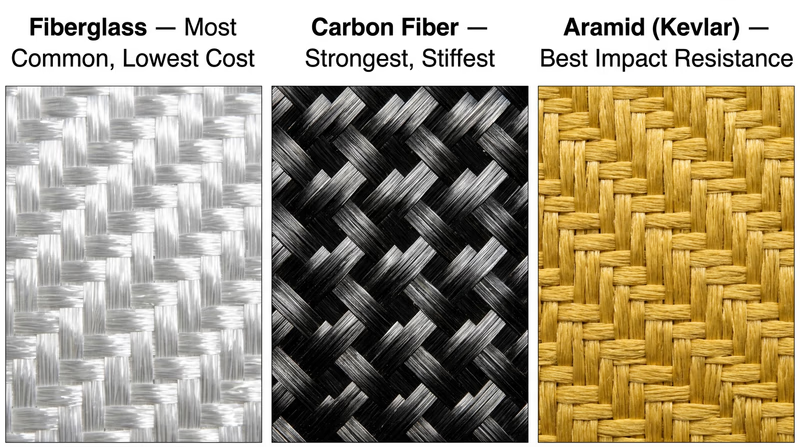
The three most common reinforcement fibers in modern composites are fiberglass, carbon fiber, and aramid (Kevlar). These are excellent choices for your discussion with your counselor, though other options exist (basalt fiber, natural fibers like flax, ultra-high-molecular-weight polyethylene).
Fiberglass (Glass Fiber)
Fiberglass is the workhorse of the composites industry — the most widely used reinforcement by volume and the most affordable.
How it is made: Molten glass is pulled through tiny holes in a heated platinum bushing, forming continuous filaments thinner than a human hair. These filaments are gathered into bundles called rovings and woven into fabrics or chopped into short strands.
Positive characteristics:
- Low cost compared to other fiber types
- Good tensile strength
- Excellent corrosion resistance (does not rust or rot)
- Electrically non-conductive (useful for electrical insulation)
- Good impact resistance — bends before breaking
- Transparent to radio waves (used in radomes and antenna housings)
Negative characteristics:
- Heavier than carbon or aramid fibers
- Lower stiffness than carbon fiber
- Itchy — loose glass fibers irritate skin and can cause respiratory issues if inhaled
- Fatigue performance is lower than carbon fiber over many stress cycles
Common uses: Boat hulls, shower stalls, automotive body panels, wind turbine blades, insulation batts, printed circuit boards, storage tanks, swimming pools.
Carbon Fiber
Carbon fiber is the high-performance option — lighter, stiffer, and stronger than fiberglass, but at a much higher price.
How it is made: A precursor material (usually polyacrylonitrile, or PAN) is heated to extremely high temperatures (2,000–3,000°C) in an inert atmosphere. This burns away everything except the carbon atoms, which align into tightly packed crystalline structures. The result is a fiber that is 90–95% pure carbon.
Positive characteristics:
- Exceptional strength-to-weight ratio (strongest common fiber per unit of weight)
- Very high stiffness — resists bending and stretching
- Low thermal expansion (does not change size much with temperature changes)
- Excellent fatigue resistance — handles millions of stress cycles without weakening
- Chemical resistance to most acids and solvents
Negative characteristics:
- Expensive — 5 to 15 times the cost of fiberglass
- Brittle — fails suddenly without warning (no gradual bending like fiberglass)
- Electrically conductive — can cause short circuits and galvanic corrosion when touching aluminum
- Dust is conductive and can damage electronics in the work area
- Difficult to detect damage visually (internal delamination is often invisible)
Common uses: Aircraft structures (Boeing 787, Airbus A350), Formula 1 cars, high-end bicycles, tennis rackets, golf clubs, drone frames, wind turbine blade spars, spacecraft components.
Aramid Fiber (Kevlar)
Aramid fibers are best known by DuPont’s brand name Kevlar. Their defining property is extraordinary impact resistance — they absorb and distribute energy from a blow rather than shattering.
How it is made: An aramid polymer solution is extruded through a spinneret (similar to making nylon), then the fibers are drawn and heat-treated to align the molecular chains. The resulting fiber has a unique combination of strength and flexibility.
Positive characteristics:
- Outstanding impact and abrasion resistance
- Excellent energy absorption — ideal for ballistic protection
- Lightweight (lower density than glass or carbon)
- Good resistance to heat and flame (does not melt; chars at high temperatures)
- Resistant to most chemicals and solvents
Negative characteristics:
- Low compressive strength — strong in tension but buckles under compression
- Degrades under prolonged UV exposure (yellows and weakens in sunlight)
- Difficult to cut and machine (fibers fuzz and pill instead of cutting cleanly)
- Absorbs moisture, which can weaken the composite over time
- Expensive (comparable to carbon fiber)
Common uses: Body armor and ballistic helmets, cut-resistant gloves, motorcycle protective gear, sailboat rigging, aircraft fuselage impact zones, tire reinforcement (belts), canoe and kayak hulls where impact resistance matters.
Quick Comparison
| Property | Fiberglass | Carbon Fiber | Aramid (Kevlar) |
|---|---|---|---|
| Tensile strength | Good | Excellent | Excellent |
| Stiffness | Moderate | Very High | Moderate |
| Impact resistance | Good | Poor (brittle) | Excellent |
| Weight | Medium | Low | Low |
| Cost | Low | High | High |
| Electrical conductivity | None | Conductive | None |
| UV resistance | Good | Good | Poor |
Reading the SDS for Reinforcement Materials
For each reinforcement material you choose, your counselor will expect you to obtain and discuss the actual Safety Data Sheet. Here is what to focus on:
Toxicity (SDS Sections 2, 3, 11)
- Fiberglass: Classified as a mechanical irritant, not a chemical toxin. Causes itching on skin contact and can irritate eyes and respiratory tract. Not classified as a carcinogen by IARC for most glass fiber types.
- Carbon fiber: Skin and respiratory irritant from dust. The fibers themselves are chemically inert but physically irritating. Main concern is dust inhalation during cutting/sanding.
- Aramid: Low toxicity. Fibers are too large to reach deep lung tissue in most handling. Dust from cutting can irritate eyes and respiratory tract.
Disposal (SDS Section 13)
- All three fiber types can usually be disposed of as non-hazardous solid waste once they are dry and uncontaminated by resins or solvents. Bag fiber scraps to prevent airborne release. Check local regulations — some jurisdictions have specific requirements for fibrous materials.
Safe Handling (SDS Sections 7, 8)
- Wear gloves, safety glasses, and a dust mask or respirator when cutting any reinforcement material. Work in a ventilated area. Avoid rubbing eyes or touching your face during handling. Wash exposed skin with soap and water after handling — do not use compressed air to blow dust off clothing (it just redistributes the fibers into the air).
SDS Discussion Prep
Make sure you can answer these questions for each of your three materials
- What is the primary health hazard listed in Section 2?
- What first-aid measures does Section 4 recommend for skin and eye contact?
- What PPE does Section 8 specify for handling?
- How should waste material be disposed of according to Section 13?
- Are there any incompatible materials listed in Section 10?
You have the reinforcement side of the equation covered. Now you need to understand the other half — the resins that bind everything together.