Req 3c — New Resin Applications
This requirement turns you from a student into an innovator. You already know what epoxy, polyester, and nylon (or whichever resins you chose) do well and where they fall short. Now your job is to match those properties to a problem that has not been solved — or to an existing product that could be made better with composites.
How to Think Like a Materials Innovator
Coming up with a genuinely useful application is not about wild science fiction ideas. It is about matching a material’s strengths to a real need. Here is a framework to guide your thinking:
Step 1: Identify the Strength
For each resin, ask: “What does this material do better than anything else?”
- Epoxy → superior adhesion, precision, durability
- Polyester → low cost, fast cure, good enough for many jobs
- Nylon → recyclable, tough, fast to manufacture
Step 2: Find the Problem
Look for situations where existing materials fail, are too heavy, too expensive, or too wasteful. Good places to look:
- Products that corrode, rot, or wear out too fast
- Products that are heavier than they need to be
- Industries with high material waste
- Applications where recyclability is becoming a regulatory requirement
Step 3: Check the Fit
Ask: “Do the resin’s weaknesses matter in this application?” If epoxy’s high cost is a deal-breaker for a disposable product, it is not the right match. If nylon’s moisture absorption does not matter because the product stays indoors, it could be perfect.
Example Applications to Spark Your Thinking
These are examples of the kind of reasoning your counselor is looking for — do not copy them directly, but use them as a model for how to connect properties to applications.
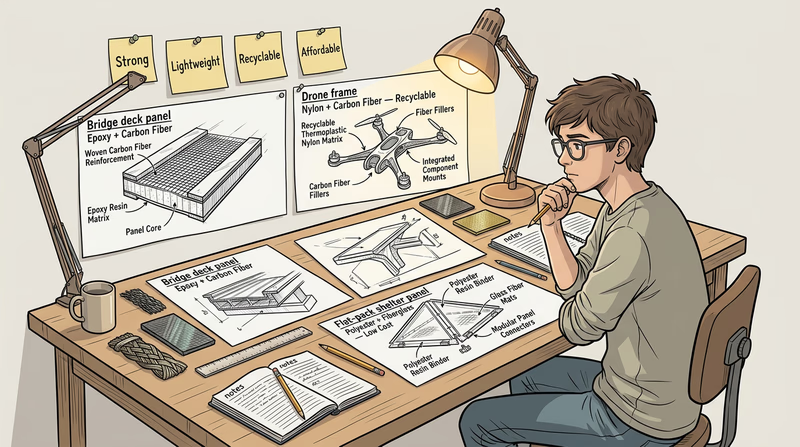
Epoxy Example: Emergency Bridge Repair Panels
The problem: Rural bridges in developing countries deteriorate from weather and overloading. Steel and concrete repairs require heavy equipment and skilled welders.
The idea: Pre-fabricated epoxy–carbon fiber panels that bolt onto damaged bridge decks. Epoxy’s excellent adhesion and structural strength mean the panels could reinforce a weakened bridge without replacing the entire deck. Lightweight panels could be carried in a truck and installed with hand tools — no welding, no crane.
Why epoxy fits: High strength, weather resistance, bonds well to concrete, handles heavy cyclic loads (traffic).
Polyester Example: Disaster Relief Shelters
The problem: After natural disasters, temporary shelters are often tarps or tents that deteriorate in weeks and cannot insulate against heat or cold.
The idea: Flat-pack fiberglass panels using polyester resin that snap together to form rigid shelters. Low resin cost makes them affordable for humanitarian organizations, and the fast cure time means panels could be mass-produced quickly after a disaster.
Why polyester fits: Lowest cost, fast manufacturing, weather-resistant, the slightly lower mechanical properties are acceptable for a one-story, temporary structure.
Nylon Example: Recyclable Drone Frames
The problem: Consumer drones break regularly (crashes, crashes, and more crashes). Broken carbon fiber–epoxy frames end up in landfills because thermoset composites cannot be recycled.
The idea: Drone frames made from nylon reinforced with continuous carbon fiber, produced by 3D printing or injection molding. When a frame breaks, the owner sends it back to the manufacturer, who grinds it up and molds new frames from the same material.
Why nylon fits: Fully recyclable (thermoplastic can be remelted), good impact resistance for crash landings, fast manufacturing via injection molding, and the slightly lower stiffness compared to epoxy is acceptable for small recreational drones.
Building Your Proposal
When you discuss your ideas with your counselor, organize your thinking like this:
- Name the resin and its key properties
- Describe the problem you are trying to solve
- Explain your proposed application — what would the product be?
- Connect the properties — why is this resin a good fit?
- Acknowledge the trade-offs — what limitations might need to be overcome?
Now that you have explored composites from the inside — fibers, resins, and creative applications — it is time to see how the real industry works.