Req 5a — Hands-On Projects
This is where everything you have learned comes together — safety gear, material properties, resin chemistry, and reinforcement behavior — all applied to building something real with your own hands. You will complete two projects, and the process of making them will teach you more than any reading ever could.
Understanding the Requirement
Two projects are required:
- Project 1 — must come from the merit badge pamphlet
- Project 2 — can come from the pamphlet OR be your own idea (approved by your counselor first)
If you do not have the pamphlet yet, talk to your counselor. The pamphlet describes several beginner-friendly projects that are specifically designed to teach fundamental composite fabrication techniques.
Common Composites Project Techniques
Regardless of which projects you choose, most beginner composites work uses one or more of these techniques:
Hand Lay-Up
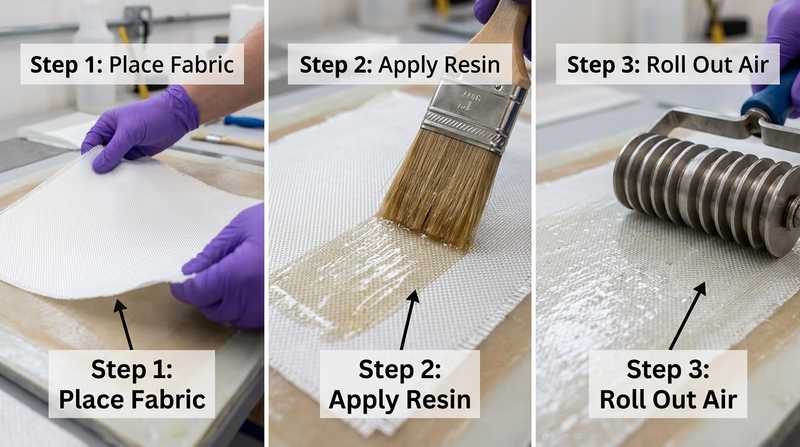
The most basic method. You cut reinforcement fabric (usually fiberglass) to shape, wet it with mixed resin using a brush or roller, and press it into or over a mold. Multiple layers build up thickness and strength. This is how most boat hulls, surfboards, and small composite parts are made in low-volume production.
What you learn: How resin wets out fiber, how fiber orientation affects strength, how air bubbles weaken the finished part.
Vacuum Bagging
After laying up wet fabric on a mold, you cover the part with a release film and breather cloth, seal it inside a plastic bag, and connect a vacuum pump. The atmospheric pressure (about 14.7 psi) presses the layers together, squeezing out excess resin and trapped air. The result is a lighter, stronger, more consistent part than hand lay-up alone.
What you learn: How consolidation pressure improves quality, how to work systematically under time pressure (the resin is curing while you bag).
Casting
Resin is poured into a mold without any reinforcement fiber. This produces solid resin objects — useful for decorative items, embedments (like coins or objects suspended in clear resin), or testing resin properties. While technically not a fiber composite, casting teaches you a lot about resin mixing, pot life, and curing behavior.
What you learn: Mixing ratios, exothermic reactions, bubbles and how to remove them, demolding techniques.
Planning Your Projects
Choosing Wisely
If you are new to composites, start with a simpler project from the pamphlet for Project 1, then try something more ambitious for Project 2. Consider these factors:
- Available materials: What fibers and resins can your counselor provide or help you source?
- Available workspace: Some projects need more room, ventilation, and mess tolerance than others (see Req 5b)
- Time: Resin curing takes hours or overnight. Plan for at least two work sessions per project — one for lay-up and one for trimming/finishing.
- Skill level: Be realistic. A carbon fiber skateboard deck is impressive but requires significant technique. A fiberglass phone case or small tray is achievable on your first try.
For Your Custom Project (Project 2)
If you design your own second project, get counselor approval before buying materials. Present your idea with:
- What you want to build and why
- What materials you need (fiber type, resin type, mold material)
- How you plan to fabricate it (hand lay-up, vacuum bag, cast)
- What safety precautions you will take
- How long you expect it to take
Project Ideas (Beyond the Pamphlet)
If you want to propose your own Project 2, here are ideas to get your thinking started. Always confirm with your counselor before committing.
- Fiberglass over foam — Shape a block of rigid foam into a shape (a fin, a small boat hull, a phone stand), then lay fiberglass over it to create a strong, lightweight shell
- Composite picture frame — Lay up fiberglass or carbon fiber fabric on a flat mold, cure, cut to shape, and finish the edges
- Tensile test samples — Make several small composite strips using different fiber orientations, then test their strength with your counselor (great for demonstrating how fiber direction affects properties)
- Repair project — If you have a cracked fiberglass item (canoe, kayak, bumper), repair it using proper composite repair techniques
You know what you want to build. Now you need to figure out where to build it.