Req 6 — Careers & Hobbies
This final requirement asks you to look beyond the badge and imagine where composites knowledge could take you — either as a career or as a lifelong hobby. Choose one of the two options below.
- Option A: Research a composites-related career
- Option B: Explore a composites-related hobby or interest
Option A: Careers in Composites
The composites industry needs people at every level — from technicians who build parts with their hands to engineers who design the next generation of materials. Here are career paths worth researching.
Materials Engineer / Materials Scientist
What they do: Design, test, and develop new composite materials and manufacturing processes. They determine which combination of fibers, resins, and processing methods will meet a product’s performance requirements.
Education: Bachelor’s degree in materials science, mechanical engineering, or chemical engineering. Graduate degrees open research and leadership roles.
Salary range: $75,000–$130,000+ depending on industry and experience.
Where they work: Aerospace (Boeing, Lockheed Martin, SpaceX), automotive (Ford, BMW, Tesla), sporting goods, defense, wind energy.
Composites Technician / Fabricator
What they do: Build composite parts by hand lay-up, vacuum bagging, resin infusion, or autoclave curing. They read engineering drawings, cut and place fiber reinforcement, mix and apply resins, and inspect finished parts for defects.
Education: High school diploma plus on-the-job training or a composites technician certificate program (community colleges and trade schools offer these).
Salary range: $40,000–$70,000, with experienced technicians in aerospace earning more.
Where they work: Aerospace manufacturing, boat building, wind turbine blade factories, automotive repair, custom fabrication shops.
Composite Repair Technician (Aviation)
What they do: Inspect, assess, and repair damage to composite aircraft structures. This is highly specialized work — a single repair on a commercial aircraft wing can involve removing damaged material, scarfing (beveling) the repair area, laying up new composite plies, vacuum bagging, and curing under precise temperature control.
Education: FAA Airframe & Powerplant (A&P) certificate, plus specialized composite repair training. Some programs are offered through community colleges and aviation maintenance schools.
Salary range: $55,000–$90,000+, with airline and MRO (Maintenance, Repair, and Overhaul) facilities at the higher end.
Other Composites Careers
- Quality inspector — uses ultrasonic, X-ray, and visual methods to verify part integrity
- Process engineer — optimizes manufacturing methods for speed, cost, and quality
- Sales engineer — sells composite products and materials to manufacturers (requires both technical knowledge and people skills)
- Research scientist — develops next-generation materials at universities or national labs
Researching Your Chosen Career
When discussing your findings with your counselor, cover these points:
- Training and education: What degree, certificate, or training is required? How long does it take?
- Costs: What does the education cost? Are there scholarships, apprenticeships, or employer-sponsored training?
- Job prospects: Is the field growing? The Bureau of Labor Statistics (BLS) Occupational Outlook Handbook has data on job growth projections.
- Salary: What is the typical starting salary? What can experienced professionals earn?
- Day-to-day duties: What does a typical workday look like?
- Career advancement: Where can this career lead over 10–20 years?
Option B: Composites as a Hobby
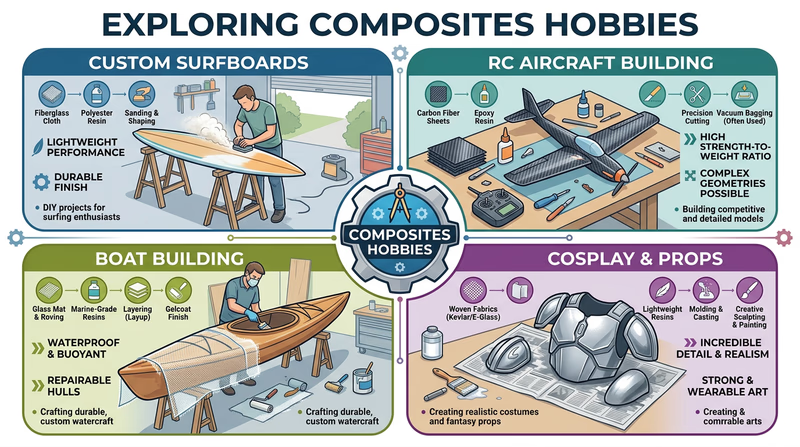
Composites skills open up a world of making, building, and customizing. Many people who learn composites through their profession — or through Scouting — turn it into a lifelong hobby.
Custom Sporting Equipment
Build your own surfboard, skateboard, longboard, or snowboard using composite lay-up techniques. The maker community has extensive tutorials for shaping a foam blank and glassing it with fiberglass or carbon fiber. Custom boards let you dial in the flex, weight, and shape that factory boards cannot match.
Model Building and RC Vehicles
Radio-controlled aircraft, boats, and cars use composite fuselages, wings, and hulls extensively. Building and repairing RC composite parts teaches you precision lay-up in miniature — skills that transfer directly to full-scale work.
Boat Building and Repair
From small sailboats to kayaks, composite construction is the standard. Learning to build or repair a fiberglass boat is a practical skill that can save thousands of dollars and give you a craft you built with your own hands.
Cosplay and Prop Making
Carbon fiber and fiberglass are popular in the cosplay community for building armor, helmets, and props that are lightweight and durable. Composite techniques create smooth, professional-looking pieces that hold up to convention wear.
Exploring Your Chosen Hobby
When discussing your findings with your counselor, cover:
- What training is needed? Can you learn from online tutorials, or do you need a class?
- What expenses are involved? Materials, tools, workspace — what does it cost to get started?
- What organizations support it? Local clubs, online communities, maker spaces?
- Short-term goals: What is the first project you would tackle?
- Long-term goals: Where could this hobby take you in a year? Five years?
You have completed all six requirements. Head to Extended Learning for deeper dives into advanced topics and resources that go beyond the badge.