Extended Learning
A. Introduction
Congratulations — you have completed the Cooking merit badge, one of the Eagle-required badges and one of the most practical skills you will ever learn. But your culinary journey is just getting started. The techniques, safety knowledge, and planning skills you developed will serve you in kitchens, campsites, and trail shelters for the rest of your life. Let’s explore what comes next.
B. Deep Dive: Mastering Knife Skills
The knife is the most important tool in any kitchen, and mastering it transforms your cooking. Beyond the basic claw grip you learned for safety, there are specific cuts that professional chefs use every day — and learning them will make your prep work faster, safer, and more consistent.
The dice is the most common cut: a uniform cube. Small dice (¼ inch), medium dice (½ inch), and large dice (¾ inch) each have different uses. Small dice is ideal for salsas and sauces where you want ingredients to blend together. Large dice works for stews and roasted vegetables where you want each piece to hold its shape. The key to a good dice is consistency — pieces that are the same size cook at the same rate, which means nothing is raw while something else is overcooked.
The julienne (also called a matchstick cut) creates thin, uniform strips. It is the foundation of stir-fries, slaws, and salads. The technique starts with cutting a vegetable into planks, then stacking the planks and slicing them into strips.
The chiffonade is a technique for leafy herbs and greens: stack the leaves, roll them into a tight cylinder, and slice across the roll to create thin ribbons. This is how restaurants get those beautiful basil ribbons on top of pasta.
Beyond the cuts themselves, knife maintenance matters. A sharp knife is a safe knife — it cuts where you direct it instead of slipping off the food. Learn to use a honing steel before each cooking session (it straightens the blade edge) and have your knives professionally sharpened once or twice a year.
C. Deep Dive: The Science of Heat
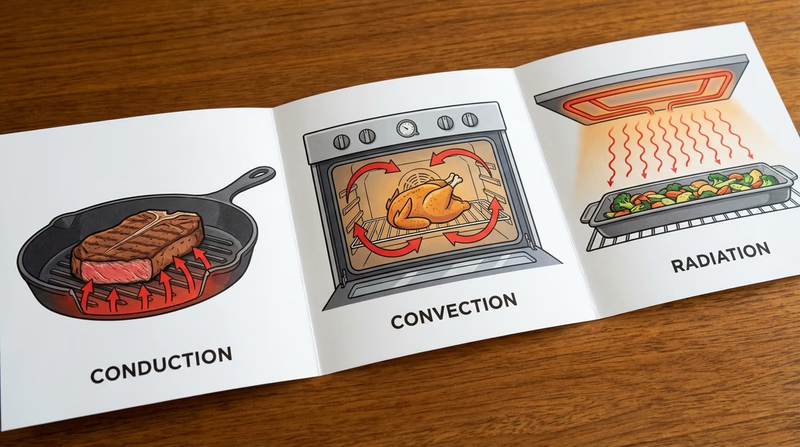
Understanding how heat works makes you a smarter cook. There are three ways heat transfers to food, and every cooking method uses one or more of them:
Conduction is heat transfer through direct contact. When you put a steak on a hot skillet, the metal surface conducts heat directly into the meat. This is why preheating pans matters — a cold pan will not sear properly. Cast iron excels at conduction because it holds and distributes heat evenly, which is why it has been the go-to material for camp cooking for centuries.
Convection is heat transfer through moving air or liquid. In an oven, hot air circulates around the food, cooking it from all sides. In a pot of boiling water, the hot water itself carries heat to the food. Convection ovens use a fan to force air circulation, which cooks food faster and more evenly than standard ovens. Air fryers are essentially small, powerful convection ovens — the rapid air circulation is what creates the crispy exterior.
Radiation is heat transfer through electromagnetic waves — no physical contact required. Broiling and grilling over infrared burners use radiant heat. The heat travels through the air and directly warms the food’s surface. This is why broiled food gets a crispy, browned top while the inside stays relatively unchanged — the radiation affects the surface first.
The Maillard reaction is what happens when proteins and sugars in food are exposed to high heat (above 280°F). It creates the brown crust on a seared steak, the golden surface of toasted bread, and the roasted flavor of coffee. Understanding this reaction explains why boiled chicken (which maxes out at 212°F) tastes completely different from grilled chicken (which experiences temperatures well above 400°F on the surface). The Maillard reaction is not the same as caramelization, which is the browning of pure sugar — though both produce delicious results.
D. Deep Dive: Building Flavor Like a Chef
Professional chefs think about flavor in layers, not as a single addition. Understanding how to build flavor transforms simple ingredients into remarkable meals.
Start with aromatics. Nearly every savory dish in every cuisine begins with aromatic vegetables cooked in fat. French cuisine uses mirepoix (onion, carrot, celery). Cajun cooking uses the “holy trinity” (onion, celery, bell pepper). Asian cuisines often start with garlic, ginger, and scallions. These aromatics create a flavor base that everything else builds upon.
Season in stages. Adding salt only at the end is a common beginner mistake. Season at multiple points: when you sauté aromatics, when you add liquids, and as a final adjustment before serving. Each addition at a different stage builds depth that a single dose at the end cannot achieve.
Use acid to brighten. A squeeze of lemon juice, a splash of vinegar, or a spoonful of salsa can transform a dish that tastes flat into something vibrant. Acid does not make food taste sour (unless you use too much) — it lifts and brightens the other flavors that are already there. If a soup or sauce tastes good but feels like it is missing something, acid is usually the answer.
Finish with fresh elements. A handful of fresh herbs, a drizzle of high-quality olive oil, a sprinkle of flaky sea salt, or a grating of fresh cheese added just before serving adds aroma and texture that cooking would destroy. These finishing touches are the difference between a good meal and a memorable one.
Deglaze the pan. After searing meat in a skillet, you will see brown bits stuck to the bottom — that is pure concentrated flavor (called “fond”). Pour in a splash of broth, wine, or even water, and scrape those bits up with a wooden spoon. The liquid dissolves all that flavor and becomes an instant pan sauce. This one technique can elevate any skillet-cooked meal from ordinary to extraordinary.
E. Real-World Cooking Experiences
Philmont Scout Ranch — Trail Cooking
Local Farmers Market
Community Cooking Class
Scout Camporee Cooking Competition
Volunteer at a Food Bank or Soup Kitchen
F. Organizations
The largest professional chefs’ organization in North America, offering certification, education, and competitions for culinary professionals at all levels.
Celebrates and supports the people behind America’s food culture, from chefs to farmers to food policy advocates.
The leading nonprofit working on behalf of the 85 million Americans with food allergies and intolerances, providing education and advocacy.
A community of outdoor cooking enthusiasts dedicated to the art and sport of Dutch oven cooking, with competitions and events nationwide.
The nation’s largest domestic hunger-relief organization, operating a network of food banks across the country where your cooking skills can make a difference.