Req 4b — Recipes & Shopping
With your menu planned, it is time to find the recipes, figure out exactly what you need to buy, and calculate what it will cost. This is where cooking meets real-world planning — budgeting, math, and organization all come into play.
Finding Good Recipes
Not all recipes are created equal. As a beginning cook, look for recipes that are:
- Clear and detailed — step-by-step instructions with specific measurements
- Appropriate for your skill level — start with recipes labeled “easy” or “beginner”
- Tested and reviewed — recipes from reputable sources (USDA MyPlate Kitchen, cooking magazines, established food websites) are more reliable than random social media posts
- Complete — a good recipe lists prep time, cook time, serving size, and all ingredients
Adjusting Recipes for Serving Size
Most recipes are written for a specific number of servings — often 4 to 6. If you are cooking for just yourself and one adult, you may need to cut the recipe in half. If you are cooking for a larger group, you may need to double it.
How to scale a recipe:
- Note the original yield (e.g., “Serves 4”).
- Determine how many servings you need (e.g., 2).
- Calculate the ratio: 2 ÷ 4 = 0.5 (half).
- Multiply every ingredient by that ratio.
Example: A recipe calls for 2 cups of rice to serve 4 people. You need to serve 2 people: 2 cups × 0.5 = 1 cup of rice.
Be careful with spices and seasonings — they do not always scale linearly. If a recipe calls for 1 teaspoon of salt for 4 servings, halving it to ½ teaspoon is usually fine. But for baking, where precision matters, scale everything exactly.
Creating Your Shopping List
Once you have all your recipes, combine the ingredient lists into one master shopping list. Organize it by store section to make shopping efficient:
Shopping List Organization
Group ingredients by where you find them in the store
- Produce (fruits, vegetables, fresh herbs)
- Meat and seafood
- Dairy and eggs
- Bread and bakery
- Canned and dry goods (pasta, rice, beans, sauces)
- Spices and seasonings
- Frozen foods
- Beverages
Tips for an accurate list:
- Check what you already have at home before shopping. You may already have staples like oil, salt, pepper, and flour.
- Write the exact amount needed for each item (e.g., “1 lb ground beef” not just “ground beef”).
- If the same ingredient appears in multiple recipes, add the amounts together.
- Note the brand or type if the recipe specifies (e.g., “whole wheat bread” vs. “white bread”).
Determining the Cost
For each meal, add up the cost of the ingredients. This teaches you to think about food budgeting — a skill you will use for the rest of your life.
How to calculate cost:
- When you shop, write down the price of each item next to it on your list.
- If you only use part of an item (half a bottle of olive oil, for example), calculate the proportional cost: if the bottle costs $6 and you used half, that is $3.
- Add up all ingredient costs for each meal.
- Divide by the number of people served to get a per-person cost.
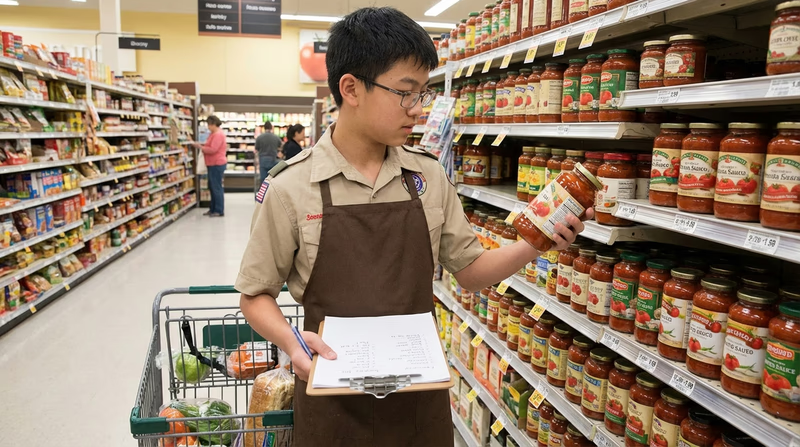
Budget-Friendly Tips
- Buy in season. Fruits and vegetables cost less and taste better when they are in season.
- Compare unit prices. The price per ounce or per pound (usually shown on the shelf tag) is more useful than the total price when comparing products.
- Use store brands. Generic or store-brand products are often the same quality as name brands at a lower cost.
- Minimize waste. Plan meals that use overlapping ingredients. If you buy a bunch of celery for one recipe, find another recipe that uses celery too.