Req 1 — Laws and Society
This requirement covers five foundational topics about law and crime:
- Why we have criminal laws — the purpose behind the rules
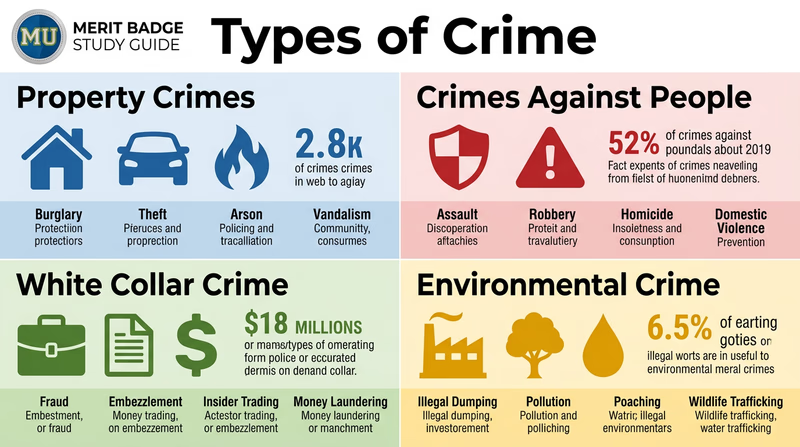
- Types of crimes — property crimes, crimes against people, white collar crime, and environmental crime
- Why people commit crimes — the factors that lead to criminal behavior
- Following the law when no one is watching — integrity and ethics
- The meaning of crime prevention — what it really means to stop crime before it happens
Why We Have Criminal Laws
Imagine a school with no rules. No dress code, no schedule, no consequences for cheating or fighting. How long before things spiral out of control? Criminal laws serve the same purpose for society that rules serve for your school or troop — they set boundaries, protect people, and create order.
Criminal laws exist to:
- Protect individuals and their property from harm, theft, and fraud
- Maintain public order so communities can function safely
- Deter harmful behavior by establishing consequences
- Deliver justice when someone is harmed
- Reflect shared values — what a society collectively agrees is right and wrong
Laws aren’t static. They evolve as society changes. A century ago, there were no laws against cyberbullying because the internet didn’t exist. As new threats emerge, communities create new protections.
Types of Crimes
Crimes generally fall into four broad categories. Understanding these categories helps you recognize criminal behavior and talk about it clearly with your counselor.
Property Crimes
Property crimes involve taking or damaging someone else’s belongings without using force against a person. These are the most common type of crime in the United States.
- Burglary — unlawfully entering a building to commit a crime inside
- Larceny/Theft — taking someone’s property (shoplifting, pickpocketing, bike theft)
- Motor vehicle theft — stealing a car, truck, or motorcycle
- Arson — intentionally setting fire to property
- Vandalism — deliberately damaging or destroying property (graffiti, breaking windows)
Crimes Against People
These crimes involve direct harm or the threat of harm to another person. They are generally considered more serious than property crimes.
- Assault — physically attacking or threatening to attack someone
- Robbery — taking property from a person by force or threat of force
- Kidnapping — unlawfully taking and holding someone against their will
- Homicide — unlawfully causing the death of another person
White Collar Crime
White collar crimes are non-violent offenses committed for financial gain, often by people in business or professional positions. They may not seem as dramatic as a robbery, but they can devastate families and entire communities.
- Fraud — deceiving someone for financial gain (insurance fraud, tax fraud)
- Embezzlement — stealing money entrusted to your care (an employee stealing from their company)
- Identity theft — using someone else’s personal information to commit fraud
- Insider trading — using confidential business information to profit in the stock market
Environmental Crime
Environmental crimes harm the natural world and the communities that depend on it.
- Illegal dumping — disposing of hazardous waste improperly
- Poaching — illegally hunting or capturing protected wildlife
- Pollution violations — knowingly releasing harmful substances into air, water, or soil
- Illegal logging or mining — harvesting natural resources in violation of environmental laws
Why People Commit Crimes
There is no single reason people break the law. Criminologists — researchers who study criminal behavior — have identified several contributing factors:
- Economic pressure — Poverty, unemployment, and financial desperation can push people toward theft or fraud
- Substance abuse — Drugs and alcohol impair judgment and can drive people to commit crimes to fund addiction
- Peer pressure — Especially for young people, the desire to fit in or prove loyalty to a group can lead to criminal behavior
- Opportunity — An unlocked car, an unattended wallet, or a poorly lit alley can tempt someone who might not otherwise commit a crime
- Mental health challenges — Untreated mental illness can contribute to some criminal behavior
- Learned behavior — People who grow up around crime may see it as normal
- Anger and revenge — Strong emotions can override good judgment
Understanding why people commit crimes isn’t about making excuses. It’s about identifying where prevention can make the biggest difference. If poverty is a driver, job training programs help. If opportunity is a factor, better security reduces temptation. Crime prevention works best when it addresses root causes.
Following the Law When No One Is Watching
This is really a question about character. Anyone can follow the rules when a teacher, parent, or police officer is watching. The real test is what you do when nobody would ever know.
Think about it this way: you find a wallet with $200 in cash on a park bench. No one is around. No cameras. Would you take the money or try to return it? Your answer reveals something about your values — and your values are the strongest crime prevention tool you’ll ever have.
The Scout Law says a Scout is Trustworthy. That means doing the right thing even when it’s inconvenient, even when no one would catch you, and even when the wrong choice seems easier. A community where most people live by this principle is a community with less crime.
The Meaning of Crime Prevention
Crime prevention is more than police patrols and security cameras. At its core, crime prevention means taking proactive steps to reduce the opportunity for crime and address the conditions that cause it.
There are three levels of crime prevention:
- Primary prevention — Addresses root causes before crime happens. Education programs, youth activities, after-school programs, and community development all fall here.
- Secondary prevention — Targets people or places at higher risk. Mentoring at-risk youth, improving lighting in high-crime areas, and substance abuse intervention programs are examples.
- Tertiary prevention — Focuses on people who have already committed crimes, working to prevent them from reoffending. Rehabilitation programs, job training for former offenders, and restorative justice fit here.
As a Scout, you are already practicing primary crime prevention every time you participate in troop activities, mentor younger Scouts, or volunteer in your community. These activities build the kind of connected, purposeful community where crime struggles to take root.
FBI Crime Data Explorer Explore national and state-level crime statistics from the FBI's Uniform Crime Reporting program.