Req 11 — Crime Prevention Careers
11.
Identify three career opportunities that would use skills and knowledge in the field of crime prevention. Pick one and research the training, education, certification requirements, experience, and expenses associated with entering the field. Research the prospects for employment, starting salary, advancement opportunities and career goals associated with this career. Discuss what you learned with your counselor and whether you might be interested in this career.
Crime prevention careers go far beyond “police officer.” There is a wide range of fields where the skills and knowledge from this badge directly apply — from technology to law, social work to environmental science.
Three Career Categories to Explore
The requirement asks you to identify three career opportunities. Here are several options organized by category to help you choose three that interest you:
Law Enforcement and Public Safety
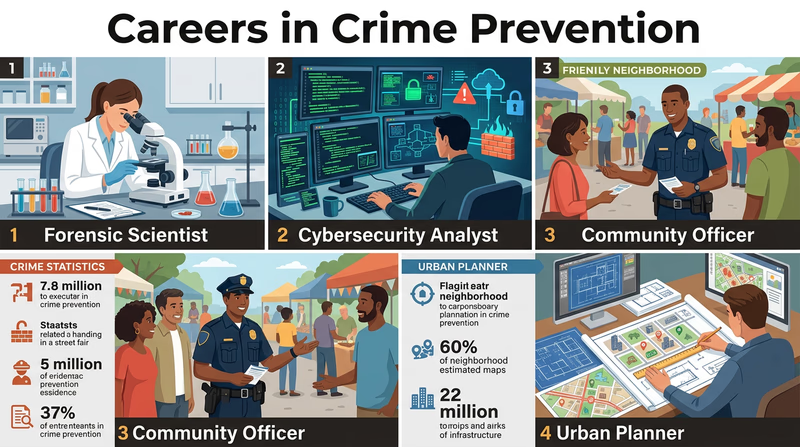
- Police Officer / Detective — Patrol communities, investigate crimes, and build relationships with residents through community policing
- FBI Special Agent — Investigate federal crimes including cybercrime, terrorism, organized crime, and civil rights violations
- Crime Analyst — Use data, statistics, and mapping software to identify crime patterns and help departments deploy resources strategically
- Forensic Scientist — Analyze physical evidence (DNA, fingerprints, ballistics) from crime scenes to support investigations
- Emergency Management Specialist — Plan for and coordinate responses to disasters, mass casualty events, and other emergencies
Legal and Justice System
- Prosecutor / District Attorney — Represent the government in criminal cases, making decisions about which cases to pursue and how
- Defense Attorney — Ensure that accused individuals receive fair legal representation
- Victim Advocate — Help crime victims navigate the justice system, access resources, and recover
- Probation / Parole Officer — Supervise offenders in the community, helping them comply with court-ordered conditions and avoid reoffending
- Juvenile Justice Counselor — Work with young offenders to provide rehabilitation and prevent future criminal behavior
Prevention, Technology, and Community
- Cybersecurity Analyst — Protect organizations from hackers, data breaches, and cyberattacks
- Social Worker — Address the root causes of crime by helping individuals and families access resources for mental health, substance abuse, housing, and education
- Urban Planner — Design communities using CPTED principles to create safer public spaces
- Loss Prevention Manager — Lead retail security programs to prevent shoplifting and employee theft
- School Counselor — Support students’ mental health and well-being, preventing problems before they escalate
Researching Your Chosen Career
After identifying three careers, pick the one that interests you most and dig deep. Here’s what to research:
Training and Education
| Career Level | Typical Education |
|---|---|
| Entry-level law enforcement | High school diploma + police academy (6–9 months) |
| Federal law enforcement (FBI, DEA) | Bachelor’s degree + specialized training |
| Crime analyst | Bachelor’s degree in criminal justice, data science, or statistics |
| Forensic scientist | Bachelor’s or master’s degree in forensic science, chemistry, or biology |
| Cybersecurity analyst | Bachelor’s degree in computer science or cybersecurity; certifications valuable |
| Attorney (prosecutor/defense) | Bachelor’s degree + law degree (J.D.) + bar exam |
| Social worker | Bachelor’s or master’s degree in social work (BSW/MSW) |
Certifications and Special Requirements
Many crime prevention careers require specific certifications:
- Law enforcement: Physical fitness tests, background check, psychological evaluation, police academy graduation
- Forensic science: American Board of Criminalistics certification
- Cybersecurity: CompTIA Security+, CISSP, CEH (Certified Ethical Hacker)
- Social work: State licensure (LCSW — Licensed Clinical Social Worker)
- Loss prevention: Loss Prevention Certified (LPC) or Certified Forensic Interviewer (CFI)
Where to Find Salary and Employment Data
The Bureau of Labor Statistics Occupational Outlook Handbook is your best resource for reliable career data:
Bureau of Labor Statistics — Occupational Outlook Handbook Detailed career profiles including job duties, education requirements, salary data, and employment outlook for hundreds of occupations.For each career, the BLS provides:
- Median annual salary — What the typical worker in this field earns
- Job outlook — Whether the field is growing, shrinking, or stable
- Entry-level education — The minimum education most employers require
- Work environment — What daily work looks like
- Similar occupations — Related careers you might also consider
Key Research Questions
Career Research Guide
Answer these questions for your chosen career
- What education or degree do I need?
- Are there certifications or licenses required?
- How long does the training take from start to entry-level job?
- What does it cost? (tuition, academy fees, certification exams)
- What is the starting salary in my state?
- What is the salary range for experienced professionals?
- Is this field growing? What’s the projected job growth over the next 10 years?
- What are the advancement opportunities? (e.g., patrol officer → detective → sergeant → lieutenant)
- What does a typical day look like?
- What skills from Scouting would help in this career?
Connecting This to Your Counselor Discussion
When you meet with your counselor, be ready to share:
- Your three career choices and why you selected them
- Detailed research on your chosen career — education, training, costs, salary, and job outlook
- Your honest assessment — Does this career interest you? Why or why not?
- Connections to this badge — How does what you learned in the Crime Prevention merit badge apply to this career?