Req 5 — Retail Crime Prevention
This requirement covers two aspects of retail crime:
- The impact of shoplifting and employee theft on retail businesses
- Techniques stores use to prevent shoplifting
The Impact of Shrinkage
“Shrinkage” is the retail industry’s term for inventory loss — the gap between the merchandise a store should have and what it actually has. It’s a massive problem that affects every shopper, every employee, and every community where stores operate.
How Big Is the Problem?
Retail shrinkage costs U.S. retailers tens of billions of dollars every year. The National Retail Federation estimates that shrinkage averaged $112.1 billion in recent years. That’s not just a number — it translates into real consequences.
Where shrinkage comes from:
| Source | Approximate Share |
|---|---|
| External theft (shoplifting, organized retail crime) | ~37% |
| Employee/internal theft | ~29% |
| Process and control failures (shipping errors, pricing mistakes) | ~25% |
| Other/unknown | ~9% |
Impact on Finances
When stores lose merchandise to theft, they lose the cost of the item plus the profit they would have earned selling it. A store with thin profit margins — many retailers earn only 1–3% net profit — can be devastated by theft. A single stolen $50 item might require $1,500 to $5,000 in additional sales just to recover the lost profit.
Stores that experience high theft may:
- Raise prices to offset losses (meaning honest customers pay more)
- Reduce staff hours to cut costs
- Close locations that are no longer profitable
Impact on Customer Service
Theft drives up security costs, which means less money for staffing. Fewer employees means longer checkout lines, less help on the sales floor, and a worse shopping experience. Some stores lock up common products behind glass cases, making shopping frustrating for honest customers who need to find an employee just to buy razor blades or phone chargers.
Impact on Reputation
Stores known for theft problems may struggle to attract customers and quality employees. The perception of a store as unsafe or poorly managed drives people to shop elsewhere, creating a downward spiral.
Employee Theft
Employee theft — also called internal theft — is nearly as costly as shoplifting. It takes many forms:
- Stealing cash from the register
- Taking merchandise home
- Giving unauthorized discounts to friends or family (“sweethearting”)
- Manipulating refund systems to pocket money
- Time theft (clocking in early, taking extended breaks, or not working while on the clock)
Employee theft can be harder to detect because employees know the store’s systems, camera blind spots, and staffing schedules.
Techniques Stores Use to Prevent Shoplifting
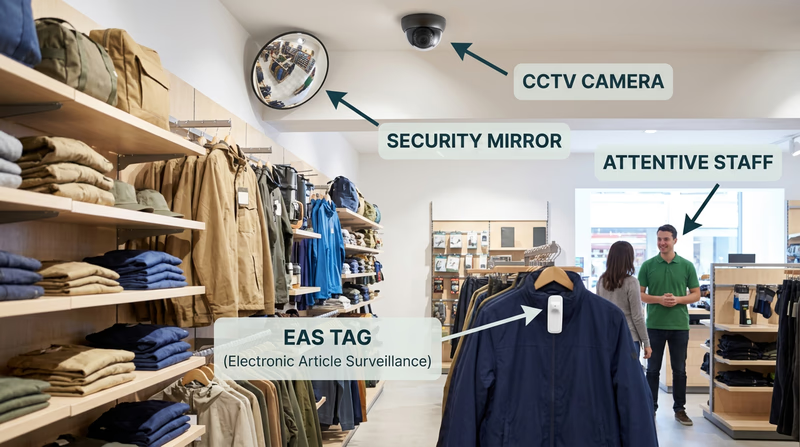
Retailers use a layered approach — no single technique is enough, but together they create a strong deterrent.
Store Layout and Design
These are CPTED principles applied to retail:
- Open floor plans — Low shelving near registers gives employees clear sightlines across the store
- Mirrors — Convex mirrors in corners and along aisles eliminate blind spots
- Checkout placement — Registers near the exit so customers must pass through a staffed area
- Fitting room controls — Limiting the number of items customers can take in and checking items when they leave
- High-value item placement — Expensive items placed near staff or in locked display cases
Technology
- Electronic Article Surveillance (EAS) — Security tags and labels that trigger alarms at exit gates if not deactivated at checkout
- CCTV cameras — Visible cameras deter theft; recorded footage helps identify and prosecute shoplifters
- Point-of-sale monitoring — Software that flags unusual transactions like excessive refunds or voided sales
- RFID tracking — Radio-frequency identification tags that track merchandise throughout the store
- Self-checkout monitoring — AI-powered cameras that detect when items aren’t scanned
People
- Trained employees — Staff who are attentive, greet every customer, and maintain a visible presence on the sales floor
- Loss prevention teams — Plainclothes and uniformed security specialists trained to detect and respond to theft
- Customer service as prevention — Simply asking “Can I help you find something?” signals awareness and deters potential shoplifters
- Employee screening — Background checks, inventory audits, and internal controls to reduce employee theft
Policies and Procedures
- Return policies — Requiring receipts or ID for returns prevents refund fraud
- Bag checks — Some stores check bags or backpacks at the entrance
- Receipt verification — Checking receipts against items at the exit (common at warehouse clubs)
- Prosecution policies — Stores that consistently prosecute shoplifters send a strong deterrent message