 Getting Started
Introduction & Overview
Someone just stole 150 million people’s personal data — names, addresses, Social Security numbers — from a single company’s database. A teenager in another country shut down a hospital’s computer network with a piece of software smaller than a photo on your phone. And right now, while you are reading this sentence, automated programs are trying thousands of stolen passwords against accounts that might include yours. This is the world of cybersecurity, and understanding it is no longer optional.
Cybersecurity is the practice of protecting computers, networks, programs, and data from unauthorized access, damage, or theft. Every time you unlock your phone, log into a game, or send a message, layers of security work behind the scenes to keep your information safe. This merit badge teaches you how those protections work — and how to be part of the solution instead of part of the problem.
Then and Now
Then: The Wild West of Computing
In the early days of computing, security was barely an afterthought. The first computers in the 1960s and 1970s were enormous machines locked in university basements, and the biggest threat was someone accidentally tripping over a power cable. Passwords were stored in plain text. Networks trusted every connected machine completely.
In 1988, a graduate student named Robert Tappan Morris released what became known as the Morris Worm — one of the first pieces of malware to spread across the internet. It wasn’t designed to cause damage, but a coding mistake made it replicate out of control, crashing roughly 6,000 computers (about 10% of the entire internet at the time). The incident led to the creation of the first Computer Emergency Response Team (CERT) and showed the world that connected computers needed real security.
Through the 1990s and early 2000s, viruses spread mainly through floppy disks and email attachments. Security meant installing antivirus software and hoping for the best. Most people didn’t think about cybersecurity at all.
Now: Everyone Is a Target
Today, cybersecurity is one of the fastest-growing fields in the world. There are over 15 billion internet-connected devices on the planet — more than two for every person alive. Cybercrime costs the global economy trillions of dollars each year. Attacks target everything from personal Instagram accounts to power grids, water treatment plants, and hospital systems.
Modern threats include ransomware that locks your files until you pay, phishing emails that look exactly like messages from your bank, and nation-state hackers backed by entire governments. But here is the encouraging part: the vast majority of successful attacks exploit simple mistakes that you can learn to avoid. Strong passwords, software updates, and knowing how to spot a scam stop most threats before they start.
Get Ready!
You are about to learn skills that protect not just you but your family, your troop, and your community. Cybersecurity knowledge is something you will use every single day — every time you create a password, connect to Wi-Fi, or download an app. By the end of this merit badge, you will understand how hackers think, how defenses work, and how to make smart decisions in a connected world. Let’s get started.
Kinds of Cybersecurity
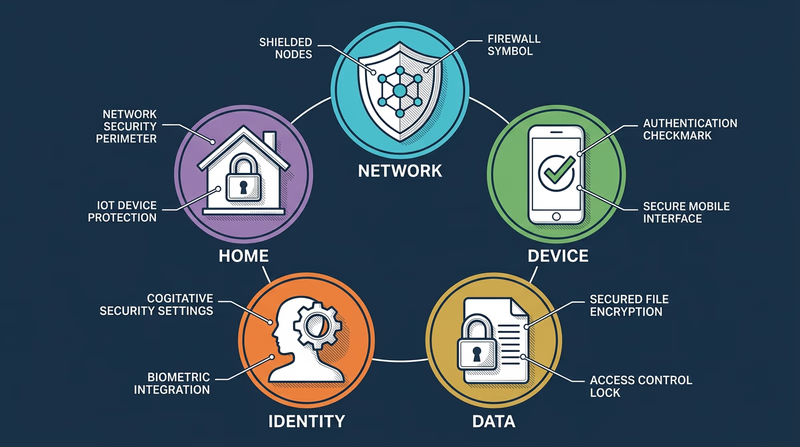
Cybersecurity is a broad field with many specialties. Here are the main areas you will explore in this merit badge.
Network Security
Network security protects the highways that data travels on. Every time you load a website, send a text, or stream a video, your data crosses networks — home Wi-Fi, cellular towers, undersea cables, and data centers. Network security tools like firewalls and intrusion detection systems watch for suspicious traffic and block attacks before they reach your devices.
Think of network security like a series of locked gates and security checkpoints on a highway. Legitimate traffic passes through quickly, but anything that looks suspicious gets stopped and inspected.
Application Security
Application security focuses on making software safe to use. Every app on your phone, every website you visit, and every program on your computer was written by developers who had to think about how attackers might try to break in. Application security means finding and fixing those weak spots — called vulnerabilities — before someone exploits them.
When a company releases a security update for an app, that is application security in action. Someone found a flaw, and the developers patched it before attackers could take advantage.
Information Security
Information security (often called InfoSec) is about protecting data itself — whether it is stored on a hard drive, traveling across a network, or displayed on a screen. This includes personal information like your name, address, and passwords, as well as sensitive data like medical records, financial information, and government secrets.
InfoSec uses tools like encryption (scrambling data so only authorized people can read it) and access controls (making sure only the right people can reach certain information).
Operational Security
Operational security (OpSec) is about the human side of cybersecurity — the decisions and habits that keep systems safe. Even the best technology fails if people make careless mistakes. OpSec includes policies like “never share your password” and practices like shredding sensitive documents.
Personal and Consumer Security
This is the area most directly relevant to your daily life. Personal security covers protecting your own devices, accounts, and identity online. It includes choosing strong passwords, recognizing phishing attempts, securing your home Wi-Fi, backing up your data, and managing your digital footprint — the trail of information you leave behind as you use the internet.
Everything you learn in this merit badge ties back to personal security. Even if you never work in cybersecurity professionally, these skills will protect you for the rest of your life.