Extended Learning
A. Congratulations
You have explored the science behind your smile — from the microscopic structure of enamel to the career paths that keep millions of mouths healthy. Along the way, you learned to read X-rays, understood the chemistry of tooth decay, discovered how to save a knocked-out tooth, and researched what it takes to work in the dental field. That is a serious amount of knowledge.
But dentistry is a field that never stops evolving. Below are some deeper topics, real-world experiences, and organizations that can take your interest even further.
B. Forensic Dentistry — Teeth That Tell Stories
Your teeth are as unique as your fingerprints. Forensic dentists (forensic odontologists) use dental records to identify individuals when other methods are not possible — after natural disasters, accidents, fires, or in criminal investigations.
Every person’s combination of fillings, crowns, missing teeth, root canal treatments, and jaw structure creates a one-of-a-kind dental “signature.” Forensic dentists compare postmortem dental findings against existing dental records, X-rays, and photographs to make identifications.
Forensic dentistry also plays a role in estimating the age of unidentified remains. Children’s teeth erupt in a predictable sequence, and adult teeth show measurable changes with age — wear patterns, root transparency, and secondary dentin formation can all help narrow down an age range.
In criminal cases, forensic dentists analyze bite mark evidence, though this area has become increasingly controversial. Modern DNA analysis has largely replaced bite mark comparison in courtrooms, but the broader field of dental identification remains an indispensable tool for disaster response teams worldwide. Organizations like DMORT (Disaster Mortuary Operational Response Teams) include forensic dentists as core members who deploy to mass casualty events.
If you are interested in both dentistry and criminal justice, forensic odontology sits at the intersection of the two. It requires a dental degree plus specialized training in forensic science.
C. Digital Dentistry — The Future Is Already Here
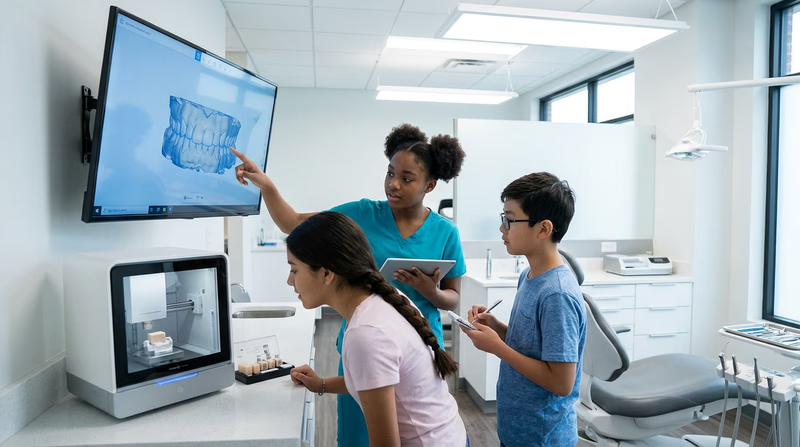
The dental office you visited for Req 3 is probably already using technology that did not exist 20 years ago. Here is a look at the cutting edge.
Intraoral scanners have largely replaced the messy alginate impression trays you may have used in Req 4b. A small wand with a camera scans your teeth in minutes, creating an exact 3D digital model that can be transmitted electronically — no physical impressions needed.
CAD/CAM (Computer-Aided Design/Computer-Aided Manufacturing) systems let dentists design and mill a custom porcelain crown right in the office. What used to require two appointments and a dental lab now takes about 90 minutes, start to finish. The dentist designs the crown on screen, and a milling machine carves it from a block of ceramic.
3D printing is expanding rapidly. Dental labs use it to create surgical guides, clear aligners, temporary crowns, and models. Some offices are printing custom night guards, retainers, and even implant components in-house.
AI-assisted diagnosis is an emerging frontier. Machine learning algorithms trained on millions of dental X-rays can detect cavities, bone loss, and other conditions with accuracy comparable to experienced dentists. These tools do not replace the dentist — they serve as a “second set of eyes” that catches things that might be missed.
Laser dentistry uses focused light energy to remove decay, reshape gum tissue, and treat infections — often without anesthesia and with faster healing times than traditional methods. Lasers are especially useful for treating soft tissue conditions and preparing small cavities.
D. The Science of Saliva — More Than You Think
In Req 5b, you learned about saliva’s roles in digestion and tooth protection. But saliva is becoming one of the most exciting frontiers in medical diagnostics.
Researchers are developing salivary diagnostics — tests that can detect diseases from a simple saliva sample instead of a blood draw. Saliva contains DNA, RNA, proteins, hormones, and antibodies that reflect what is happening throughout your body. Scientists have identified salivary biomarkers for:
- Oral and breast cancer
- Diabetes (glucose levels in saliva correlate with blood glucose)
- HIV infection
- Hepatitis
- Heart disease risk factors
- Stress hormones (cortisol)
- Drug use
A saliva-based diagnostic test is painless, non-invasive, and can be administered by non-medical personnel. For Scouts working in remote areas during high-adventure activities, imagine being able to run a health screening with a simple spit test instead of a blood draw.
The field is still developing, but the potential is enormous. The mouth may turn out to be the most convenient window into overall health — a concept that connects directly to the mouth-body relationship you explored in Req 5b.
E. Real-World Experiences
These are experiences you can seek out to extend your learning beyond the badge requirements.
F. Organizations
These organizations offer resources, programs, and connections for anyone interested in dentistry and oral health.
American Dental Association (ADA) The largest dental professional organization in the U.S. Offers career resources, oral health information, and the ADA Seal of Acceptance program for dental products. American Dental Hygienists' Association (ADHA) The professional association for dental hygienists. Provides career information, continuing education resources, and student membership for those exploring the field. National Institute of Dental and Craniofacial Research (NIDCR) Part of the National Institutes of Health. Funds dental research and provides comprehensive, science-based oral health information for the public. American Student Dental Association (ASDA) A national student-run organization for dental students. Offers pre-dental resources, mentorship, and information about dental school admissions. Give Kids A Smile An ADA Foundation program providing free dental care to underserved children. Look for local events where you can volunteer or receive care.