 Getting Started
Introduction & Overview
The phone in your pocket has more computing power than every computer NASA used to land astronauts on the Moon — combined. The device you carry around to watch videos, text friends, and check the weather would have filled an entire building sixty years ago. Digital technology is not just a subject you study — it is the invisible engine running nearly every part of modern life.
This merit badge takes you under the hood. You will learn how computers turn music, photographs, and text into ones and zeros, how data travels across the planet in milliseconds, and how to create your own digital projects. You will also learn how to stay safe online and why the technology you throw away matters just as much as the technology you use.

Then and Now
Then — Rooms Full of Wires
The first general-purpose electronic computer, ENIAC, came to life in 1945. It weighed 30 tons, filled a room the size of a gymnasium, and used 18,000 vacuum tubes that burned out so often that engineers spent most of their time replacing them. Programming meant physically rewiring cables and flipping switches — there were no keyboards, no screens, and no software as we know it.
- Storage: Early data was stored on punched cards — stiff paper rectangles with holes punched in specific positions to represent numbers and letters
- Speed: ENIAC could perform about 5,000 additions per second — impressive in 1945, but your phone’s processor handles billions of operations per second
- Access: Only governments, militaries, and large universities could afford computers
By the 1970s, the microprocessor — an entire computer brain shrunk onto a single chip — changed everything. Suddenly, computers could sit on a desk instead of filling a building. The Apple II (1977) and IBM PC (1981) brought computing into homes and schools for the first time.
Now — A Computer in Every Pocket
Today, digital technology is woven into almost everything. Your watch tracks your heart rate. Your car uses dozens of embedded computers. A farmer’s tractor drives itself using GPS. And the smartphone in your pocket connects you to the accumulated knowledge of human civilization in seconds.
- Storage: A microSD card smaller than your fingernail can hold 1 terabyte — enough for 250,000 songs or 500 hours of video
- Speed: Modern processors execute billions of instructions per second and can run artificial intelligence models that generate images, write text, and recognize faces
- Access: Over 5 billion people worldwide now use the internet, and cloud computing lets anyone with a browser access supercomputer-level resources
Get Ready!
You are about to explore the technology that shapes your world every single day. By the end of this badge, you will understand how your devices actually work, how to protect yourself online, and how to use digital tools to create real projects. These are skills that will serve you in school, in your career, and in every aspect of Scouting.
Kinds of Digital Technology
Computing Devices
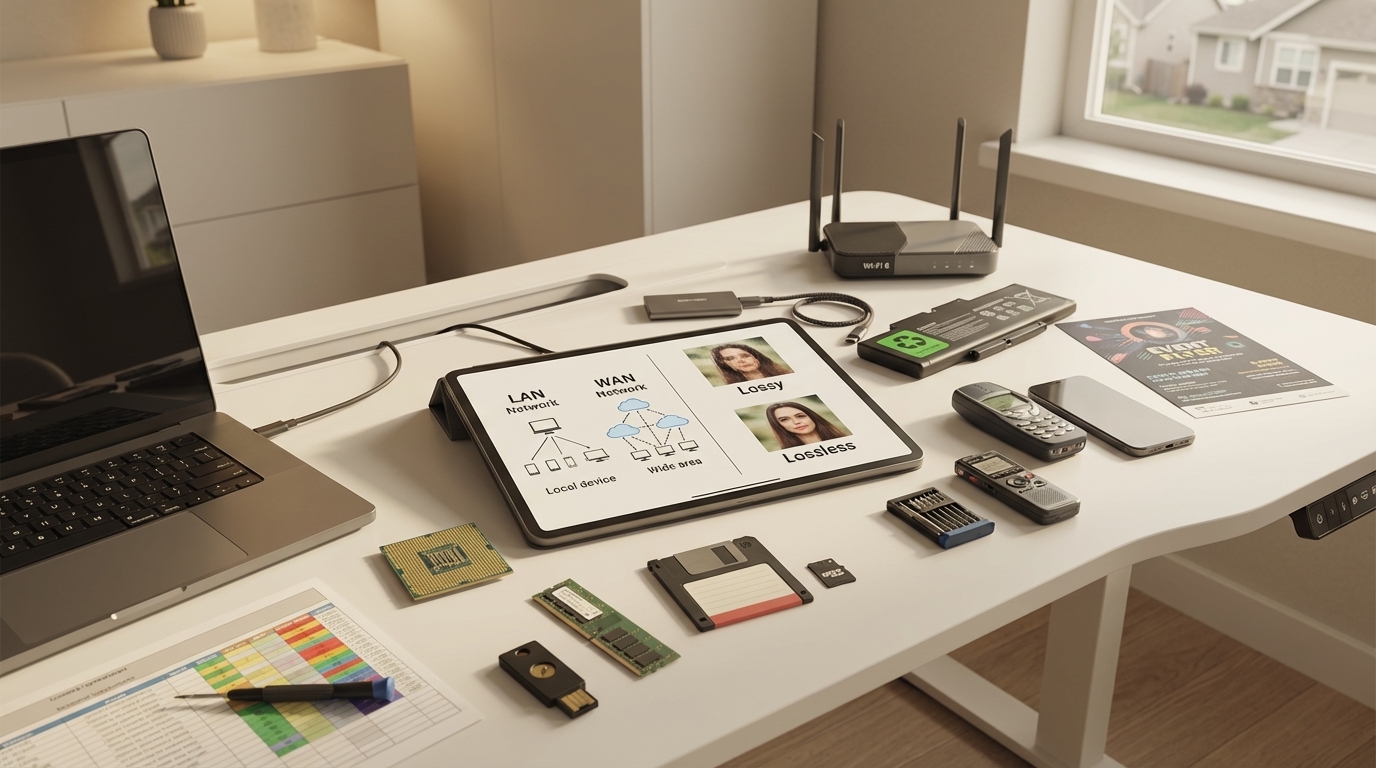
From towering server racks in data centers to the slim laptop in your backpack, computing devices are the workhorses of the digital world. This category includes desktop computers, laptops, tablets, and smartphones — any device built around a processor, memory, and storage that can run software. Each type trades off between power and portability. A desktop with a dedicated graphics card can render 3D animations, while a tablet lets you sketch designs on a camping trip.
Embedded & IoT Devices
Not all computers look like computers. Embedded systems are specialized computers built into other machines — the chip in your microwave, the controller in a traffic light, the processor in a game controller. The Internet of Things (IoT) takes this further by connecting everyday objects to the internet: smart thermostats, fitness trackers, security cameras, and even water bottles that remind you to hydrate. These devices are often invisible, but they run on the same digital principles you will learn in this badge.
Networking & Communication
Digital technology only becomes truly powerful when devices talk to each other. Networking technology includes everything from the Wi-Fi router in your home to the undersea fiber-optic cables that carry internet traffic between continents. Cell towers, Bluetooth, satellite links, and Ethernet cables all fall into this category. Understanding how networks operate helps you grasp why your video call sometimes freezes and how your email reaches someone on the other side of the planet.
Data & Storage
Every photo, text message, and homework file exists as data — patterns of ones and zeros stored on physical media. Hard drives use spinning magnetic disks. Solid-state drives (SSDs) store data in flash memory chips with no moving parts. Cloud storage saves your files on servers in massive data centers, accessible from any device with an internet connection. Understanding data and storage helps you make smart decisions about backups, file formats, and keeping your information safe.
Software & Applications
Hardware without software is like a guitar without strings — it has potential but cannot do anything useful. Operating systems (Windows, macOS, Linux, Android, iOS) manage your device’s resources. Applications run on top of the operating system to let you browse the web, edit documents, play games, and more. Software ranges from simple calculator apps to complex programs that control spacecraft. In this badge, you will learn how programs work and create several digital projects of your own.
Ready to start your journey through the digital world? Your first stop is learning how to stay safe while you explore it.