Req 2b — Future Technology
In 1995, most people could not have imagined carrying a computer in their pocket that shoots 4K video, navigates with satellite GPS, and connects to billions of other devices. Yet here we are. The technology of 2040 will likely seem just as unimaginable to us today — but we can make some educated guesses based on trends already in motion.
Technologies Taking Shape
Artificial Intelligence Everywhere
AI has already moved from research labs into daily life. Voice assistants answer questions. AI generates images, writes code, and translates languages in real time. But today’s AI is still limited — it cannot truly understand the world the way humans do.
By the time you are an adult, AI will likely be embedded in far more devices and situations:
- Personal AI assistants that know your schedule, learning style, and preferences — helping you study, plan projects, and make decisions
- AI-powered medical diagnosis that catches diseases earlier than human doctors alone
- Autonomous vehicles — cars, trucks, drones, and delivery robots that navigate without human drivers
- Creative AI tools that collaborate with you on music, art, engineering designs, and scientific research
Augmented and Virtual Reality
Virtual reality (VR) immerses you in a completely digital environment using a headset. Augmented reality (AR) overlays digital information onto the real world — like seeing directions projected onto the road as you walk, or identifying a plant by pointing your phone at it.
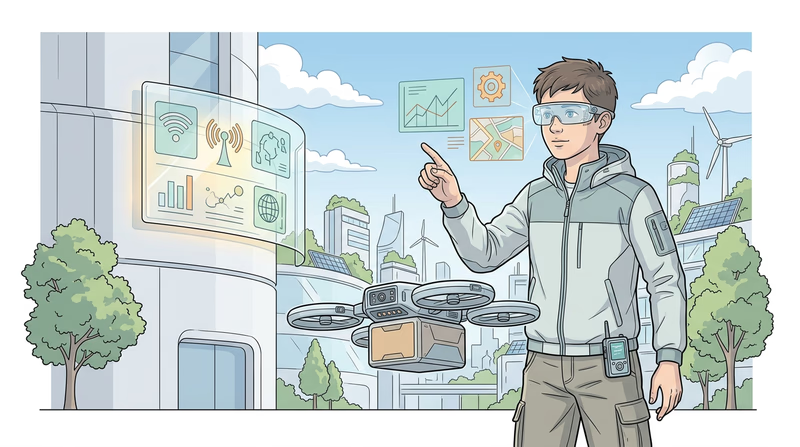
Today’s VR and AR hardware is still bulky and expensive. But lightweight AR glasses may eventually replace smartphones, projecting information, maps, and messages directly into your field of vision. Imagine:
- Attending a Scout meeting virtually, with holographic participants who look like they are sitting right next to you
- Repairing a car engine with step-by-step AR instructions floating above each part
- Exploring a historical battlefield with AR soldiers and events recreated around you
Quantum Computing
Traditional computers store information as bits — each one is either a 0 or a 1. Quantum computers use qubits, which can be 0, 1, or both at the same time (a property called superposition). This allows quantum computers to solve certain problems astronomically faster than any traditional computer.
Quantum computing is still in its early stages — today’s quantum computers are delicate, room-sized machines that need to be cooled to temperatures colder than outer space. But once the technology matures, it could:
- Break current encryption methods (and create new, unbreakable ones)
- Simulate complex chemical reactions to design new medicines and materials
- Optimize logistics problems that would take traditional computers millions of years
Wearable and Implantable Technology
Smartwatches and fitness trackers are just the beginning. Future wearables might include:
- Smart clothing with embedded sensors that monitor your health, adjust temperature, or charge your devices using body heat
- Brain-computer interfaces that let you control devices with your thoughts — already being tested in medical settings to help people with paralysis
- Flexible, rollable screens built into sleeves, bags, or any surface
How to Think About the Future
When imagining future technology, it helps to follow the trends:
- Smaller and more portable — mainframes became desktops became laptops became smartphones. What comes after phones?
- More connected — from standalone devices to local networks to the global internet to the Internet of Things. What happens when everything is connected?
- More intelligent — from manual calculations to automated computing to AI that learns. What happens when AI becomes a partner in daily work?
- More personal — from shared mainframes to personal computers to wearable devices. What happens when technology is literally part of you?
You have traveled from ENIAC to quantum computing. Now it is time to understand the fundamental building block of all digital technology — how information becomes data.