Req 7a — Copyrights, Patents & Trademarks
If you spent months building an app, writing a song, or designing a logo, you would not want someone to copy it and claim it as their own. Intellectual property (IP) law exists to protect the things people create with their minds — giving creators the right to control and benefit from their work. In the digital world, where copying is as easy as pressing Ctrl+C, these protections matter more than ever.
Copyright
What it protects: Original creative works — books, music, movies, photographs, software code, artwork, blog posts, and websites.
How it works: Copyright protection is automatic. The moment you create an original work and fix it in a tangible form (write it down, record it, save the file), it is copyrighted. You do not need to register it or put a © symbol on it, though both can help if you ever need to prove ownership.
What it gives the creator:
- The exclusive right to reproduce (copy) the work
- The right to create derivative works (adaptations, remixes)
- The right to distribute, perform, and display the work publicly
- The right to license others to do any of the above
How long it lasts: In the United States, copyright lasts for the life of the creator plus 70 years.
Why it exists: Without copyright, creators would have little incentive to invest time and effort in new works. Why spend a year writing a novel if anyone could immediately copy and sell it? Copyright ensures that creators can earn a living from their work.
Patents
What they protect: Inventions — new and useful processes, machines, manufactured items, or compositions of matter. In the tech world, patents cover things like new chip designs, algorithms, device mechanisms, and manufacturing processes.
How they work: Unlike copyright, patent protection is not automatic. You must apply to the U.S. Patent and Trademark Office (USPTO), describe your invention in detail, and prove that it is genuinely new, useful, and non-obvious. The application process can take years and cost thousands of dollars.
What they give the inventor:
- The exclusive right to make, use, and sell the invention for a limited time
- The right to license the invention to others (often for royalty payments)
How long they last: Utility patents last 20 years from the filing date. Design patents last 15 years.
Why they exist: Patents encourage innovation by guaranteeing inventors a period of exclusivity to profit from their inventions. In exchange, the inventor must publicly disclose how the invention works — so after the patent expires, anyone can use the idea. This system balances rewarding inventors with eventually sharing knowledge with everyone.
Trademarks
What they protect: Brand identifiers — names, logos, slogans, sounds, and other symbols that distinguish one company’s products from another’s.
Examples: The Nike “swoosh” logo, Apple’s apple icon, McDonald’s golden arches, the NBC three-note chime, the phrase “Just Do It.”
How they work: Trademark rights develop through use in commerce — the more you use a distinctive brand mark, the stronger your rights become. You can register a trademark with the USPTO for additional legal protection, but registration is not required.
What they give the owner:
- The exclusive right to use the mark in connection with specific goods or services
- The right to prevent others from using confusingly similar marks
- Protection against brand impersonation and consumer confusion
How long they last: Trademarks can last indefinitely, as long as the owner continues to use the mark and maintains the registration.
Why they exist: Trademarks protect both businesses and consumers. They ensure that when you buy a product with a recognized brand, you know what you are getting. Without trademarks, anyone could sell a low-quality phone and put an Apple logo on it.
Trade Secrets
What they protect: Valuable business information that derives its value from being kept secret — formulas, processes, customer lists, algorithms, strategies, and proprietary data.
Famous examples: The Coca-Cola formula, Google’s search ranking algorithm, KFC’s “11 herbs and spices” recipe.
How they work: Trade secrets are protected not by registration but by secrecy. The owner must take reasonable steps to keep the information confidential — non-disclosure agreements (NDAs), restricted access, encryption, and security measures. If the secret becomes public (through legitimate means like independent discovery or reverse engineering), the protection is lost.
What they give the owner:
- Legal recourse against anyone who steals, leaks, or misappropriates the secret
- No time limit — as long as the information stays secret, it is protected
Why they exist: Some innovations are better protected as secrets than patents. A patent requires public disclosure (and expires after 20 years), while a trade secret can theoretically last forever. The Coca-Cola formula, for instance, has been a trade secret for over 130 years — far longer than any patent could provide.
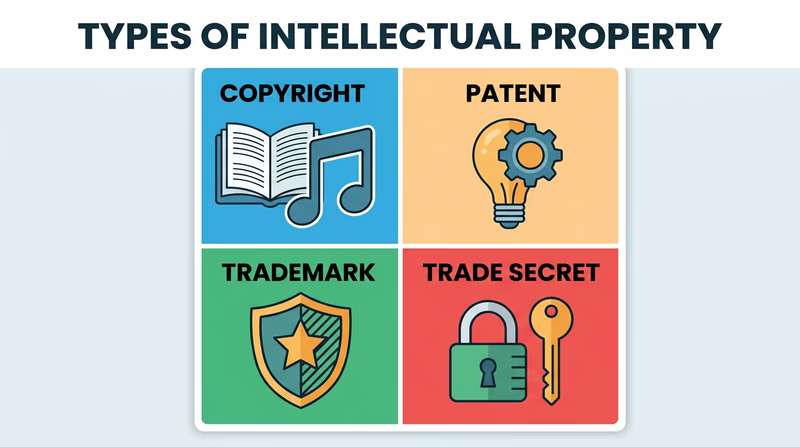
Quick Comparison
| Type | What It Protects | Registration Required? | Duration |
|---|---|---|---|
| Copyright | Creative works | No (automatic) | Life + 70 years |
| Patent | Inventions | Yes (USPTO application) | 20 years |
| Trademark | Brand identifiers | Recommended but not required | Indefinite (with use) |
| Trade Secret | Confidential business info | No (maintained by secrecy) | Indefinite (while secret) |
Now that you understand IP protections, let’s look at a specific ethical question that comes up constantly in the digital world.