Req 9 — Tech Careers & Hobbies
This requirement asks you to look ahead — either toward a potential career in digital technology or toward a hobby you could pursue using the skills you have built throughout this badge. Choose one of the two options below.
Option A: Explore a Tech Career
Digital technology careers are among the fastest-growing and highest-paying fields in the economy. Here are some paths worth researching:
Software Developer / Engineer
What they do: Write the code that powers apps, websites, operating systems, and everything in between. Front-end developers build what users see; back-end developers build the systems behind the scenes; full-stack developers do both.
Education: Bachelor’s degree in computer science (typical) or coding bootcamp + portfolio. Many successful developers are self-taught.
Median salary: $130,000–$150,000/year (U.S.)
Cybersecurity Analyst
What they do: Protect organizations from cyberattacks. They monitor networks for threats, investigate security breaches, set up defenses, and develop security policies — much of what you learned in Req 4c at a professional level.
Education: Bachelor’s degree in cybersecurity, computer science, or IT. Professional certifications (CompTIA Security+, CISSP) are highly valued.
Median salary: $110,000–$130,000/year
Data Scientist / Data Analyst
What they do: Use statistics, programming, and machine learning to find patterns and insights in large datasets. They help companies make data-driven decisions about products, marketing, operations, and strategy.
Education: Bachelor’s or master’s degree in data science, statistics, computer science, or mathematics.
Median salary: $100,000–$140,000/year
UX/UI Designer
What they do: Design how apps and websites look and feel. UX (User Experience) designers research how people use technology and design intuitive interfaces. UI (User Interface) designers create the visual elements — buttons, layouts, colors, and typography.
Education: Bachelor’s degree in design, human-computer interaction, or related field. A strong portfolio matters more than the specific degree.
Median salary: $90,000–$120,000/year
Network / Systems Administrator
What they do: Set up, maintain, and troubleshoot the computer networks and servers that organizations depend on — connecting the LAN and WAN concepts you learned in Req 3e to real infrastructure.
Education: Bachelor’s degree in IT or computer science. Certifications (CompTIA Network+, Cisco CCNA) are important.
Median salary: $85,000–$105,000/year
Bureau of Labor Statistics — Computer and IT Occupations Detailed career profiles from the Bureau of Labor Statistics covering education requirements, salary data, job outlook, and typical duties for every major IT career.Career Research Guide
Cover these points in your counselor discussion
- What does a typical day look like in this career?
- What education or training is needed? How long does it take?
- What does it cost (college tuition, bootcamp fees, certification exams)?
- What is the job outlook — is the field growing or shrinking?
- What is the typical starting salary? What about with 10+ years of experience?
- What career advancement opportunities exist (senior roles, management, specialization)?
- What about this career interests you personally?
Option B: Explore a Tech Hobby
The skills from this badge open doors to hobbies that are creative, social, and technically rewarding. Here are some ideas:
Coding and App Development
Build your own apps, games, or websites. Start with free resources like Scratch, Python, or web development tutorials. Many successful apps started as hobby projects by teenagers.
Robotics and Electronics
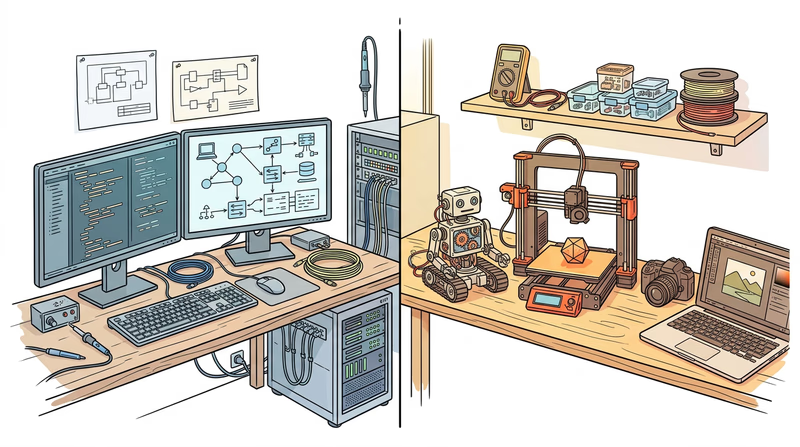
Build and program robots using platforms like Arduino, Raspberry Pi, or LEGO Mindstorms. This combines programming with hands-on building — perfect for Scouts who like working with their hands and their minds.
Digital Photography and Videography
Go beyond snapping photos — learn composition, lighting, and editing. Free tools like DaVinci Resolve (video) and GIMP (photos) give you professional-level editing capabilities. Share your work on photography communities or start a YouTube channel about Scouting.
3D Printing and Design
Design objects in free CAD software like Tinkercad or Fusion 360, then print them on a 3D printer. Many libraries, makerspaces, and schools have 3D printers available. Create custom camping gear, badge display cases, or troop decorations.
Game Development
Create your own video games using free engines like Unity, Godot, or Unreal Engine. Start small — a simple puzzle game teaches you programming, art, sound design, and project management.
Podcasting or Blogging
Build on the skills from Req 6 to create ongoing content. Start a Scouting podcast, a technology review blog, or a channel focused on your other hobbies.
Congratulations — you have worked through every requirement of the Digital Technology merit badge. Head to the Extended Learning page to discover where your digital skills can take you next.