 Getting Started
Introduction & Overview
One in four adults in the United States lives with some form of disability. That means in a troop of twenty Scouts, statistically five of them — or their parents, siblings, or close friends — are directly affected. Disabilities are not rare, they are not always visible, and they are not something that only happens to “other people.” They are part of everyday life.
The Disabilities Awareness merit badge asks you to look at the world through a wider lens. You will learn the language people use to talk about disability, practice the etiquette that shows genuine respect, meet people who navigate the world differently than you do, and evaluate how well your school, place of worship, and community actually serve everyone. By the end, you will not just be aware — you will be an advocate.
Then and Now
Then — The Institutional Era
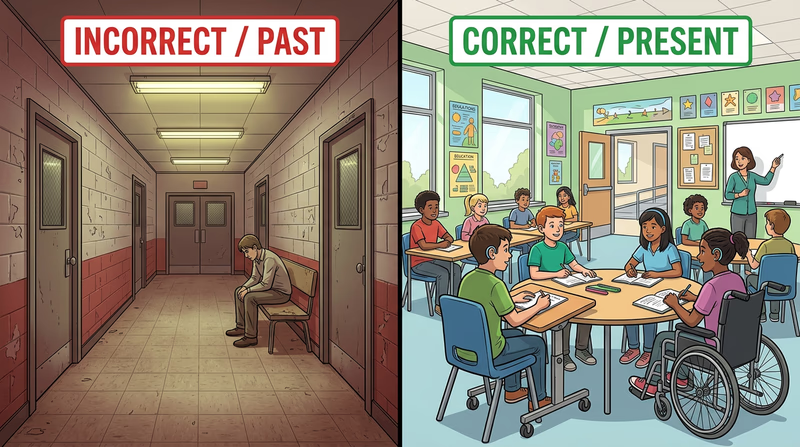
For most of history, people with disabilities were hidden. Families kept disabled children at home, and governments built large institutions — often in remote locations — where people with physical, intellectual, and mental health disabilities lived in isolation, separated from their communities. The prevailing view was the medical model of disability: disability was a defect in the person, something to be “fixed” or, if it could not be fixed, hidden away.
In the United States, conditions in many state institutions were shockingly poor. Overcrowding, neglect, and abuse were common. It was not until journalist Geraldo Rivera exposed conditions at the Willowbrook State School in New York in 1972 that the public began demanding change.
- Mindset: Disability as a personal deficiency
- Approach: Institutionalization and segregation
- Result: Millions of people denied education, employment, and community life
Now — The Rights Era
The modern disability rights movement changed everything. Activists — many of them people with disabilities — fought for laws that guarantee equal access and opportunity. The landmark Americans with Disabilities Act (ADA), signed in 1990, banned discrimination based on disability in employment, public services, and commercial facilities. Section 504 of the Rehabilitation Act (1973) had already required federally funded programs to be accessible, and the Individuals with Disabilities Education Act (IDEA) guaranteed children with disabilities the right to a free public education alongside their peers.
Today, the dominant framework is the social model of disability: the idea that people are not disabled by their conditions, but by barriers in the environment and attitudes in society. A wheelchair user is not disabled by paralysis — they are disabled by a building with no ramp.
- Mindset: Disability as a social and environmental issue
- Approach: Inclusion, accommodation, and universal design
- Impact: Millions of people living, working, and learning in their communities
Get Ready! This badge will challenge you to think differently about ability, access, and inclusion. You will meet people, visit places, and have conversations that open your eyes. The world needs more people who understand disability — and you are about to become one of them.
Kinds of Disabilities
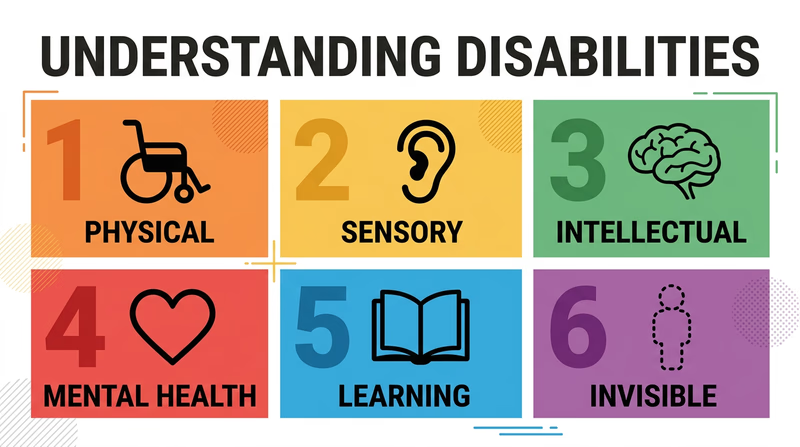
Disabilities come in many forms. Some are visible — you can see them right away. Others are invisible — a person might look perfectly healthy while dealing with significant challenges. Understanding the major categories will give you a foundation for everything else in this badge.
Physical Disabilities
Physical disabilities affect a person’s ability to move, use their hands, or control their body. They include conditions like cerebral palsy, spinal cord injuries, muscular dystrophy, and limb differences. Some people use wheelchairs, crutches, prosthetic limbs, or other mobility devices. Others may walk independently but have limited range of motion or strength.
Sensory Disabilities
Sensory disabilities affect the senses — primarily vision and hearing. A person who is deaf or hard of hearing may communicate using American Sign Language (ASL), lip reading, hearing aids, or cochlear implants. A person who is blind or has low vision may use a white cane, a guide dog, screen readers, or braille.
Intellectual and Developmental Disabilities
These include conditions like Down syndrome, autism spectrum disorder, and intellectual disabilities that affect learning, reasoning, or social interaction. People with these disabilities may process information differently, communicate in nontraditional ways, or need more time to learn new tasks — but they have talents, interests, and goals just like anyone else.
Mental Health Disabilities
Conditions like depression, anxiety disorders, bipolar disorder, PTSD, and schizophrenia are mental health disabilities. They affect mood, thinking, and behavior. These are among the most common — and most misunderstood — disabilities. Many people manage mental health conditions with therapy, medication, and support, and live full, productive lives.
Learning Disabilities
Dyslexia, dyscalculia, ADHD, and other learning disabilities affect how the brain processes information. A person with dyslexia might be highly intelligent and creative but struggle with reading. These disabilities do not reflect a person’s effort or intelligence — they reflect differences in how the brain is wired.
Invisible Disabilities
Invisible disabilities deserve special attention because they are so often overlooked. Chronic pain, autoimmune diseases (like lupus or Crohn’s disease), epilepsy, diabetes, anxiety disorders, and many other conditions have no outward signs. A person who “looks fine” may be dealing with exhaustion, pain, or cognitive challenges that you cannot see.
Ready to learn the key terms that form the foundation of disabilities awareness? Let’s start with the vocabulary that matters.