Extended Learning
A. You Made a Difference
You have earned the Disabilities Awareness merit badge — and in the process, you have done something that most people never do. You stopped, looked around, and asked: “Does this world work for everyone?” The answer, as you discovered, is not yet. But people like you are changing that.
The pages ahead will take you deeper into topics that go beyond the requirements — universal design, disability in media, and the global disability rights movement.
B. Universal Design — Building a World That Works for Everyone
You learned about accessibility and accommodation in this badge. Universal design takes that thinking a step further: instead of making special modifications for people with disabilities after a building, product, or program is created, design it to work for everyone from the start.
The Seven Principles
Architect Ronald Mace coined the term “universal design” in 1997. His team at North Carolina State University developed seven principles that still guide designers, engineers, and architects today:
Equitable use — The design is useful to people with diverse abilities. A power door opener benefits a person in a wheelchair, a parent carrying a child, and a delivery driver with full arms.
Flexibility in use — The design accommodates a wide range of preferences and abilities. A pair of scissors with a spring-loaded handle works for right-handed users, left-handed users, and people with limited grip strength.
Simple and intuitive — The design is easy to understand regardless of experience, knowledge, language, or cognitive ability. A crosswalk button with a clear tactile arrow and audible signal communicates its function without words.
Perceptible information — The design communicates necessary information effectively, regardless of ambient conditions or the user’s sensory abilities. A smoke alarm that flashes a strobe light and sounds an alarm reaches people who are deaf, people who are blind, and everyone in between.
Tolerance for error — The design minimizes hazards and the consequences of accidental or unintended actions. A medication bottle with a child-proof cap that is also easy for adults with arthritis to open reduces both accidental ingestion and frustration.
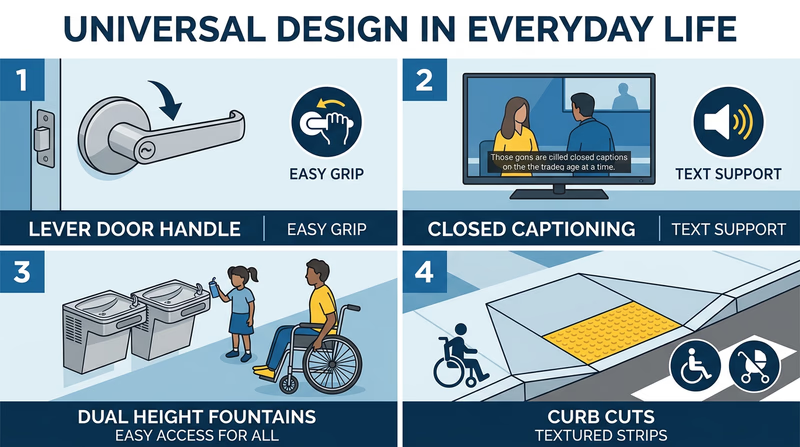
Low physical effort — The design can be used efficiently and comfortably with minimum fatigue. A lever-style door handle requires less strength and precision than a round doorknob — useful for people with arthritis, people carrying groceries, or anyone with wet hands.
Size and space for approach and use — Appropriate size and space is provided for approach, reach, manipulation, and use. A checkout counter with a lowered section serves wheelchair users, children, and shorter adults.
Universal Design in Action
The beauty of universal design is that it helps everyone, not just people with disabilities. Consider:
- Closed captions were created for people who are deaf — but they are used by gym-goers watching TV without sound, language learners, people in noisy airports, and anyone trying to watch a video without waking a sleeping baby.
- Voice assistants (Siri, Alexa) were a breakthrough for people with mobility and vision disabilities — but millions of nondisabled people use them daily.
- Textured sidewalk edges (called truncated domes) alert people who are blind to street crossings — but they also warn distracted pedestrians looking at their phones.
C. Disability in Media — Representation Matters
How people with disabilities are portrayed in movies, TV shows, books, and news coverage shapes how the public thinks about disability. And for decades, that portrayal has been deeply flawed.
Common Media Tropes
The tragic figure — Disability is presented as a tragedy, and the character exists to make the audience feel grateful for their own abilities. Their life is defined by suffering and struggle.
The inspiration — A person with a disability does something ordinary (going to school, getting a job, making a friend) and it is presented as extraordinary. This is sometimes called “inspiration porn” — it uses disability to make nondisabled people feel good.
The villain — From Captain Hook to countless Bond villains, characters with visible disabilities or disfigurements are disproportionately cast as the bad guy. The message: physical difference equals moral failing.
The cure narrative — The story ends when the character is “cured” or “fixed,” implying that disability is a problem to be solved rather than a way of being.
The supercrip — A person with a disability is portrayed as having superhuman abilities to “compensate” for their condition (like the blind character who can hear a whisper from a mile away). This sets unrealistic expectations and ignores the real, everyday experiences of disability.
What Good Representation Looks Like
Good representation includes characters with disabilities who are:
- Complex — They have personality traits, goals, flaws, and storylines that are not entirely about their disability
- Played by actors with disabilities — Increasingly, casting directors are hiring actors who actually have the disabilities their characters have
- Written with input from the disability community — The best shows and movies consult people with disabilities during development
- Present in ordinary roles — Not every character with a disability needs to be the “disability character.” Sometimes a character just happens to use a wheelchair, and the story is about something else entirely
D. The Global Disability Rights Movement
The ADA was a watershed moment for disability rights in the United States, but the fight for disability rights is a global movement — and it is far from over.
Key Milestones
1981 — International Year of Disabled Persons: The United Nations declared 1981 the International Year of Disabled Persons, raising global awareness and launching programs to improve the lives of people with disabilities worldwide.
2006 — Convention on the Rights of Persons with Disabilities (CRPD): The UN adopted the CRPD, the first international treaty to address the rights of people with disabilities. It has been ratified by over 180 countries. (The United States signed the treaty in 2009 but has not yet ratified it.)
Present day: Despite progress, roughly 80% of people with disabilities live in developing countries, where access to healthcare, education, and employment is severely limited. The World Health Organization estimates that 1 billion people worldwide — about 15% of the global population — live with some form of disability.
What Scouts Can Do
The global movement needs local action. As a Scout, you can:
- Support organizations working on disability rights in developing countries
- Advocate for your school, troop, or community to adopt universal design principles
- Learn about the CRPD and discuss it with others
- Stay informed about disability legislation in your state and country
E. Real-World Experiences
Experiences to Seek Out
Continue your disabilities awareness journey
- Attend a disability pride event: Many cities hold Disability Pride Month events in July. Attend a parade, fair, or speaker series to celebrate disability culture and identity.
- Try an adaptive sport: Many parks and recreation departments offer adaptive sports programs open to all participants. Try wheelchair basketball, sled hockey, or adaptive climbing to experience the athleticism and strategy involved.
- Visit a disability history exhibit: The Smithsonian’s online exhibit “EveryBody: An Artifact History of Disability in America” explores how Americans with disabilities have shaped the nation. Many local museums also host disability history exhibits.
- Volunteer for Special Olympics: Help organize, officiate, or support athletes at a local Special Olympics event. It is one of the most rewarding volunteer experiences you can have.
- Shadow a professional: Spend a day with an occupational therapist, speech-language pathologist, or other professional you researched in Req 7 to see what their work looks like up close.