Req 1a — Key Terminology
Words shape how we think about people. The wrong word can reduce a person to their condition — “the blind kid,” “a cripple,” “the autistic one.” The right word sees the person first and the disability second. This requirement asks you to learn six foundational terms and understand why each one matters.
Disability
A disability is a physical, mental, intellectual, or sensory condition that limits a person’s ability to perform certain activities or interact with the world around them in the way most people do. The key word in that definition is “limits” — not “prevents.” Most people with disabilities find ways to do the things they want to do; they just do them differently.
Under the ADA, a disability is defined as a physical or mental impairment that substantially limits one or more major life activities. That legal definition covers a wide range of conditions — from paralysis to depression to dyslexia.
Accessibility
Accessibility means designing environments, products, services, and information so that people with disabilities can use them. A building with a wheelchair ramp is accessible. A website that works with a screen reader is accessible. A movie with closed captions is accessible.
Accessibility is not just about ramps and elevators. It includes:
- Physical accessibility — Ramps, elevators, accessible restrooms, wide doorways, lowered counters
- Digital accessibility — Screen reader compatibility, keyboard navigation, alt text on images, captioned videos
- Communication accessibility — Sign language interpreters, braille materials, plain-language documents
- Sensory accessibility — Good lighting, reduced background noise, tactile maps and guides
Adaptation
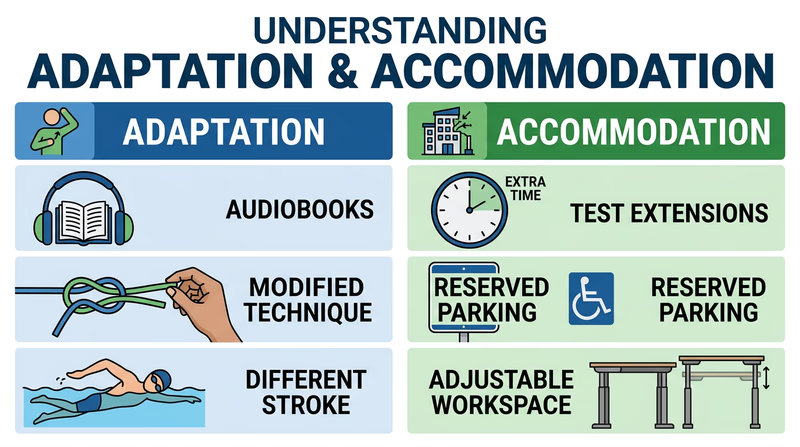
An adaptation is a change to how a task is performed so that a person with a disability can complete it. Adaptations focus on the task, not the environment. For example:
- A student with dyslexia uses audiobooks instead of printed textbooks
- A Scout with one arm learns to tie knots using one hand and their teeth
- A swimmer with a leg amputation uses a modified stroke technique
Adaptations are personal — what works for one person may not work for another with the same disability. The key is creativity and willingness to try different approaches.
Accommodation
An accommodation is a modification to a rule, policy, practice, or environment that gives a person with a disability equal access to an opportunity. Unlike adaptations (which change how a person performs a task), accommodations change what the organization provides.
Common accommodations include:
- Extra time on tests for students with learning disabilities
- A reserved parking space close to a building entrance
- A flexible work schedule for someone managing a chronic illness
- A sign language interpreter at a meeting
- An adjustable-height desk
Invisible Disability
An invisible disability (also called a hidden disability) is a condition that significantly affects a person’s daily life but has no outward signs. You cannot tell the person has a disability by looking at them.
Examples include:
- Chronic pain conditions (fibromyalgia, back injuries)
- Autoimmune diseases (lupus, Crohn’s disease, multiple sclerosis)
- Mental health conditions (anxiety, depression, PTSD)
- Neurological conditions (epilepsy, migraines)
- Learning differences (ADHD, dyslexia)
- Chronic fatigue syndrome
- Diabetes
People with invisible disabilities often face a unique challenge: because they “look normal,” others may doubt that their disability is real. Comments like “but you don’t look sick” or “you seem fine to me” can be hurtful and dismissive.
Person-First Language
Person-first language puts the person before the disability. Instead of defining someone by their condition, you describe them as a person who happens to have a condition.
| Person-First (Preferred) | Identity-First (Avoid Unless Requested) |
|---|---|
| A person with a disability | A disabled person |
| A student with autism | An autistic student |
| A person who uses a wheelchair | A wheelchair-bound person |
| A person with epilepsy | An epileptic |
| A person with a visual impairment | A blind person |
| A child with Down syndrome | A Down syndrome child |
There is one important exception: some communities prefer identity-first language. Many people in the Deaf community prefer “Deaf person” because they view deafness as a cultural identity, not a medical condition. Some autistic adults prefer “autistic person” because they see autism as an integral part of who they are, not something they “have.” When in doubt, ask the person how they prefer to be described — and then use their preference.
Now that you know the key terms, let’s explore how to put that knowledge into action with proper disability etiquette.