Req 3 — Personal Experiences
This requirement gives you five options for learning directly from people with disabilities or experiencing what they experience. You will choose two of them. Each option teaches something different — some involve one-on-one conversations, others involve research or hands-on activities.
Read through all five options below, then pick the two that interest you most and that you can realistically complete in your community.
Option 3a — Talk with a Scout Who Has a Disability
What to do: Find a Scout (in your troop, district, or council) who has a disability and have a conversation about their experience in Scouting. What merit badges have they earned? What activities do they enjoy most? What challenges have they faced, and how did they overcome them?
How to prepare: Ask your Scoutmaster or council office to help you connect with a Scout who is willing to share their experience. Have questions ready, but let the conversation flow naturally. This is not an interview — it is a chance to listen and learn.
Key question to explore: How has Scouting adapted to include this Scout? Were any accommodations made, and did they work well?
Option 3b — Talk with a Person Who Has a Disability
What to do: Have a conversation with someone who has a disability — a family member, neighbor, teacher, coach, or someone you met through the agency visit in Req 2. Learn about their daily life, their interests, and the activities they enjoy.
How to prepare: Approach this conversation with genuine curiosity and the etiquette you learned in Req 1b. Ask about their life — not just their disability. People with disabilities are whole people with hobbies, careers, families, and dreams.
Suggested conversation starters:
- “What do you enjoy doing in your free time?”
- “What is something most people do not understand about living with your disability?”
- “What accommodations make the biggest difference in your daily life?”
- “What would you want people my age to know?”
Option 3c — Learn About Adaptive Sports
What to do: Research how people with disabilities participate in a specific adaptive sport or recreational activity. Learn about the rules, the equipment modifications, and the organizations that support it.
People with disabilities compete at the highest levels of athletic performance. Adaptive sports are not watered-down versions of “real” sports — they are fierce, demanding, and inspiring.
Adaptive Sports to Explore
| Sport | Adaptation | Organization |
|---|---|---|
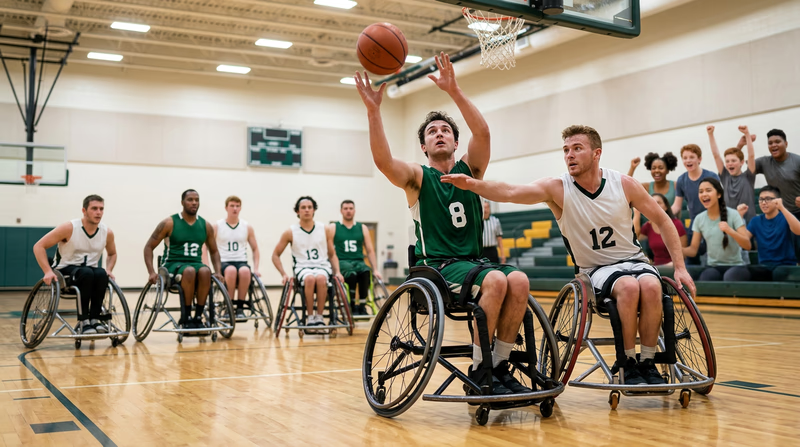
| Wheelchair basketball | Played in sport wheelchairs; same court, same hoop height | National Wheelchair Basketball Association |
| Sled hockey | Players sit on sleds with two short sticks instead of one | USA Hockey Sled Program |
| Goalball | Designed for athletes with visual impairments; players wear blackout goggles and track a ball by sound | USA Goalball |
| Adaptive rock climbing | Modified harnesses, prosthetic grips, route setting for various disabilities | Paradox Sports |
| Sit-skiing | Athletes sit in a mono-ski or bi-ski frame attached to a single ski or pair of skis | Move United |
| Wheelchair rugby | Also called “murderball” — full contact in reinforced chairs | USA Wheelchair Rugby |
Option 3d — Learn About Independent Living Aids
What to do: Research assistive technologies and independent living aids that help people with disabilities navigate daily life. Learn how these tools work and how they promote independence.
Categories of Assistive Technology
Mobility aids:
- Manual and power wheelchairs
- Walkers, canes, and crutches
- Prosthetic limbs — from basic models to microprocessor-controlled knees and bionic hands
Communication aids:
- Augmentative and alternative communication (AAC) devices — from simple picture boards to sophisticated speech-generating computers
- Captioned telephones and video relay services for people who are deaf
- Text-to-speech and speech-to-text software
Service animals:
- Guide dogs for people who are blind
- Hearing dogs that alert their handlers to sounds like doorbells, alarms, and approaching vehicles
- Psychiatric service dogs trained to recognize and respond to anxiety attacks, PTSD episodes, or seizures
- Service miniature horses (yes, really — the ADA recognizes them as service animals)
Daily living aids:
- Braille displays and refreshable braille keyboards
- Screen readers that convert text to speech
- One-handed kitchen tools, button hooks, and adaptive utensils
- Smart home technology — voice-controlled lights, locks, and appliances
Option 3e — Plan or Participate in an Awareness Activity
What to do: Plan or take part in an activity that helps other people understand what it is like to live with a disability. This could be a simulation, a presentation, a community event, or something you design yourself.
Activity Ideas
Simulation experiences (use with caution — see safety note below):
- Navigate your school or Scout meeting place in a wheelchair and note every barrier you encounter
- Wear earplugs during a meeting and try to follow the conversation
- Wear simulation goggles that mimic visual impairments while trying to read or pour a glass of water
Educational presentations:
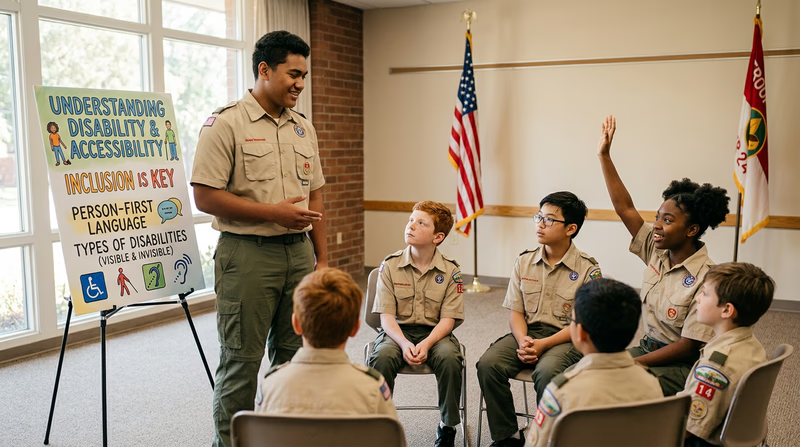
- Create a presentation for your troop about person-first language
- Lead a discussion about invisible disabilities using the myths and facts you will research in Req 5
- Invite a speaker with a disability to share their story with your troop or pack
Remember: you need to complete two of these five options. Choose the two that you find most interesting and that you can access in your community. Discuss what you learned from each with your counselor.