Req 1a — Rough Sketches & Paper Sizing
Before you lay a straightedge on a fresh sheet of drawing paper, you need to know what you are drawing and how big it needs to be. Professional drafters never jump straight to the final drawing — they start with a rough sketch. Think of it as a rehearsal: you figure out the layout, the scale, and the paper size before committing to the real thing.
Why Rough Sketches Matter
A rough sketch is a freehand drawing — no rulers, no precise measurements, just pencil on scrap paper. It serves three purposes:
- Layout planning — Where will the views go on the sheet? Will there be room for dimensions, notes, and a title block?
- Scale selection — What scale will make the drawing readable without wasting paper?
- Paper sizing — Based on the layout and scale, which standard paper size fits best?
Skipping the rough sketch is the fastest way to end up halfway through a drawing only to realize your floor plan does not fit on the sheet, or your dimensions are crammed so tightly together they become unreadable.
Standard Drawing Paper Sizes
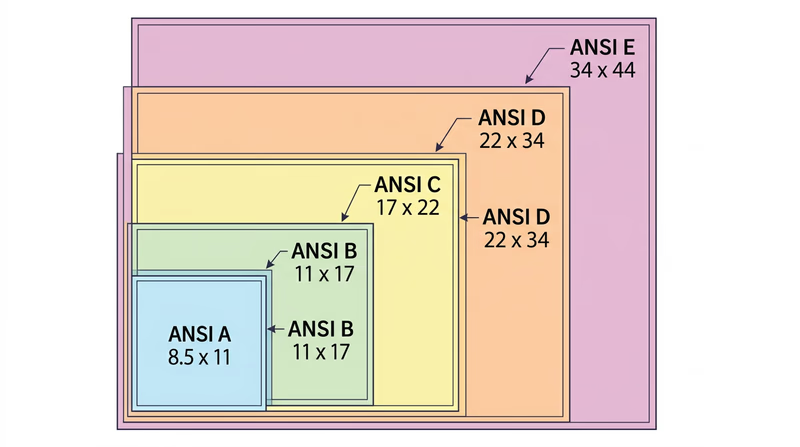
Drafting paper comes in standard sizes defined by ANSI (American National Standards Institute). Each size is a specific width and height:
| Size | Dimensions (inches) | Common Use |
|---|---|---|
| A | 8.5 x 11 | Small details, schematics, simple parts |
| B | 11 x 17 | Small floor plans, mechanical parts, circuit diagrams |
| C | 17 x 22 | Medium architectural plans, assembly drawings |
| D | 22 x 34 | Large architectural plans, complex assemblies |
| E | 34 x 44 | Full building plans, large site plans |
For this merit badge, Size A (8.5 x 11) or Size B (11 x 17) will work for most projects. Size B gives you more room for dimensions and notes, which is especially helpful for architectural drawings.
How to Create Your Rough Sketch
Here is a step-by-step approach:
Decide what you are drawing. For Requirement 2, you will create a manual drawing (architectural, mechanical, or electrical). For Requirement 5 (as referenced in Requirement 1), you will create a lettering project. Make a rough sketch for each.
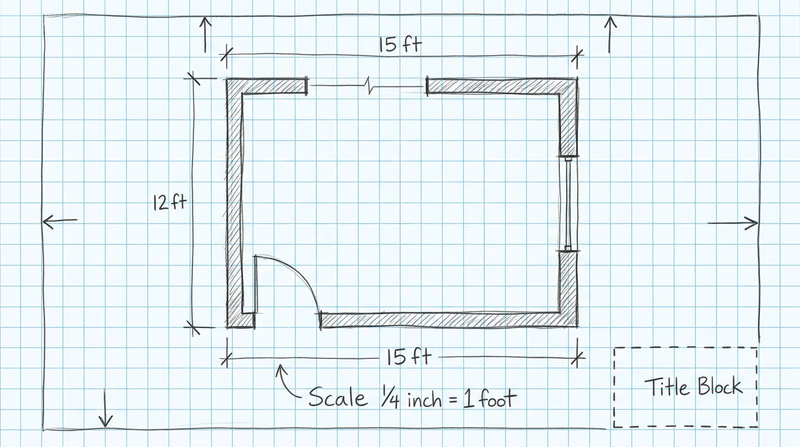
Estimate the object’s real-world dimensions. If you are drawing a floor plan of a room that is 12 feet by 15 feet, write those numbers down. If you are drawing a mechanical part that is 6 inches long, note that.
Choose a scale. Common scales include:
- Architectural: 1/4" = 1’-0" (a 12-foot wall becomes 3 inches on paper)
- Mechanical/engineering: Full size (1:1), half size (1:2), or double size (2:1)
- Electrical schematics: Usually not to scale — just make them clear and readable
Sketch the layout. On scrap paper, roughly draw where your views will sit on the sheet. Leave room for:
- A border (typically 1/2 inch on three sides, 1 inch on the left for binding)
- A title block (bottom right corner, about 4-5 inches wide by 1-2 inches tall)
- Dimensions and notes around each view
Pick your paper size. If the layout fits comfortably on A-size paper with room to spare, use A-size. If it is tight, step up to B-size.
Preparing for Both Projects
Remember: Requirement 1 asks you to format two sheets of paper — one for your manual drawing project (Requirement 2) and one for your lettering project (Requirement 6). Your rough sketches should account for both.
For the manual drawing project, your sketch should show where the drawing views, dimensions, notes, and bill of materials will go.
For the lettering project, your sketch should show how much text you plan to write and how large the lettering needs to be to fill the sheet attractively. Gothic lettering at 1/8-inch height takes up more space than you might expect — plan accordingly.
Engineering Drawing Standards — ASME Y14.1 The official ASME standard for drawing sheet sizes and formatting. This is the professional reference used in industry.Now that you have your rough sketches done and your paper sizes selected, it is time to set up those sheets with proper borders and a title block.