Req 7 — Workplace Visit or Research
This requirement connects your badge work to the professional drafting world. You will choose one of two paths: visiting a workplace where drafting happens, or researching the history and evolution of drafting tools and media. Read through both options and pick the one that works best for your situation.
Remember: you only need to complete ONE of these options.
Option A: Visit a Drafting Workplace
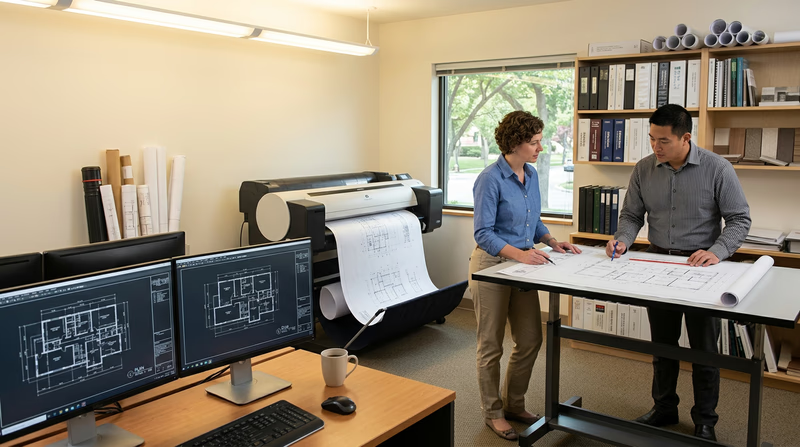
A workplace visit brings everything you have learned in this badge to life. You will see how professional drafters and engineers use the same skills — drawing, dimensioning, revising — in a real business setting. The requirement asks you to investigate three specific areas during your visit:
Sub-requirement 7a(1): Manual vs. CAD in the Workplace
Most modern workplaces use CAD almost exclusively, but you might be surprised to find manual skills still in play — especially during design brainstorming, field sketches, or in shops that maintain older equipment with legacy drawings.
Questions to ask:
- What percentage of your drafting is done with CAD versus by hand?
- What CAD software do you use? Did you evaluate other options before choosing it?
- Do your drafters ever sketch by hand? In what situations?
- How did the transition from manual to CAD happen here?
Sub-requirement 7a(2): Who Uses the Drawings?
Drawings are communication tools — they carry information from the designer to the builder, installer, inspector, and maintenance crew. Understanding who reads the drawings helps you understand why accuracy and clarity matter so much.
Questions to ask:
- Who are the main users of the drawings your team produces?
- How do drawings get transmitted to the people who need them — paper, PDF, shared CAD files?
- How does the drafting team work with engineers, architects, or project managers?
- What happens when someone in the field has a question about a drawing?
Sub-requirement 7a(3): Drafting’s Role in the Business
This question gets at the big picture — how does drafting fit into the company’s overall mission? In some businesses, drafting is the core product (architecture and engineering firms sell drawings). In others, drafting supports manufacturing, construction, or maintenance.
Questions to ask:
- Could this business operate without a drafting department? Why or why not?
- How has drafting improved the quality or speed of your products/services?
- What would happen if a drawing contained a significant error that was not caught?
Workplace Visit Prep
Be ready before you arrive
- Arrange the visit through your counselor or a parent/guardian — do not just show up.
- Write down your questions in advance so you do not forget anything.
- Bring a notebook to record answers and observations.
- Wear appropriate clothing (collared shirt, closed-toe shoes if visiting a shop floor).
- Thank your hosts at the end of the visit and follow up with a written thank-you note.
Option B: Research the Drafting Trade
If a workplace visit is not feasible, this option lets you research the history and evolution of drafting tools and media. You will investigate three topics:
Sub-requirement 7b(1): Evolution of Drafting Tools
The history of drafting tools stretches back thousands of years. Here are some starting points for your research:
Historical tools:
- Compass and straightedge — Used since ancient Greece, still fundamental today
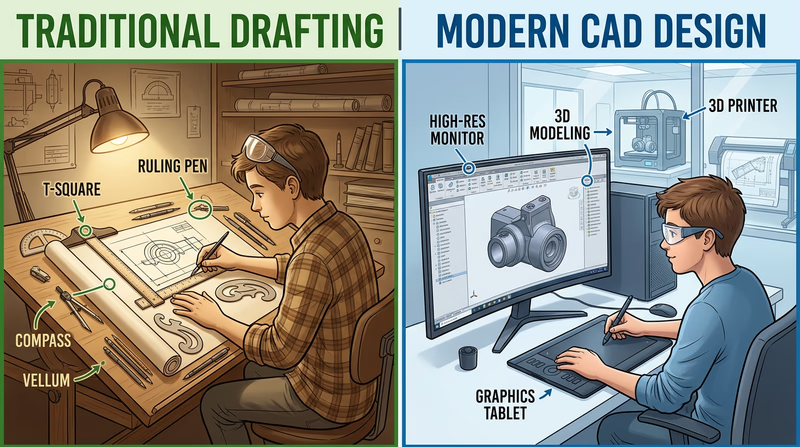
- T-square — A long straightedge that slides along the edge of a drafting board to draw horizontal lines. Once the most essential drafting tool.
- Triangles — 30-60-90 and 45-45-90 triangles used with a T-square to draw angled lines
- French curve — A plastic template with complex curves for drawing smooth non-circular arcs
- Ruling pen — A pen with an adjustable gap between two blades, used for drawing ink lines of consistent width
- Parallel rule — A straightedge mounted on cables across a drafting board, replacing the T-square
Tools still in use: Mechanical pencils, architect’s and engineer’s scales, compasses, erasers, and triangles are still used for hand sketching and markup.
Tools becoming obsolete: Ruling pens, lettering guides, drafting machines (pantograph-style devices mounted to drawing boards), and large-format light tables have been largely replaced by CAD.
Sub-requirement 7b(2): Drawing Media Through History
Historical media:
- Vellum — Translucent drafting paper that allowed blueprinting (light-sensitive copying)
- Mylar — Plastic film that replaced vellum; more durable and dimensionally stable
- Linen — Starched cotton fabric used for permanent ink drawings before plastic films existed
- Blueprints — A chemical reproduction process using light-sensitive paper that produced white lines on a blue background. The term “blueprint” is still used colloquially even though the process is nearly extinct.
- Diazo prints — Replaced blueprints; produced blue or black lines on white paper using ammonia fumes
Modern media: CAD files stored on hard drives, cloud servers, and version-controlled repositories. Drawings are shared as PDFs, plotted on large-format inkjet printers, or viewed directly on screens and tablets at job sites.
Sub-requirement 7b(3): New Media and New Uses
The shift from paper to digital has not just changed how drawings are made — it has changed what drawings can do:
- 3D models replace flat 2D drawings in many workflows, allowing virtual walkthroughs and interference checking
- BIM (Building Information Modeling) embeds cost, schedule, and material data directly into the 3D model
- VR and AR let designers and clients walk through buildings before they are built, using headsets or tablet overlays
- Direct-to-machine output sends CAD geometry to CNC mills, 3D printers, and laser cutters without a human interpreting a drawing
- Cloud collaboration allows teams in different cities or countries to work on the same model simultaneously
Which Option Should You Choose?
| Option | Best For | Requires |
|---|---|---|
| A — Workplace Visit | Hands-on learners who want to see real drafting in action | Access to a business with a drafting or engineering department |
| B — Research | Scouts interested in history and technology evolution | Library access, internet research, curiosity |
Discuss with your counselor which option fits your situation best.
You are almost done with the Drafting merit badge. One requirement remains — exploring drafting as a career.