 Getting Started
Introduction & Overview
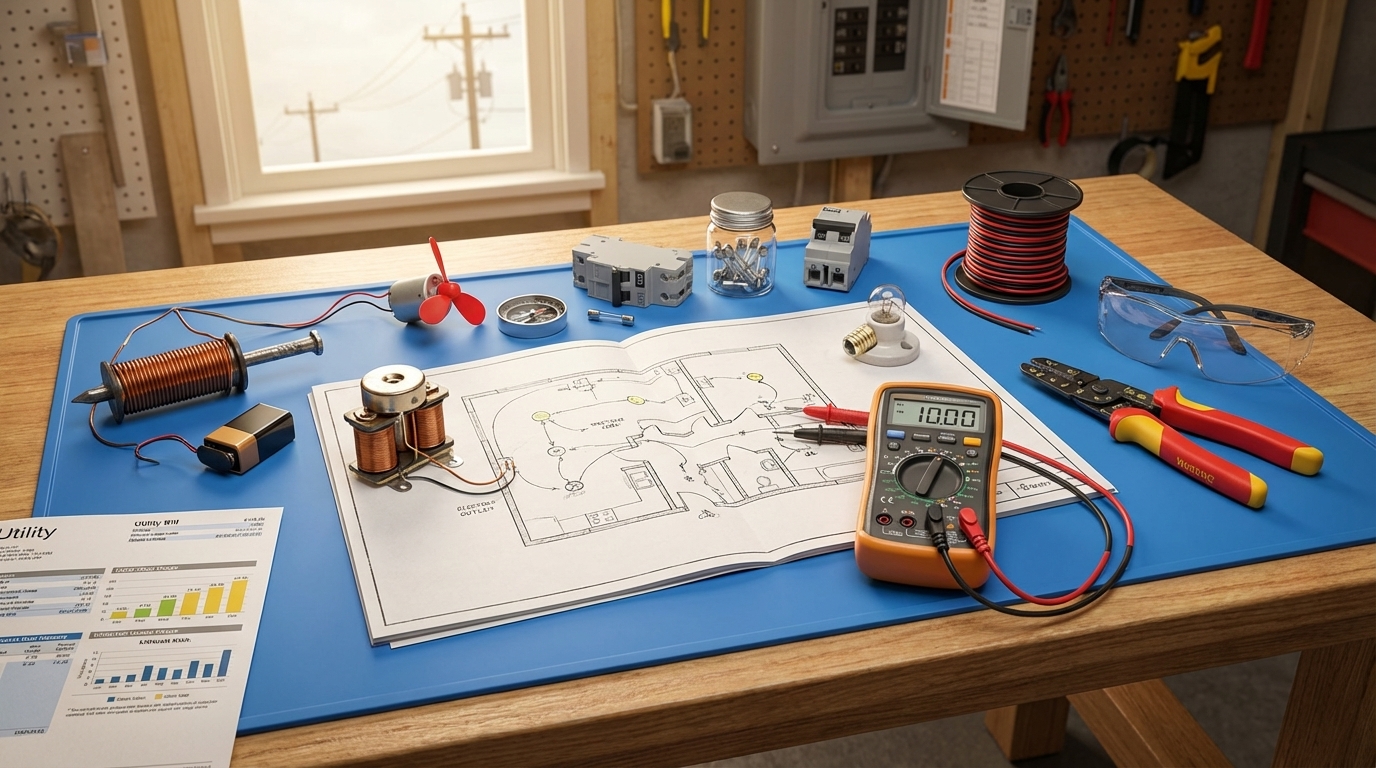
Flip a switch and the lights come on so fast that it is easy to forget how much science, engineering, and safety knowledge are hiding behind that one click. The Electricity merit badge helps you look past the wall plate and understand how power is made, moved, controlled, and used in everyday life. If you have ever wondered why lightning is so dangerous, why breakers trip, or how a motor spins, this badge turns those questions into hands-on learning.
Electricity is one of the most useful tools humans have ever learned to control, but it is also one of the easiest to underestimate. This guide will help you build a strong safety mindset, understand the language of circuits, and try projects that make invisible ideas feel real.
Then and Now
Then
For most of human history, electricity was a mystery that appeared only in nature. People saw lightning split trees, watched static sparks jump from cloth, and noticed that certain rocks could attract bits of iron. In the 1700s and 1800s, scientists like Benjamin Franklin, Alessandro Volta, Michael Faraday, and Thomas Edison began turning those strange effects into experiments, batteries, generators, and lighting systems.
The first electrical systems were limited and local. A city might have a few electric lights, a telegraph office, or a streetcar line, but most homes still depended on candles, wood stoves, and daylight. Learning how to generate and distribute electricity safely changed cities, factories, farms, and homes.
- Early tools: batteries, telegraphs, simple motors, and generators
- Big challenge: moving electricity where it was needed without wasting too much of it
- Big payoff: lighting, communication, industry, and safer indoor work after dark
Now
Today, electricity powers nearly every part of modern life. It keeps refrigerators cold, charges phones, runs traffic lights, powers hospitals, and moves information around the world in milliseconds. The modern grid links power plants, substations, transformers, power lines, solar panels, wind turbines, batteries, and home wiring into one huge system.
Electricity is also changing fast. Renewable energy, electric vehicles, home battery storage, and smart devices are making the system more flexible and more complex. That means people who understand electrical safety and basic electrical ideas are more valuable than ever.
- Modern sources: fossil fuels, nuclear, hydro, wind, and solar
- Modern challenge: making power reliable, affordable, and cleaner
- Modern opportunity: careers in construction, utilities, electronics, renewable energy, and engineering
Get Ready! You are about to study a force you cannot see directly but that you can measure, guide, and use to do amazing work. Stay curious, stay careful, and keep asking how each device around you actually works.
Kinds of Electricity
Electricity shows up in more than one form. Before you dive into the requirements, it helps to know the major categories you will run into.
Static Electricity
Static electricity is a buildup of electric charge that stays in one place until it suddenly moves. The snap you feel after shuffling across carpet, or the crackle when you pull off a fleece jacket in winter, is static electricity. Lightning is the giant outdoor version of the same basic idea: charge builds up until it discharges.
Current Electricity
Current electricity is the steady movement of electric charge through a conductor such as a wire. This is the kind of electricity that powers lights, motors, doorbells, and appliances. In this badge, you will work mostly with current electricity because that is what makes circuits useful.
Household Power
Household electricity is designed for everyday use in buildings. It includes branch circuits, outlets, switches, lighting fixtures, breakers, and safety devices like GFCIs. You will learn how this system is organized, how to inspect it safely, and how to avoid overloads and shock hazards.
Low-Voltage Project Circuits
Low-voltage circuits use small batteries and safe classroom-style components to teach big ideas. A battery, a bulb, a switch, and a few wires are enough to learn about open and closed circuits, resistance, magnetism, motors, and switches. Many of your hands-on badge projects live in this category.
Power Generation and the Grid
Electricity also exists as a system larger than any one room or building. Power plants generate it. Transmission lines move it long distances. Substations and transformers prepare it for neighborhoods and homes. Renewable systems like solar panels and wind turbines add even more ways to produce power.
You have the big picture. Now start where every electrician, lineline worker, engineer, and careful homeowner starts: safety in an emergency.