Extended Learning
A. Congratulations
You have finished a badge that most people use every day without really understanding. You now know how to talk about electrical safety, read the basics of circuits, compare series and parallel wiring, and connect electrical ideas to real careers. That puts you in a strong position to keep learning, because electricity touches almost every other technical field around you.
B. Deep Dive: The Grid Is a Giant Team Project
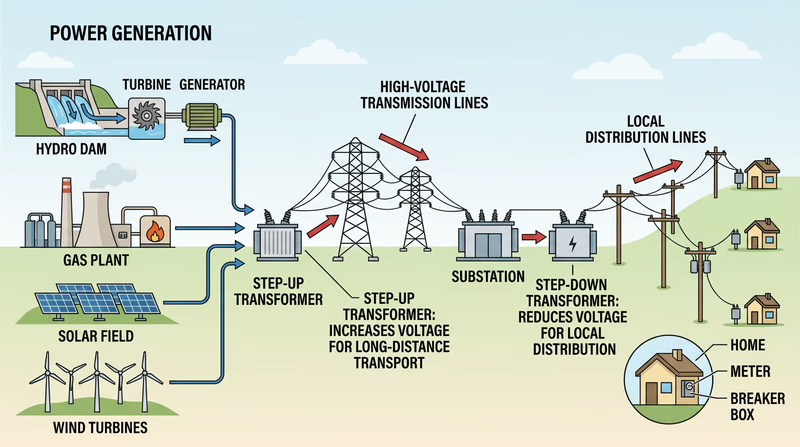
It is easy to imagine electricity as something that just “comes from the wall,” but the grid is really one of the largest coordinated systems humans have ever built. Power may start at a hydroelectric dam, natural gas plant, nuclear plant, wind farm, or solar field. From there, it moves through transmission lines at high voltage so less energy is lost as heat over long distances. Substations route and reshape that power. Transformers reduce the voltage step by step until it is ready for neighborhoods, schools, and homes.
One reason this system is so impressive is that generation and use have to stay balanced all the time. Utilities cannot simply make a month’s worth of electricity on Monday and stack it in a warehouse. Instead, the grid constantly adjusts to demand. On a hot summer afternoon, air-conditioner use can rise fast. On a cold winter morning, heaters and lights may all come on around the same time. Operators use data, forecasting, and automated controls to keep the system stable. The next time a light turns on instantly, remember that you are seeing the final moment of a huge teamwork chain.
C. Deep Dive: Electricity and Renewable Energy
Renewable energy is one of the most exciting areas for future learning. Solar panels and wind turbines both produce electricity without burning fuel, but they do it in different ways. Solar panels make DC electricity directly from sunlight. Wind turbines use moving air to spin a generator. Both methods can reduce pollution and diversify the energy supply, but both also raise good engineering questions.
For example, what happens when the Sun is not shining or the wind is weak? That is where battery storage, smart controls, and a flexible grid become important. Engineers are working on better batteries, smarter inverters, and cleaner ways to keep energy available around the clock. If you liked the part of this badge that connected electricity to the real world, renewable systems are a great next subject to explore because they combine physics, construction, electronics, economics, and environmental science.
D. Deep Dive: Hidden Electricity All Around You
Once you begin noticing electrical systems, you will see them everywhere. A refrigerator cycles a motor on and off to move heat. A phone charger converts AC from the wall into DC for the battery. A smoke alarm depends on reliable power and a warning circuit. Traffic lights, elevators, school intercoms, routers, and arcade games all rely on circuits, switching, and protection devices.
This is one reason electricity knowledge is so powerful: it transfers. Even if you never become an electrician or engineer, understanding circuits helps you become a better troubleshooter, a safer homeowner, and a smarter user of technology. It also pairs well with other merit badges. Robotics, Engineering, Electronics, Radio, and Sustainability all connect naturally to what you learned here. The badge may be finished, but the subject is now attached to almost everything around you.
E. Real-World Experiences
Try these next
Real places and activities that make electricity more concrete
- Visit a science museum or children’s museum with electricity exhibits: hands-on stations often let you experiment with generators, motors, and circuits.
- Tour a utility or public power open house if available in your area: many utilities host safety days, line-worker demonstrations, or facility tours.
- Build a larger low-voltage project: try a hobby electronics kit, snap-circuit set, or beginner robotics project.
- Compare household devices: read the wattage labels on small appliances and estimate which ones use the most power.
- Attend a career day or trade fair: talk with electricians, technicians, utility workers, or engineers about what they actually do.