Req 4 — AC, DC, and Power Generation
This requirement brings together two big ideas. First, you need to understand the two main ways current moves in a circuit: direct current and alternating current. Second, you need to know that electricity does not just appear at an outlet — it has to be produced somewhere by turning motion, heat, light, water, or nuclear energy into electric power.
Requirement 4a
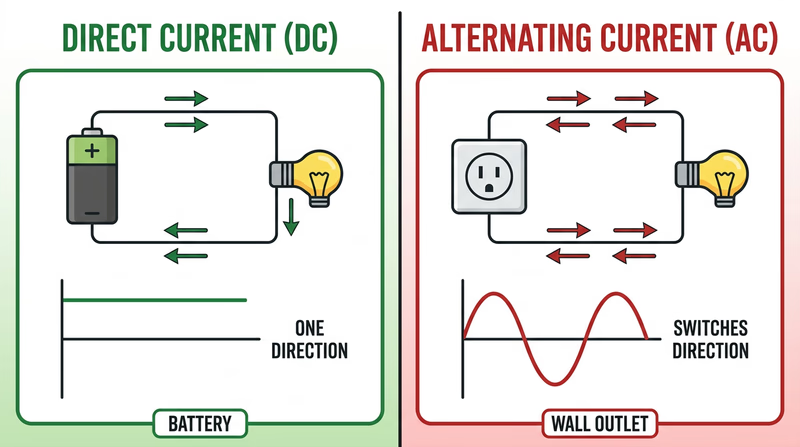
Direct current (DC) flows in one direction. Batteries provide DC, and so do many solar panels before their output is changed by other equipment. DC is easy to store in batteries and works well in electronics that need steady voltage.
Alternating current (AC) changes direction back and forth many times each second. In the United States, household power alternates at 60 hertz, which means it switches direction 60 times per second. AC became the standard for long-distance power distribution because transformers can change its voltage more easily.
Advantages and Disadvantages
| Type | Advantages | Disadvantages | Everyday example |
|---|---|---|---|
| DC | Great for batteries, electronics, and storage systems | Harder to change voltage with simple traditional equipment | Flashlight, phone battery, car battery |
| AC | Efficient for long-distance transmission and home distribution | Can be more dangerous in household settings because of the voltage and supply system | Wall outlets, household lighting, appliances |
A good way to picture this is to imagine traffic. DC is like cars all moving in one direction on a one-way road. AC is like the direction of flow switching back and forth repeatedly on the same path.
Requirement 4b
Even though the sources look very different, most power generation methods rely on the same core idea: making a conductor move through a magnetic field, or a magnetic field move around a conductor. That motion pushes electrons and produces current.
1. Turbine and Generator Systems
This is the biggest category. Water, steam, wind, or gas turns a turbine. The turbine spins a shaft connected to a generator. Inside the generator, coils and magnets create electric current.
Examples include:
- Hydroelectric power: moving water turns the turbine.
- Wind power: wind spins the blades and shaft.
- Natural gas or coal plants: fuel heats water into steam, and the steam spins the turbine.
- Nuclear power: heat from nuclear reactions makes steam, which spins the turbine.
2. Solar Photovoltaic Cells
Solar panels make electricity directly from light. They do not need spinning parts. When sunlight hits the semiconductor material inside the panel, it knocks electrons loose and creates DC electricity. That is then used directly, stored in batteries, or changed to AC by an inverter.
3. Chemical Action in Batteries
Batteries produce electricity through chemical reactions. Different materials inside the battery create a difference in electrical potential, and that pushes current through a circuit when the battery is connected.
This is why a battery-powered circuit in Req 3 — Build an Electromagnet can work even though there is no generator spinning anywhere nearby.
U.S. Energy Information Administration — Electricity Explained Clear explanations of how electricity is generated, transmitted, and used in the United States.