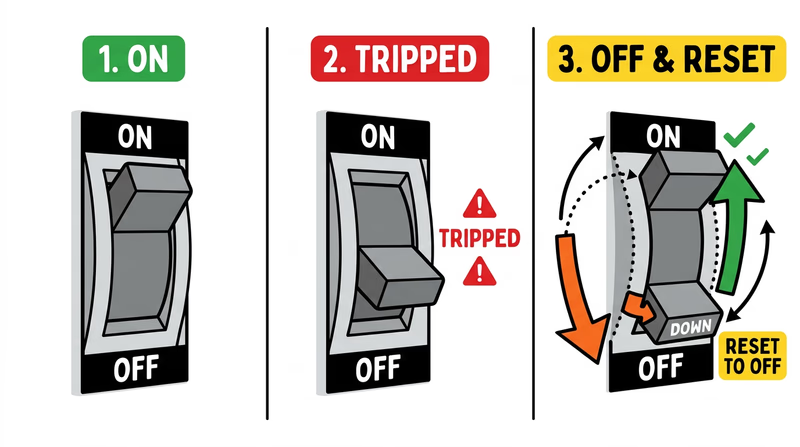
Req 6 — Overloads, Fuses, and Breakers
This requirement is about one of the most practical parts of the whole badge: understanding what your home wiring is trying to protect you from. Circuits are designed to carry only a certain amount of current. When you ask them to carry too much, wires heat up, insulation can fail, and fire risk increases. Fuses and breakers are there to interrupt that danger before the wiring becomes the problem.
Requirement 6a
An overload happens when a circuit is asked to supply more current than it is designed to handle safely. A common branch circuit in a home may be rated for 15 or 20 amps. If too many devices run at once, especially high-wattage devices, the current can climb too high.
A hair dryer, portable heater, microwave, toaster oven, and gaming PC all draw very different amounts of power. A circuit that seems fine with lamps and phone chargers may overload quickly once heating devices are added.
Good habits that help prevent overloads include:
- spreading high-draw appliances across different circuits,
- avoiding daisy-chained power strips,
- not running space heaters on overloaded outlet groups,
- unplugging devices you are not actively using, and
- learning which breakers feed which rooms or outlets.
Requirement 6b
This is where electrical vocabulary becomes useful. The power equation is:
Power = Voltage × Current
Or rewritten for current:
Current = Power ÷ Voltage
In a typical U.S. household branch circuit, voltage is often about 120 volts. So if a device uses 1,200 watts, the current draw is about 10 amps.
Example
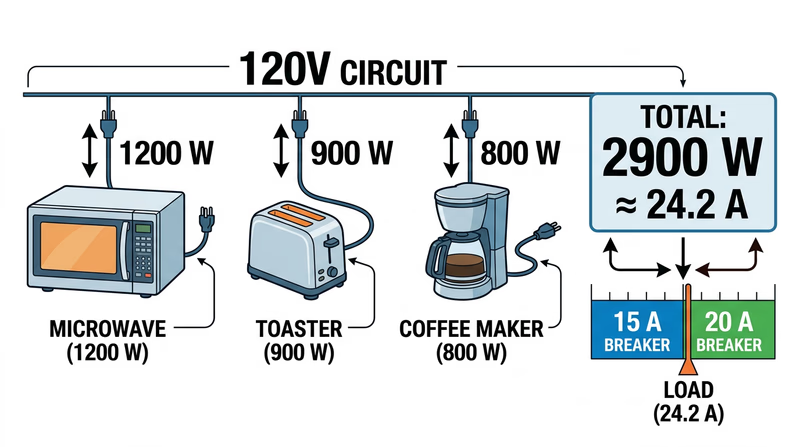
Suppose one branch circuit powers:
- microwave: 1,200 W
- toaster: 900 W
- coffee maker: 800 W
Total power = 2,900 W
Current = 2,900 ÷ 120 ≈ 24.2 amps
That would overload a 15-amp or 20-amp branch circuit.
How to check for overload
Use labels or the power equation
- Find the devices on the same branch circuit.
- Look for wattage or current labels on each device.
- Add the current draws directly if they are already listed in amps.
- Or convert watts to amps using current = power ÷ voltage.
- Compare the total to the circuit rating.
Requirement 6c
A fuse or breaker does not fail randomly. It responds to dangerous current levels.
A fuse contains a metal element designed to melt if the current gets too high. When it melts, the circuit opens and current stops. A fuse works once and must then be replaced.
A circuit breaker is a resettable protective switch. If the current becomes too high, the breaker trips open. Inside, that trip may happen because of heat, magnetic force, or both, depending on the breaker design.
Both are protecting the wiring, not just the device. That is an important idea. They are trying to stop overheated conductors before the insulation is damaged or a fire starts.
Requirement 6d
To find a blown fuse, go to the fuse box and look for the affected branch. Depending on the type, the blown fuse may show a broken internal element, discoloration, or a visible indicator.
To find a tripped breaker, go to the service panel and look for a breaker handle that is not lined up with the others. Many tripped breakers sit in a middle position between fully on and fully off.
To reset a breaker safely:
- Turn off or unplug devices on the affected circuit.
- Stand to the side of the panel, not directly in front of it.
- Move the breaker fully to off first.
- Then move it firmly to on.
- Restore loads one at a time.
If it trips again right away, stop. That means the problem is not solved and needs further investigation by a qualified person.